Advertisements
Advertisements
प्रश्न
Describe the bearded man in your own words.
Advertisements
उत्तर
The bearded man was courageous. He wanted to avenge his brother’s death killing the king. He lacked patience because when the king didn’t return by evening, he became anxious and left his hiding place. He was thankful and obliged by the king’s act. He repented for his act and asked for forgiveness. He returned the favour by promising the king faithfulness of his entire family for the kingdom.
संबंधित प्रश्न
Tick the right answer.
When we take to something, we find it (boring/interesting).
Behrman has a dream. What is it? Does it come true?
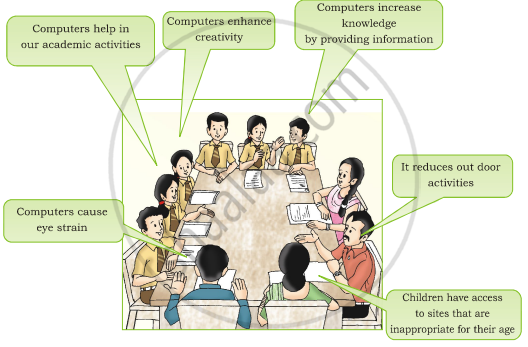
This is a meeting of the school’s Parent-Teacher Association. Some student representatives have also been invited to participate to discuss the role that Information technology/computers play in the growth and development of children.
Some are meet for a maiden's wrist,
Silver and blue as the mountain mist,
Some are flushed like the buds that dream
On the tranquil brow of a woodland stream,
Some are aglow with the bloom that cleaves
To the limpid glory of new born leaves
Read the lines given above and answer the question that follow.
Explain with reference to context.
A free bird leaps on the back
Of the wind and floats downstream
Till the current ends and dips his wing
In the orange suns rays
And dares to claim the sky.
Read the above lines and answer the question that follow.
Which birds are used to describe the state of the free bird?
It was my business to cross the bridge, explore the bridge head 3 beyond and find out to what point the enemy had advanced. I did this and returned over the bridge. There were not so many carts now and very few people on foot, but the old man was still there.’’Where do you come from?” I asked him.
“From San Carlos,” he said, and smiled.
That was his native town and so it gave him pleasure to mention it and he smiled.
“I was taking care of animals,” he explained.
“Oh,” I said, not quite understanding.
“Yes,” he said, “I stayed, you see, taking care of animals. I was the last one to leave the town of San Carlos.”
He did not look like a shepherd nor a herdsman and I looked at his black dusty clothes and his gray dusty face and his steel rimmed spectacles and said, “What animals were they?”
“Various animals,” he said, and shook his head. “I had to leave them.”
Read the extract given below and answer the question that follow.
What was the name of the old man’s native town?
Of the seven hundred villages dotting the map of India, in which the majority of India’s five hundred million live, flourish and die, Kritam was probably the tiniest, indicated on the district survey map by a microscopic dot, the map being meant more for the revenue official out to collect tax than for the guidance of the motorist, who in any case could not hope to reach it since it sprawled far from the highway at the end of a rough track furrowed up by the iron-hooped wheels of bullock carts. But its size did not prevent its giving itself the grandiose name Kritam, which meant in Tamil coronet or crown on the brow of the subcontinent. The village consisted of fewer than thirty houses, only one of them built from brick and cement and painted a brilliant yellow and blue all over with
gorgeous carvings of gods and gargoyles on its balustrade, it was known as the Big House. The other houses, distributed in four streets, were generally of bamboo thatch, straw, mud and other unspecified material. Muni’s was the last house in the fourth street, beyond which stretched the fields. In his prosperous days Muni had owned a flock of sheep and goats and sallied forth every morning driving the flock to the highway a couple of miles away.
Read the extract given below and answer the question that follow.
Where was Muni’s house located?
The village consisted of less than thirty houses, only one of them built with brick and cement. Painted a brilliant yellow and blue all over with gorgeous carvings of gods and gargoyles on its balustrade, it was known as the Big House. The other houses, distributed in four streets, were generally of bamboo thatch, straw, mud, and other unspecified material. Muni’s was the last house in the fourth street, beyond which stretched the fields. In his prosperous days Muni had owned a flock of forty sheep and goats and sallied forth every morning driving the flock to the highway a couple of miles away.
Read the extract given below and answer the question that follow.
What had Muni owned in his days of prosperity? What did he do every morning?
“Jane,” said the wheelwright, with an impressiveness of tone that greatly subdued his wife, “I read in the Bible sometimes, and find much said about little children. How the Savior rebuked the disciples who would not receive them; how he took them up in his arms, and blessed them; and how he said that ‘whosoever gave them even a cup of cold water should not go unrewarded.’ Now, it is a small thing for us to keep this poor motherless little one for a single night; to be kind to her for a single night; to make her life comfortable for a single night.”
The voice of the strong, rough man shook, and he turned his head away, so that the moisture in his eyes might not be seen. Mrs. Thompson did not answer, but a soft feeling crept into her heart.
“Look at her kindly, Jane; speak to her kindly,” said Joe. “Think of her dead mother, and the loneliness, the pain, the sorrow that must be on all her coming life.” The softness of his heart gave unwonted eloquence to his lips.
Read the extract given below and answer the question that follow.
What did Joe say to his wife?
Suddenly all the tension seemed to ebb out of my body as the truth of what he said hit me. Confidently, I drew a line a full foot in back of the board and proceeded to jump from there. I qualified with almost a foot to spare.
That night I walked over to Luz Long’s room in the Olympic village to thank him. I knew that if it hadn’t been for him I probably wouldn’t be jumping in the finals the following day. We sat in his quarters and talked for two hours—about track and field, ourselves, the world situation, a dozen other things.
When I finally got up to leave, we both knew that a real friendship had been formed. Luz would go out to the field the next day trying to beat me if he could. But I knew that he wanted me to do my best—even if that meant my winning.
Read the extract given below and answer the question that follow.
How did Luz Long help Jesse Owens?
So after that, dimly, dimly, she sensed it, she was different and they knew her difference and kept away. There was talk that her father and mother were taking her back to Earth next year; it seemed vital to her that they do so, though it would mean the loss of thousands of dollars to her family. And so, the children hated her for all these reasons of big and little consequence. They hated her pale snow face, her waiting silence, her thinness, and her possible future. “Get away 1” The boy gave her another push. “What’re you waiting for?”Then, for the first time, she turned and looked at him. And what she was waiting for was in her eyes. “Well, don’t wait around here !” cried the boy savagely. “You won’t see nothing!” Her lips moved. “Nothing 1” he cried. “It was all a joke, wasn’t it?” He turned to the other children. “Nothing’s happening today. Is it ?”
Read the extract given below and answer the question that follow.
Why did the children hate her?
Do the following activity in groups.
Go to the library and collect information about the lifestyle of people in desert areas— their food, clothes, work, social customs, etc. Share this information with the group.
Describe the stranger who came to the pet shop. What did he want?
Answer the following questions.
(i) Who is the speaker in the poem?
(ii) Is she/he afraid or curious, or both?
(iii)What is she/he planning to do soon?
(iv)“But not just yet...” suggests doubt, fear, hesitation, laziness, or something else. Choose the word which seems right to you. Tell others why you chose it.
What questions did Golu ask the python?
What does the poet refer to ‘meadow houses’?
The little elf was a nag. How did it tell Patrick’s health?
Multiple Choice Question:
How are words related to ideas?
Look at the following phrases and their meanings. Use the phrase to fill in the blank in the sentence given below.
We should _____________ a little money every month.
Complete the following sentence by providing a reason.
In the short story, Indigo, Aniruddha asked Sukhanram if there were ghosts in the bungalow because ______.
