Advertisements
Advertisements
प्रश्न
Define the term 'Vernier constant'.
Advertisements
उत्तर
Vernier constant is equal to the difference between the values of one main scale division and one vernier scale division. It is the least count of vernier callipers.
APPEARS IN
संबंधित प्रश्न
The size of bacteria is 1 µ. Find the number of bacteria present in 1 m length.
A screw gauge has 50 divisions on its circular scale and its screw moves by 1 mm on turning it by two revolutions. When the flat end of the screw is in contact with the stud, the zero of the circular scale lies below the base line and 4th division of the circular scale is in line with the base line. Find
(i) The pitch,
(ii) The least count and
(iii) The zero error of the screw gauge
Fig., below shows the reading obtained while measuring the diameter of a wire with a screw gauge. The screw advances by 1 division on the main scale when circular head is rotated once.
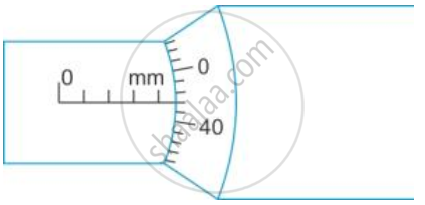 Find:
(i) Pitch of the screw gauge,
(ii) Least count of the screw gauge and
(iii) The diameter of the wire.
(a) A vernier scale has 20 divisions. It slides over the main scale, whose pitch is 0.5 mm. If the number of divisions on the left hand of the zero of vernier on the main scale is 38 and the 18th vernier scale division coincides with the main scale, calculate the diameter of the sphere, held in the jaws of vernier callipers.
(b) If the vernier has a negative error of 0.04 cm, calculate the corrected radius of the sphere.
State the formula for calculating length if:
Number of vernier scale division coinciding with the main scale and number of division of main scale on the left-hand side of zero of vernier scale is known.
Explain the term least count of a screw gauge. How are they determined?
Define the least count of an instrument.
On a vernier calliper, 25 vernier scale divisions are equal in length to 24 main scale divisions. One main scale division is 1 mm. Find the least count of the instrument.
