Advertisements
Advertisements
प्रश्न
Define the e.m.f. (E) of a cell and the potential difference (V) of a resistor R in terms of the work done in moving a unit charge. State the relation between these two works and the work done in moving a unit charge through a cell connected across the resistor. Take the internal resistance of the cell as ‘r’. Hence obtain an expression for the current i in the circuit.
Advertisements
उत्तर
E. M. F. of a cell is generally defined as the amount of work done (or the energy spent) in taking a unit positive charge around the complete circuit of the cell (i.e., in the wire outside the cell and the electrolyte within the cell). It is also defined as the potential difference between the terminals of a cell when no current is drawn from it (or when the cell is in open circuit).

Potential difference (p.d.) or the terminal voltage of a cell is generally defined as the amount of work done in carrying a unit positive charge round the circuit connected across the terminals of the cell. If W is the amount of work done (in J) in moving a test charge q between the terminals of a cell through a resistor R, then the p.d. i.e., work done in moving a unit positive charge across the terminals of the cell.
Relation between E, V (p.d.), external resistance R and the internal resistance r’,
Applying Ohm's law to external resistance only
I = `"V"/"R"` .....(i)
Again applying Ohm's law to complete circuit
I = `"E"/("R" + "r")` ....(ii)
Comparing I in (i) and (ii), We have
`"V"/"R" = "E"/("R" + "r")`
संबंधित प्रश्न
Name two factors on which the internal resistance of a cell depends and state how does it depend on the factors stated by you.
A cell of e.m.f ε and internal resistance r is used to send current to an external resistance R. Write expressions for
- the total resistance of circuit.
- the current drawn from the cell.
- the p.d. across the cell.
- voltage drop inside the cell.
Explain why the p.d across the terminals of a cell is more in an open circuit and reduced in a closed circuit.
A cell is used to send current to an external circuit.
- How does the voltage across its terminals compare with its e.m.f.?
- Under what condition is the e.m.f. of a cell equal to its terminal voltage?
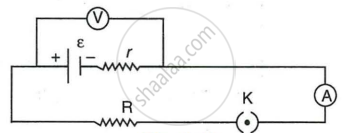
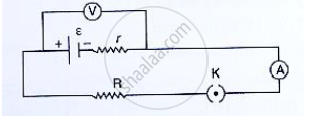
The diagram below in Fig. 8.40 shows a cell of e.m.f. ε = 2 volt and internal resistance r = 1 ohm to an external resistance R = 4 ohm. The ammeter A measures the current in the circuit and the
voltmeter V measures the terminal voltage across the cell. What will be the readings of the ammeter and voltmeter when (i) the key K is open, (ii) the key K is closed.
A battery of e.m.f 3.0 V supplies current through a circuit in which the resistance can be changed.
A high resistance voltmeter is connected across the battery. When the current is 1.5 A, the voltmeter reads 2.7 V. Find the internal resistance of the battery.
A cell of e.m.f. 1.8V and internal resistance 2Ω is connected in series with an ammeter of resistance 0.7Ω and a resistor of 4.5Ω as shown in Fig.
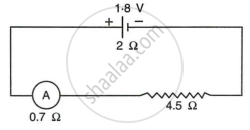
- What would be the reading of the ammeter?
- What is the potential difference across the terminals of the cell?
Four cells each of e.m.f. 2V and internal resistance 0.1 Ω are connected in series to an ammeter of negligible resistance, a 1.6 Ω resistor and an unknown resistor R1. The current in the circuit is 2A. Draw a labelled diagram and calculate:
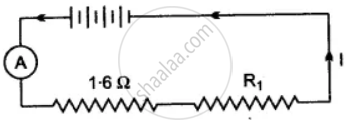
(i) Total resistance of the circuit,
(ii) Total e.m.f.
(iii) The value of R1 and
(iv) The p.d. across R1.
Study the diagram:
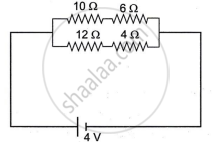
- Calculate the total resistance of the circuit.
- Calculate the current drawn from the cell.
- State whether the current through 10 Ω resistor is greater than, less than or equal to the current through the 12 Ω resistor.
The diagram in Figure shows a cell of e.m.f. ε = 4 volt and internal resistance r = 2 ohm connected to an external resistance R = 8 ohm. The ammeter A measures the current in the circuit and the voltmeter V measures the terminal voltage across the cell. What will be the readings of the ammeter and voltmeter when
- the key K is open, and
- the key K is closed