Advertisements
Advertisements
प्रश्न
Define pole of a mirror.
एक पंक्ति में उत्तर
Advertisements
उत्तर
Pole is the centre of the reflecting surface, in this case spherical mirror.
shaalaa.com
क्या इस प्रश्न या उत्तर में कोई त्रुटि है?
APPEARS IN
संबंधित प्रश्न
Explain the following term related to spherical lenses:- principal focus
An image that cannot be obtained on a screen is called ______.
A ray of light is incident on a plane mirror at an angle of 30°. What is the angle of reflection
How is a spherical mirror used to converge a beam of light at a point? Name the type of mirror used.
Define the following terms in the context of spherical mirrors :
(i) Pole
(ii) Centre of curvature
(iii) Radius of curvature
(iv) Principal axis
How is the focal length of a spherical mirror related to its radius of curvature?
What do you mean by a spherical mirror?
Name the spherical mirror which can produce a real and diminished image of the object.
What is the nature of the mirror having a focal length of -20 cm?
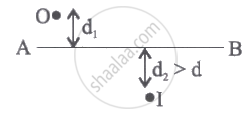
In the figure shown, the image of a real object is formed at the point I. AB is the principal axis of the mirror. The mirror must be: