Advertisements
Advertisements
प्रश्न
Deduce the expression for kinetic energy, potential energy, and total energy of a particle performing S.H.M. State the factors on which total energy depends.
Advertisements
उत्तर
- Expression for kinetic energy:
a. Consider a particle of mass m, performing a linear S.H.M. along the path MN about the mean position O as shown in the figure.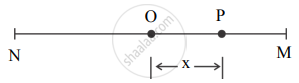
Energy in an S.H.M.
b. At a given instant, let the particle be at P, at a distance x from O.
c. Velocity of the particle in S.H.M. is given as
v = ω`sqrt("A"^2 - "x"^2)` = Aω cos(ωt + Φ)
where x is the displacement of the particle performing S.H.M. and A is the amplitude of S.H.M.
d. Thus, the kinetic energy,
Ek = `1/2"mv"^2`
= `1/2"m"ω^2("A"^2 - "x"^2)` ............(1)
= `1/2"k"("A"^2 - "x"^2)`
This is the kinetic energy at displacement x.
e. Also, at time t, kinetic energy is,
Ek = `1/2"mv"^2 = 1/2`mA2ω2cos2(ωt + Φ)
= `1/2`kA2cos2(ωt + Φ)
Thus, with time, it varies as cos2θ. - Expression for potential energy:
a. The restoring force acting on the particle at point P is given by, f = –kx where k is the force constant.
b. Suppose that the particle is displaced further by an infinitesimal displacement ‘dx’ against the restoring force ‘f’.
c. The external work done (dW) during this displacement is dW = f(–dx) = –kx(–dx) = kxdx
d. The total work done on the particle to displace it from O to P is given by,
W = `int_0^x "dW" = int_0^x "kx" "dx" = 1/2"kx"^2`
e. This work done is stored as the potential energy (P.E.) Ep of the particle at displacement x.
∴ Ep = `1/2 "kx"^2 = 1/2 "m"omega^2"x"^2` .....(2)
f. At time t,
∴ Ep = `1/2 "kx"^2 = 1/2"kA"^2 sin^2(omega"t" + phi) = 1/2"mA"^2omega^2cos^2(omega"t" + phi)`Thus, with time, it varies as sin2θ. - Expression for total energy:
a. The total energy of the particle is the sum of its kinetic energy and potential energy.
∴ E = Ek + Ep
b. Using equation (1) and equation (2), we get
E = `1/2`mω2(A2 - x2) + `1/2`mω2x2
E = `1/2` mω2A2 = `1/2`kA2 = `1/2`m(vmax)2
This expression gives the total energy of the particle at point P. - The total energy in S.H.M. is
a. directly proportional to
1. the mass of the particle
2. the square of the amplitude
3. the square of the frequency
4. the force constant
b. inversely proportional to the square of the period.
APPEARS IN
संबंधित प्रश्न
At what distance from the mean position is the speed of a particle performing S.H.M. half its maximum speed. Given the path length of S.H.M. = 10 cm.
The quantity which does not vary periodically for a particle performing SHM is ______.
The frequency of oscillation of a particle of mass m suspended at the end of a vertical spring having a spring constant k is directly proportional to ____________.
The kinetic energy of a particle, executing SHM is 16 J, when it is in its mean position. If the amplitude of oscillation is 25 cm and the mass of the particle is 5.12 kg, the time period of its oscillation is ____________.
A body executing SHM has amplitude of 4 cm. What is the distance at which the body has equal value of both K.E. and P.E.?
The displacement of a particle performing S.H.M. is given by x = 10 sin (`omega"t"+ alpha`) metre. If the displacement of the particle is 5 m, then the phase of S.H.M. is ____________.
The total energy of a simple harmonic oscillator is proportional to ______.
The kinetic energy of a particle performing S.H.M. is `1/n` times its potential energy. If the amplitude of S.H.M. is 'A', then the displacement of the particle will be ______
A simple pendulum of length 'L' has mass 'm' and it oscillates freely with amplitude 'A'. At the extreme position, its potential energy is ______
(g = acceleration due to gravity)
If the length of an oscillating simple pendulum is made `1/3` times at a place keeping amplitude the same, then its total energy (E) will be ______
The potential energy of a particle executing S.H.M is 2.5 J, when its displacement is half of amplitude. The total energy of the particle is ______.
Two springs of spring constants 'K' and '2K' are stretched by same force. If 'E1' and 'E2' are the potential energies stored in them respectively, then ______.
A particle performs S.H.M. Its potential energies are 'U1' and 'U2' at displacements 'x1' and 'x2' respectively. At displacement (x1 + x2), its potential energy 'U' is ______.
A particle performs S.H.M. of period 24 s. Three second after passing through the mean position it acquires a velocity of 2 π m/s. Its path length is ______.
`(sin45^circ=cos45^circ=1/sqrt2)`
A simple harmonic oscillator has amplitude A, angular velocity ω and mass m. Then, average energy in one time period will be ______.
A particle executes SHM with an amplitude of 10 cm and frequency 2 Hz. At t = 0, the particle is at a point, where potential energy and kinetic energy are same. The equation of displacement of particle is ______.
A body of mass 0.5 kg performs SHM with amplitude 3 cm and force constant 10 N/m. Find its total energy.
When a longitudinal wave propagates through a medium, the particles of the medium execute simple harmonic oscillations about their mean positions. These oscillations of a particle are characterised by an invariant ______.
A particle is executing Simple Harmonic Motion (SHM). The ratio of potential energy and kinetic energy of the particle when its displacement is half of its amplitude will be ______.
A particle of mass ‘m’ is executing S.H.M. about the origin on x-axis with frequencу `sqrt ((k a)/(pi m))`, where ‘k’ is a constant and ‘a’ is the amplitude of S.H.M. If ‘x’ is a displacement of a particle, at time ‘t’, potential energy of the particle will be ______.
A body attached to a spring oscillates in horizontal plane with frequency ‘n’. Its total energy is ‘E’ and the spring constant is ‘K’ then the velocity in the mean position is ______.
