Advertisements
Advertisements
प्रश्न
Construct a right triangle ABC whose base BC is 6 cm and the sum of hypotenuse AC and other side AB is 10 cm.
Advertisements
उत्तर
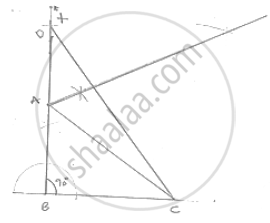
Steps of construction:
Step 1: Draw a line segment BC of 6cm.
Step 2: At B draw an angle le × BC of 90° .
Step 3: with center B and radius 10cm draw an arc which intersects XB at D.
Step 4: Join DC.
Step 5: Draw the perpendicular bisector of DC which intersects DB at A
Step 6: Join AC
∴ΔABC is the required triangle
APPEARS IN
संबंधित प्रश्न
Construct a triangle ABC in which BC = 8 cm, ∠B = 45° and AB − AC = 3.5 cm.
Construct a triangle PQR in which QR = 6 cm, ∠Q = 60° and PR − PQ = 2 cm
Construct a ΔABC in which BC = 3.6 cm, AB + AC = 4.8 cm and ∠B = 60°.
Construct a ΔABC in which BC = 3.4 cm, AB − AC = 1.5 cm and ∠B = 45°.
Using ruler and compasses only, construct a ΔABC from the following data:
AB + BC + CA = 12 cm, ∠B = 45° and ∠C = 60°.
A triangle ABC can be constructed in which AB = 5 cm, ∠A = 45° and BC + AC = 5 cm.
A triangle ABC can be constructed in which ∠B = 105°, ∠C = 90° and AB + BC + AC = 10 cm.
Construct a triangle ABC in which BC = 5 cm, ∠B = 60° and AC + AB = 7.5 cm.
Construct the following and give justification:
An equilateral triangle if its altitude is 3.2 cm.
Construct the following and give justification:
A rhombus whose diagonals are 4 cm and 6 cm in lengths.
