Advertisements
Advertisements
प्रश्न
Construct a triangle ABC in which AB = AC = 5 cm and BC = 5.6 cm. If possible, draw its lines of symmetry.
Advertisements
उत्तर
Steps of Construction:
(i) Draw a line segment BC = 5.6 cm
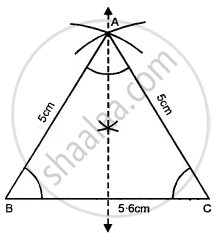
(ii) With centres B and C and radius 5 cm, draw two arcs intersecting each other at A.
(iii) Join AB and AC.
∆ ABC is an isosceles triangle.
(iv) Draw the bisector of ∠A. This is the only one line of symmetry as the triangle is an isosceles.
APPEARS IN
संबंधित प्रश्न
Write capital letters A to Z of English alphabet; and in each case, if possible, draw the largest number of lines of symmetry.
A quadrilateral ABCD is symmetric about its diagonal AC. Name three sides of this quadrilateral which are equal.
In the figure below are an isosceles triangle; state if the triangle is a symmetrical figure. If a figure is symmetrical, state the number of axis of symmetry and indicate them by dotted line.
Draw the axes of symmetry of the figure below. Which of them has more than one axis of symmetry?

Draw the mirror image: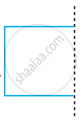
Identify the shape given below. Check whether they are symmetric or not. Draw the line of symmetry as well.
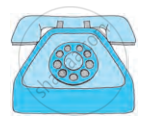
Draw all lines of symmetry for the following figure.

The flag of Japan is shown below. How many lines of symmetry does the flag have?

Which of the following figures do not have line symmetry?
The imaginary line along which a figure can be folded to obtain symmetrical halves is called:
