Advertisements
Advertisements
प्रश्न
Construct a triangle ABC in which AB = AC = 5 cm and BC = 5.6 cm. If possible, draw its lines of symmetry.
Advertisements
उत्तर
Steps of Construction:
(i) Draw a line segment BC = 5.6 cm
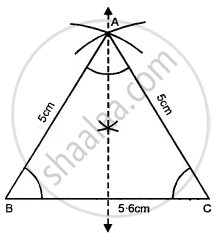
(ii) With centres B and C and radius 5 cm, draw two arcs intersecting each other at A.
(iii) Join AB and AC.
∆ ABC is an isosceles triangle.
(iv) Draw the bisector of ∠A. This is the only one line of symmetry as the triangle is an isosceles.
APPEARS IN
संबंधित प्रश्न
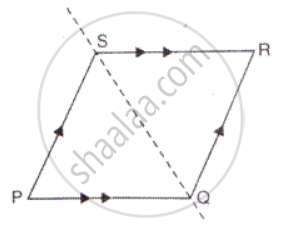
In the following figure, the line of symmetry has been drawn with a dotted line. Identify the corresponding sides and the corresponding angles about the line of symmetry.
By drawing a freehand sketch of the following, draw the line (s) of symmetry, if any:
a scalene triangle
By drawing a freehand sketch of the following, draw the line (s) of symmetry, if any:
an isosceles
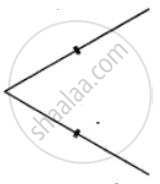
In the figure given below, draw the line (s) of symmetry, if possible:
In the figure below are an isosceles triangle; state if the triangle is a symmetrical figure. If a figure is symmetrical, state the number of axis of symmetry and indicate them by dotted line.
In each of the figure below, state the number of axes of symmetry, if any.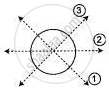
A quadrilateral ABCD has exactly one axis of symmetry, which is not a diagonal. Show that the quadrilateral is an isosoeles trapezium.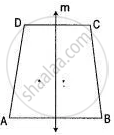
Draw all lines of symmetry for the following figure as given below:

Draw all lines of symmetry for the following figure.

What is the defining characteristic of a symmetrical shape?
