Advertisements
Advertisements
प्रश्न
Calculate the de Broglie wavelength of an electron moving with - of the speed of light in vacuum (Negelct relativistic effect)
(Planck's constant: h = 6.63 x 10⁻³⁴ Js, Mass of electron : m = 9.11 x 10⁻²⁸ g)
Advertisements
उत्तर
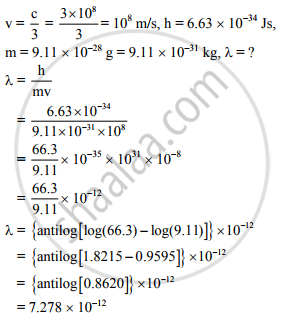
∴ The de Broglie wavelength of electron is 7.278 × 10⁻¹² m
APPEARS IN
संबंधित प्रश्न
A proton and an α-particle are accelerated through the same potential difference. Which one of the two has less kinetic energy? Justify your answer.
State de Broglie hypothesis
State how de-Broglie wavelength (`lambda`) of moving particles varies with their linear momentum (p).
A proton and an alpha particle are accelerated through the same potential. Which one of the two has (i) greater value of de−Broglie wavelength associated with it and (ii) less kinetic energy. Give reasons to justify your answer.
A deuteron and an alpha particle are accelerated with the same accelerating potential greater value of de-Broglie wavelength, associated it ?
An electron is accelerated from rest through a potential V. Obtain the expression for the de-Broglie wavelength associated with it ?
A proton and an electron have same kinetic. Which one has greater de-Broglie wavelength and why?
Using de Broglie’s hypothesis, explain with the help of a suitable diagram, Bohr’s second postulate of quantization of energy levels in a hydrogen atom.
An electron, an alpha particle and a proton have the same kinetic energy.
Which one of these particles has the largest de-Broglie wavelength?
An electron of energy 150 eV has wavelength of 10-10m. The wavelength of a 0.60 keV electron is?
Let p and E denote the linear momentum and energy of a photon. If the wavelength is decreased,
Answer the following question.
Obtain the expression for the ratio of the de-Broglie wavelengths associated with the electron orbiting in the second and third excited states of the hydrogen atom.
Light of wavelength 2000 Å falls on a metal surface of work function 4.2 eV.
What will be the change in the energy of the emitted electrons if the intensity of light with same wavelength is doubled?
A particle is dropped from a height H. The de Broglie wavelength of the particle as a function of height is proportional to
A solid sphere is in a rolling motion. In rolling motion, a body possesses translational kinetic energy (kt) as well as rotational kinetic energy (kr) simultaneously. The ratio kt : kr for the sphere is:
If the kinetic energy of the particle is increased to 16 times its previous value, the percentage change in the de-Broglie wavelength of the particle is:
Two bodies have their moments of inertia I and 2I respectively about their axis of rotation. If their kinetic energies of rotation are equal, their angular momenta will be in the ratio:
For production of characteristic of X-rays the electron trans mission is
A strong argument for the particle mature of cathode ray is to
An oil drop carrying a charge q has a mass m kg it is falling freely in air with terminal speed v. the electron field required to make the drop move upward with the same speed is
The work function of a metal is 4.50 eV. Find the frequency of light to be used to eject electrons from the metal surface with a maximum kinetic energy of 6.06 × 10⁻¹⁹ J.
What is meant by “Dual nature of matter”?
