Advertisements
Advertisements
प्रश्न
Calculate the de Broglie wavelength of an electron moving with - of the speed of light in vacuum (Negelct relativistic effect)
(Planck's constant: h = 6.63 x 10⁻³⁴ Js, Mass of electron : m = 9.11 x 10⁻²⁸ g)
Advertisements
उत्तर
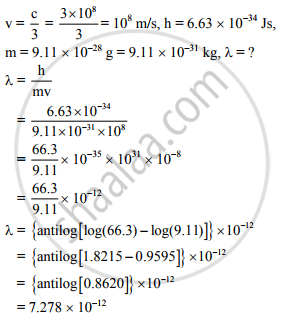
∴ The de Broglie wavelength of electron is 7.278 × 10⁻¹² m
APPEARS IN
संबंधित प्रश्न
A proton and an α -particle are accelerated through the same potential difference. Which one of the two has greater de-Broglie wavelength Justify your answer.
A proton and an α-particle have the same de-Broglie wavelength. Determine the ratio of their accelerating potentials
An α-particle and a proton are accelerated through the same potential difference. Find the ratio of their de Broglie wavelength.
State de Broglie hypothesis
State how de-Broglie wavelength (`lambda`) of moving particles varies with their linear momentum (p).
An electron is accelerated from rest through a potential V. Obtain the expression for the de-Broglie wavelength associated with it ?
Using de Broglie’s hypothesis, explain with the help of a suitable diagram, Bohr’s second postulate of quantization of energy levels in a hydrogen atom.
An electron, an alpha particle and a proton have the same kinetic energy.
Which one of these particles has the largest de-Broglie wavelength?
An electron of energy 150 eV has wavelength of 10-10m. The wavelength of a 0.60 keV electron is?
Consider the de-Broglie wavelength of an electron and a proton. Which wavelength is smaller if the two particles have (a) the same speed (b) the same momentum (c) the same energy?
A proton and an electron are accelerated by the same potential difference. Let λe and λpdenote the de Broglie wavelengths of the electron and the proton, respectively.
Find the de Broglie wavelength of electrons moving with a speed of 7 × 10⁶ ms -1.
Answer the following question.
Obtain the expression for the ratio of the de-Broglie wavelengths associated with the electron orbiting in the second and third excited states of the hydrogen atom.
Light of wavelength 2000 Å falls on a metal surface of work function 4.2 eV.
What will be the change in the energy of the emitted electrons if the intensity of light with same wavelength is doubled?
Gas exerts pressure on the walls of the container because :
Two bodies A and B having masses in the ratio of 3 : 1 possess the same kinetic energy. The ratio of linear momentum of B to A is:
Two bodies have their moments of inertia I and 2I respectively about their axis of rotation. If their kinetic energies of rotation are equal, their angular momenta will be in the ratio:
When the displacement of a particle executing simple harmonic motion is half of its amplitude, the ratio of its kinetic energy to potential energy is:
For an electron accelerated from rest through a potential V, the de Broglie wavelength associated will be:
The de- Broglie wave length of an electron moving with a speed of 6.6 × 10⁵ m/s is approximately
The kinetic energy of electron in (electron volt) moving with the velocity of 4 × 10⁶ m/s will be
Number of ejected photo electrons increase with increase
A neutron beam of energy E scatters from atoms on a surface with a spacing d = 0.1 nm. The first maximum of intensity in the reflected beam occurs at θ = 30°. What is the kinetic energy E of the beam in eV?
The work function of a metal is 4.50 eV. Find the frequency of light to be used to eject electrons from the metal surface with a maximum kinetic energy of 6.06 × 10⁻¹⁹ J.
The de-Broglie wavelength (λ) associated with a moving electron having kinetic energy (E) is given by ______.
What is meant by “Dual nature of matter”?
