Advertisements
Advertisements
प्रश्न
Arrange 5: 6, 8: 9, 13: 18 and 7: 12 in ascending order of magnitude.
Advertisements
उत्तर
The given ratios are 5: 6, 8: 9, 13: 18 and 7: 12.
Now L.C.M., of 6, 9, 18 and 12 = 36
Now `(5)/(6) = (5 xx 6)/(6 xx 6) = (30)/(36)`
`(8)/(9) = (8 xx 4)/(9 xx 4) = (32)/(36)`
`(13)/(18) = (13 xx 2)/(18 xx 2) = (26)/(36)`
Also `(7)/(12) = (7 xx 3)/(12 xx 3) = (21)/(36)`
Here `(21)/(36) < (26)/(36) < (30)/(36) < (32)/(36)`
Hence `(7)/(12) < (13)/(18) < (5)/(6) < (8)/(9)`
i.e., Ascending order
7 : 12 < 13 : 18 < 5 : 6 < 8 : 9.
संबंधित प्रश्न
If (a – b) : (a + b) = 1 : 11, find the ratio (5a + 4b + 15) : (5a – 4b + 3).
which of the following ratio is greater?
2 : 3 and 13 : 19
A bag contains Rs 1800 in the form of Rs 1 , Rs 2 and Rs 5 ooins. The ratio of the number of the respective coins is 3: 7: 11. Find the total number of ooi ns in the bag.
If `1 1/4 : 2 1/3 = "p" : "q"` and q : r = `4 1/2 : 5 1/4`; find p : r.
The sides of a triangle are in the ratio 3 : 2 : 4. If the perimeter of the triangle is 27 cm, find the length of each side.
If (4x + 3y) : (3x + 5y) = 6 : 7, find x : y
Express the following ratio in the simplest form:
186 : 403
A picture is 60 cm wide and 1.8 m long. The ratio of its width to its perimeter in lowest form is ______.
In a floral design made from tiles dimensions 40 cm by 60 cm (See figure), find the ratios of the area of the shaded portion to the area of the unshaded portion.
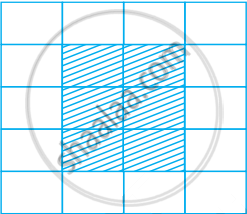
In the following figure, find the ratio of the area of the shaded portion to that of the whole figure: