Advertisements
Advertisements
प्रश्न
Answer of these question in two or three paragraphs (100–150 words).
What are the main features of the mechanical teachers and the schoolrooms that
Margie and Tommy have in the story?
Advertisements
उत्तर
Margie and Tommy had mechanical teachers. They had large black screens on which all the lessons were shown and questions were asked. They had a slot in which students had to put their homework and test papers. They had to write their answers in a punch code and the mechanical teacher calculated the marks immediately. Their schools were in their homes itself. They did not have any classmates. They learned geography, history and arithmetic. They had regular days and hours for school. Margie’s school was right next to her bedroom. The mechanical teacher always turned on at the same time every day except Saturdays and Sundays because her mother said that little girls learned better when they learned at regular hours.
संबंधित प्रश्न
Some are meet for a maiden's wrist,
Silver and blue as the mountain mist,
Some are flushed like the buds that dream
On the tranquil brow of a woodland stream,
Some are aglow with the bloom that cleaves
To the limpid glory of new born leaves
Read the lines given above and answer the question that follow.
Pick out two simile from this stanza.
For oft, when on my couch I lie
In vacant or in pensive mood,
They flash upon that inward eye
Which is the bliss of solitude;
And then my heart with pleasure fills,
And dances with the daffodils.
Read the lines given above and answer the question that follow.
What is the bliss of solitude referred to here?
But even as he approached the boy, Mr. Oliver sensed that something was wrong. The boy appeared to be crying. His head hung down, he held his face in his hands, and his body shook convulsively. It was a strange, soundless weeping, and Mr. Oliver felt distinctly uneasy.
Well, what’s the matter, he asked, his anger giving way to concern. What are you crying for? The boy would not answer or look up. His body continued to be wracked with silent sobbing.
Oh, come on, boy. You shouldn’t be out here at this hour. Tell me the trouble. Look up.
Read the extract given below and answer the question that follow.
When did Mr Oliver sense that there was something wrong?
She again rubbed a match on the wall, and the light shone round her; in the brightness stood her old grandmother, clear and shining, yet mild and loving in her appearance. “Grandmother,” cried the little one, “O take me with you; I know you will go away when the match burns out; you will vanish like the warm stove, the roast goose, and the large, glorious Christmas-tree.” And she made haste to light the whole bundle of matches, for she wished to keep her grandmother there. And the matches glowed with a light that was brighter than the noon-day, and her grandmother had never appeared so large or so beautiful. She took the little girl in her arms, and they both flew upwards in brightness and joy far above the earth, where there was neither cold nor hunger nor pain, for they were with God.
In the dawn of morning there lay the poor little one, with pale cheeks and smiling mouth, leaning against the wall; she had been frozen to death on the last evening of the year; and the New-year’s sun rose and shone upon a little corpse! The child still sat, in the stiffness of death, holding the matches in her hand, one bundle of which was burnt. “She tried to warm herself,” said some. No one imagined what beautiful things she had seen, nor into what glory she had entered with her grandmother, on New-year’s day.
Read the extract given below and answer the question that follow.
What happened when she lighted another match?
Answer the following question.
Name two things the elephant can do with his trunk, and two he cannot.
Why was everyone in the Control Room greatly excited?
Was the spacecraft manned or unmanned? How do you know it?
What was unique about the Great Glass Elevator?
How did the king reward the new governor?
“Trees are to make no shade in winter.” What does this mean? (Contrast this line with the line immediately before it.)
To what use a mother puts the trees?
Does father lose hope?
How did father make an attempt to save the Cat for the Second time?
Answer the following question. (Refer to that part of the text whose number is given against the question. This applies to the comprehension questions throughout the book.)
In what subjects did the little man need help to do Patrick’s homework? (5, 6)
Use the clues given below to complete this crossword puzzle.
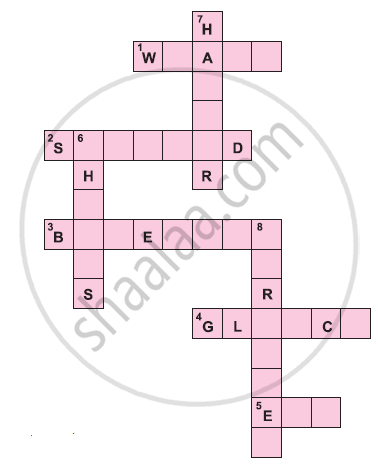
Across
1. very tired
2. had an angry look on the face
3. short trousers
4. a fault in a machine that prevents it from working properly
5. a small and naughty boy-fairy
Down
6. work that must be done every day, often boring
7. a basket with a lid
8. gave a short, high-pitched cry
Multiple Choice Question:
The members of a family ______
Multiple Choice Question:
How is English a wonderful game?
What is the hawker selling here?
Based on the following points write a story.
- Your aunt has gone to her mother’s house.
- Your uncle does his cooking.
- He is absent-minded.
- He puts vegetables on stove
- He begins to clean his bicycle outside.
- The neighbour calls out saying something is burning.
- Your uncle rushes to the kitchen.
- To save vegetables, he puts some oil in them.
- Unfortunately, it’s machine oil, not cooking oil.
- What do you think happens to the vegetables?

Begin like this: Last month my aunt decided to visit her parents...
The poem Beethoven explores the role of pain and suffering in the process of artistic creativity and excellence. Justify this statement in 200-250 words.
