Advertisements
Advertisements
प्रश्न
Answer the following questions briefly:
The age of Shah Jahan is the Golden Age of Mughal rule. Do you agree? Give reasons for your answer.
Advertisements
उत्तर
Yes, The age of Shah Jahan is the Golden Age of Mughal rule. The points describing are as follows:
- During the reign of Shah Jahan, there was undisturbed peace within the country. There were no foreign threats and Shah Jahan too devoted most of his time in maintaining peace and order in the country. Trade and commerce flourished bringing in lots of wealth. The land was fertile and revenue flowed into the treasury.
- Shah Jahan carried out many works of public welfare. Roads, canals, bridges, sarais, etc., were constructed for the welfare of the people. Similarly, during the famine and plague, he did a lot to relieve the people of their suffering.
- Shah Jahan had a natural love for magnificence, which was reflected in the buildings that he constructed. His reign is, in fact, called the Golden Age of the Mughal Architecture. One of the most important buildings constructed by him is the Taj Mahal, which was built in the memory of his beloved wife Mumtaz Mahal.
APPEARS IN
संबंधित प्रश्न
______, a symbol of love, shows a variety of cultural influences.
State whether the following statement is True or False:
Shah Jahan married Mumtaz Mahal, in whose memory the built the Taj.
Answer the following questions briefly:
Name two travellers who visited Jahangir’s court.
Shah Jahan built the magnificent ______ in the memory of his wife, Mumtaz Mahal.
Jahangir is said to have installed a chain of justice.
Answer the following question in one or two words/sentences:
Name Jahangir’s son who rebelled against him.
Answer the following question briefly:
To what extent were Jahangir’s Deccan campaigns successful?
Shah Jahan’s reign was an age of splendour and cultural brilliance. In this context, discuss: Red Fort
This is a picture of a 17th century-CE monument, built-in red sandstone by a Mughal emperor.
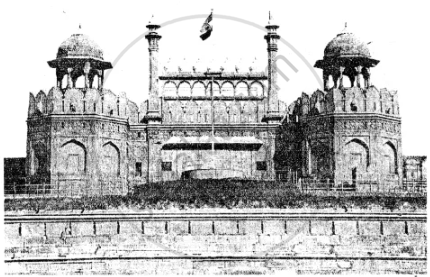
Name two important buildings inside this monument.
This is a picture of a 17th century-CE monument, built-in red sandstone by a Mughal emperor.
Mention its important features.
