Advertisements
Advertisements
प्रश्न
Answer the following question.
Identify the acid and the base from which sodium chloride is obtained. Which type of salt is it? When is it called rock salt? How is rock salt formed?
Advertisements
उत्तर
NaCl is obtained by the reaction between NaOH and HCl.
\[\ce{HCl + NaOH->NaCl + H2O}\]
NaCl is a neutral salt. It is known as rock salt in crystalline form. Rock salt is simply crystallized salt, also known as halite. It is the result of the evaporation of ancient oceans millions of years ago. Sometimes, pressure from deep inside the Earth forces up large masses of rock salt to form salt domes.
APPEARS IN
संबंधित प्रश्न
Give two examples of organic acids.
What happens when bases react with non-metal oxides? Explain with the help of an example. What does this reaction tell us about the nature of non-metal oxides?
Name the acid present in vinegar.
Define a base.
An hydrous hydrogen chloride is not an acid but its aqueous solution is a strong acid. Explain.
Choose the correct answer from the options given below:
Benzoic acid is used for/in/as
Give the reaction of acid with nitrates. State the conditions under which they react.
Match the chemical substances given in Column (A) with their appropriate application given in Column (B)
| Column (A) |
Column (B) |
| (A) Bleaching powder | (i) Preparation of glass |
| (B) Baking soda | (ii) Production of H2 and Cl2 |
| (C) Washing Soda | (iii) Decolourisation |
| (D) Sodium chloride | (iv) Antacid |
Phenolphthalein is a synthetic indicator and its colours in acidic and basic solutions, respectively are ______.
Fill in the cross word given in figure with the help of the clues provided.
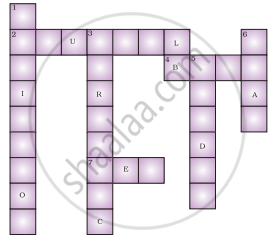
Across
(2) The solution which does not change the colour of either red or blue litmus.
(4) Phenolphthalein gives pink colour in this type of solution.
(7) Colour of blue litmus in lemon juice.
Down
(1) It is used to test whether a substance is acidic or basic.
(3) It is a natural indicator and gives pink colour in basic solution.
(5) Nature of ant’s sting.
(6) It is responsible for the increase in temperature during a neutralisation reaction.
