Advertisements
Advertisements
प्रश्न
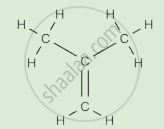
An element A has 4 valence electrons in its atom whereas element B has only one valence electron in its atom. The compound formed by A and B does not conduct electricity. What is the nature of chemical bond in the compound formed? Give its electron-dot structure.
Advertisements
उत्तर
The compound formed by elements A and B has covalent bonds between their atoms. One atom of element A reacts with four atoms of element B to share its one electron.
Its electron-dot structure is represented as:

APPEARS IN
संबंधित प्रश्न
Write the electron-dot structure for the following molecule.
Cl2
What type of bonds are present in methane (CH4) and sodium chloride (NaCl)?
Give the formula of the compound that would be formed by the combination of the following pair of elements:
Al and Cl2
What type of bonding would you expect between Hydrogen and Chlorine?
The solution of one of the following compounds will not conduct electricity. This compounds is:
(a) NaCl
(b) CCl4
(c) MgCl2
(d) CaCl2
Give two example in following case:
Solid covalent compounds
Molecular formula of Propane is C3H8 , write the structural formula of propane.
The carbon compound is used in daily life is ______.
Explain the structure of Ammonium ion.
The molecule which contains a triple covalent bond is ______.
Compound X consists of molecules.
Choose the letter corresponding to the correct answer from the options A, B, C and D given below:
The type of bonding in X will be ______.
Compound X consists of molecules.
Choose the letter corresponding to the correct answer from the options A, B, C and D given below:
X is likely to have a ______.
What are the term defined below?
A bond formed by share pair of electrons, each bonding atom contributing one electron to the pair.
Write a short note.
Aromatic hydrocarbons
Complete the following activity.
Write the names of the hydrocarbons for the following structural formula.
(isobutylene, cyclohexane, propene, cyclohexene, cyclopentane, benzene, propyne, isobutane, propane)
 |
Which of the following statements are usually correct for carbon compounds? These
- are good conductors of electricity
- are poor conductors of electricity
- have strong forces of attraction between their molecules
- do not have strong forces of attraction between their molecules.
Two carbon atoms can always form one or two covalent bonds.
What is a covalent bond?
Show the covalent bond formation in nitrogen molecule.
