Advertisements
Advertisements
प्रश्न
An aqueous solution turns red litmus solution blue. Excess addition of which of the following solutions would reverse the change?
विकल्प
Baking powder
Lime
Ammonium hydroxide solution
Hydrochloric acid
Advertisements
उत्तर
Hydrochloric acid
Explanation -
The aqueous solution is of basic nature since red litmus changes to blue. The reaction can be reversed (acidic solution) by adding excess of hydrochloric acid.
APPEARS IN
संबंधित प्रश्न
You have been provided with three test tubes. One of them contains distilled water and the other two contain an acidic solution and a basic solution, respectively. If you are given only red litmus paper, how will you identify the contents of each test tube?
Name one natural source of the following acid:
Oxalic acid
A white shirt has a yellow stain of curry. When soap is rubbed on this shirt during washing, the yellow stain turns reddish-brown. On rinsing the shirt with plenty of water, the reddish-brown stain turns yellow again.
- Name the natural indicator present in curry stain.
- Explain the changes in colour of this indicator which take place during washing and rinsing the shirt.
- What is the nature of soap (acidic/basic) as shown by the indicator present in curry stain?
What happens to the temperature of the solution when an acid is neutralised?
What happens during a wasp sting? What is its remedy?
One of the following is a medicine for indigestion. This is:
The salt which will give an acidic solution on dissolving in water is ______.
Give two examples of the following:
oxy-acid
What is the difference between an alkali and a metal hydroxide?
what effect does the concentration of [H3O+] ion have on solution?
Write balanced equation to satisfy the following statement:
\[\ce{Acid + Sulphite or bisulphite -> Salt + water + sulphur dioxide}\]
Write the balanced equations for the reaction required to convert insoluble lead (II) oxide into insoluble lead chloride.
Complete the following table and write one equation for each to justify the statement:
|
Reactants |
Products |
Method |
|
Soluble base + Acid (dil) |
Salt + water |
Neutralisation Titration |
|
Metal + Non-metal |
Salt (soluble/insoluble) |
______ |
|
Insoluble base + ______ |
Salt (soluble) + water |
______ |
|
Active metal + Acid (dil) |
______ + ______ |
______ |
|
Soluble salt solution (A) + Soluble salt solution (B) |
Precipitated salt + Soluble salt |
______ |
|
Carbonate/bicarbonate + Acid (dil) |
Salt + ______ + ______ |
Decomposition of carbonate |
|
Chlorides/nitrates + Acid (conc.) |
______ + ______ |
Decomposition of chlorides and nitrates |
Write the balanced equation for the preparation of the following compound (as major product) starting from iron and using only one other substance:
Iron (III) chloride
Acids are ________ in taste.
Fill in the cross word given in figure with the help of the clues provided.
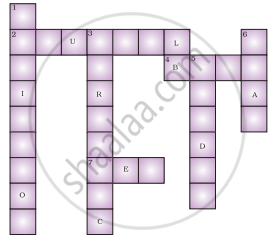
Across
(2) The solution which does not change the colour of either red or blue litmus.
(4) Phenolphthalein gives pink colour in this type of solution.
(7) Colour of blue litmus in lemon juice.
Down
(1) It is used to test whether a substance is acidic or basic.
(3) It is a natural indicator and gives pink colour in basic solution.
(5) Nature of ant’s sting.
(6) It is responsible for the increase in temperature during a neutralisation reaction.
Hydrochloric Acid reacts with metal bicarbonates to give ______.
Why does blue color copper sulphate become white on heating?
Name the acid present in grapes.
In a set of the given reactions, acetic acid yielded a product C.
\[\begin{array}{cc}
\phantom{}\ce{\underset{}{CH3COOH + PCl5} ->[][ ] \underset{}{A}->[C6H6][anhy.AlCl3 ] \underset{}{B}->[C2H5MgBr][Ether] \underset{}{C}}\\
\end{array}\]
Product C would be:
