Advertisements
Advertisements
प्रश्न
Complete the following table and write one equation for each to justify the statement:
|
Reactants |
Products |
Method |
|
Soluble base + Acid (dil) |
Salt + water |
Neutralisation Titration |
|
Metal + Non-metal |
Salt (soluble/insoluble) |
______ |
|
Insoluble base + ______ |
Salt (soluble) + water |
______ |
|
Active metal + Acid (dil) |
______ + ______ |
______ |
|
Soluble salt solution (A) + Soluble salt solution (B) |
Precipitated salt + Soluble salt |
______ |
|
Carbonate/bicarbonate + Acid (dil) |
Salt + ______ + ______ |
Decomposition of carbonate |
|
Chlorides/nitrates + Acid (conc.) |
______ + ______ |
Decomposition of chlorides and nitrates |
Advertisements
उत्तर
|
Reactants |
Products |
Method |
|
Soluble base + Acid (dil) |
Salt + water |
Neutralisation Titration |
|
Metal + Non-metal |
Salt (soluble/insoluble) |
Direct Combination |
|
Insoluble base + Acid |
Salt (soluble) + water |
Neutralisation |
|
Active metal + Acid (dil) |
Salt + Hydrogen |
Displacement |
|
Soluble salt solution (A) + Soluble salt solution (B) |
Precipitated salt + Soluble salt |
Precipitation |
|
Carbonate/bicarbonate + Acid (dil) |
Salt + Water + Carbon dioxide |
Decomposition of carbonate |
|
Chlorides/nitrates + Acid (conc) |
Acid salt + HCl/HNO3 |
Decomposition of chlorides and nitrates |
APPEARS IN
संबंधित प्रश्न
A solution turns red litmus blue. Its pH is likely to be ______.
What type of ions are formed?
When a base (or alkali) is dissolved in water.
Do basic solutions also have H+(aq)? Why are they basic?
Write the chemical name from the given formula.
H2SO4
Which of the following set of substances contain acids?
Fill in the cross word given in figure with the help of the clues provided.
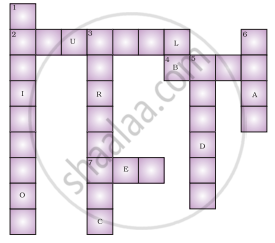
Across
(2) The solution which does not change the colour of either red or blue litmus.
(4) Phenolphthalein gives pink colour in this type of solution.
(7) Colour of blue litmus in lemon juice.
Down
(1) It is used to test whether a substance is acidic or basic.
(3) It is a natural indicator and gives pink colour in basic solution.
(5) Nature of ant’s sting.
(6) It is responsible for the increase in temperature during a neutralisation reaction.
Complete the following equation.
HCl + H2O → ______ + ______.
Complete the following equation.
Mg+ ______ → ______ + H2.
Why does blue color copper sulphate become white on heating?
Consider the acidity of the carboxylic acids:
(1) PhCOOH
(2) o-NO2C6H4COOH
(3) p-NO2C6H4COOH
(4) m-NO2C6H4COOH
