Advertisements
Advertisements
प्रश्न
∆ABC ~ ∆LBN. In ∆ABC, AB = 5.1 cm, ∠B = 40°, BC = 4.8 cm, \[\frac{AC}{LN} = \frac{4}{7}\]. Construct ∆ABC and ∆LBN.
Advertisements
उत्तर
As shown in the figure,
Let B – C – N and B – A – L.
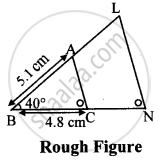
∆ABC ~ ∆LBN ...[Given]
∴ ∠ABC ≅ ∠LBN ...[Corresponding angles of similar triangles]
`"AB"/"LB"="BC"/"BN"="AC"/"LN"` ...(i) [Corresponding sides of similar triangles]
But, `"AC"/"LN"=4/7` ...(ii) [Given]
∴ `"AB"/"LB"="BC"/"BN"="AC"/"LN"` ...[From(i) and (ii)]
∴ Sides of ∆LBN are longer than corresponding sides of ∆ABC.
∴ If seg BC is divided into 4 equal parts, then seg BN will be 7 times each part of seg BC.
So, if we construct ∆ABC, point N will be on side BC, at a distance equal to 7 parts from B.
Now, point L is the point of intersection of ray BA and a line through N, parallel to AC.
∆LBN is the required triangle similar to ∆ABC.
Steps of construction:
- Draw ∆ABC of given measure. Draw ray BD making an acute angle with side BC.
- Taking convenient distance on compass, mark 7 points B1, B2, B3, B4, B5, B6 and B7 such that BB1 = B1B2 = B2B3 B3= B44 = B4B5 = B5B6 = B6B7.
- Join B4C. Draw line parallel to B4C through B7 to intersects ray BC at N.
- Draw a line parallel to side AC through N. Name the point of intersection of this line and ray BA as L.
∆LBN is the required triangle similar to ∆ABC.

संबंधित प्रश्न
Draw a line segment of length 7.6 cm and divide it in the ratio 5:8. Measure the two parts. Give the justification of the construction.
Draw a triangle ABC with side BC = 7 cm, ∠B = 45°, ∠A = 105°. Then, construct a triangle whose sides are `4/3 `times the corresponding side of ΔABC. Give the justification of the construction.
Construct an isosceles triangle with base 8 cm and altitude 4 cm. Construct another triangle whose sides are `2/3` times the corresponding sides of the isosceles triangle.
Construct a triangle similar to a given ΔABC such that each of its sides is (5/7)th of the corresponding sides of Δ ABC. It is given that AB = 5 cm, BC = 7 cm and ∠ABC = 50°.
Construct a triangle similar to a given ΔABC such that each of its sides is (2/3)rd of the corresponding sides of ΔABC. It is given that BC = 6 cm, ∠B = 50° and ∠C = 60°.
Draw a line segment of length 7.6 cm and divide it in the ratio 5 : 8. Measure the two parts.
Draw a ∆ABC in which AB = 4 cm, BC = 5 cm and AC = 6 cm. Then construct another triangle whose sides are\[\frac{3}{5}\] of the corresponding sides of ∆ABC ?
∆PQR ~ ∆LTR. In ∆PQR, PQ = 4.2 cm, QR = 5.4 cm, PR = 4.8 cm. Construct ∆PQR and ∆LTR, such that `"PQ"/"LT" = 3/4`.
Δ SHR ∼ Δ SVU. In Δ SHR, SH = 4.5 cm, HR = 5.2 cm, SR = 5.8 cm and
SHSV = 53 then draw Δ SVU.
Δ AMT ∼ ΔAHE. In Δ AMT, MA = 6.3 cm, ∠MAT = 120°, AT = 4.9 cm, `(MA)/(HA) = 7/5`. construct Δ AHE.
______ number of tangents can be drawn to a circle from the point on the circle.
ΔRHP ~ ΔNED, In ΔNED, NE = 7 cm, ∠D = 30°, ∠N = 20° and `"HP"/"ED" = 4/5`. Then construct ΔRHP and ΔNED
ΔPQR ~ ΔABC. In ΔPQR, PQ = 3.6 cm, QR = 4 cm, PR = 4.2 cm. Ratio of the corresponding sides of triangle is 3 : 4, then construct ΔPQR and ΔABC.
ΔRHP ~ ΔNED, In ΔNED, NE = 7 cm, ∠D = 30°, ∠N = 20°, `(HP)/(ED) = 4/5`, then construct ΔRHP and ∆NED.
ΔABC ~ ΔPBR, BC = 8 cm, AC = 10 cm, ∠B = 90°, `(BC)/(BR) = 5/4` then construct ∆ABC and ΔPBR.
To divide a line segment AB in the ratio p : q (p, q are positive integers), draw a ray AX so that ∠BAX is an acute angle and then mark points on ray AX at equal distances such that the minimum number of these points is ______.
The image of construction of A’C’B a similar triangle of ΔACB is given below. Then choose the correct option.

A point C divides a line segment AB in the ratio 5 : 6. The ratio of lengths AB: BC is ______.

What is the ratio `(AC)/(BC)` for the following construction: A line segment AB is drawn. A single ray is extended from A and 12 arcs of equal lengths are cut, cutting the ray at A1, A2… A12.A line is drawn from A12 to B and a line parallel to A12B is drawn, passing through the point A6 and cutting AB at C.
