Advertisements
Advertisements
प्रश्न
ABC is a right angled triangle in which ∠A = 90° and AB = AC. Find ∠B and ∠C.
Advertisements
उत्तर
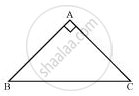
ABC is a right angled triangle in which
∠A = 90°
and AB = AC
In △ABC,
AB = AC
⇒ ∠C = ∠B …(I) ...[Angles opposite to equal sides]
Now, in △ABC,
∠A + ∠B + ∠C = 180° ...[Angle Sum Property of a △)
⇒ 90° + ∠B + ∠B = 180° ...[∵ ∠A = 90° (Given) and ∠B = ∠C from (I)]
⇒ 2∠B = 180° – 90°
⇒ 2∠B = 90°
⇒ ∠B = 45°
Also, ∠C = ∠B
⇒ ∠C = 45°
APPEARS IN
संबंधित प्रश्न
ΔABC and ΔDBC are two isosceles triangles on the same base BC and vertices A and D are on the same side of BC (see the given figure). If AD is extended to intersect BC at P, show that
- ΔABD ≅ ΔACD
- ΔABP ≅ ΔACP
- AP bisects ∠A as well as ∠D.
- AP is the perpendicular bisector of BC.

BE and CF are two equal altitudes of a triangle ABC. Using RHS congruence rule, prove that the triangle ABC is isosceles.
ABC is an isosceles triangle with AB = AC. Drawn AP ⊥ BC to show that ∠B = ∠C.
ABC is an isosceles triangle in which AC = BC. AD and BE are respectively two altitudes to sides BC and AC. Prove that AE = BD.
Prove that sum of any two sides of a triangle is greater than twice the median with respect to the third side.
In a right triangle, prove that the line-segment joining the mid-point of the hypotenuse to the opposite vertex is half the hypotenuse.
Two lines l and m intersect at the point O and P is a point on a line n passing through the point O such that P is equidistant from l and m. Prove that n is the bisector of the angle formed by l and m.
Line segment joining the mid-points M and N of parallel sides AB and DC, respectively of a trapezium ABCD is perpendicular to both the sides AB and DC. Prove that AD = BC.
ABC is a right triangle such that AB = AC and bisector of angle C intersects the side AB at D. Prove that AC + AD = BC.
ABCD is quadrilateral such that AB = AD and CB = CD. Prove that AC is the perpendicular bisector of BD.
