Advertisements
Advertisements
प्रश्न
AB and AC are the two chords of a circle whose radius is r. If p and q are
the distance of chord AB and CD, from the centre respectively and if
AB = 2AC then proove that 4q2 = p2 + 3r2.
Advertisements
उत्तर
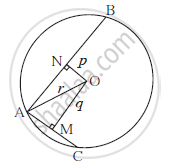
Let AC = a then AB = 2a
seg OM ⊥ chord AC, seg ON ⊥ chord AB.
AM =MC = `a/2` and AN = NB = a
In Δ OMA and Δ ONA, By theorem of Pythagoras,
`AO^2 = AM^2 + MO^2`
`AO^2 = AN^2+ q^2` ....... (1)
`AO^2 = AN^2 + NO^2`
`AO^2 = a^2 + p^2` ........ (2)
From equation (1) and (2)
`(a/2)^2 + q^2 = a^2 + p^2`
`a^2/4 + q^2 = a^2 + p^2`
`a^2 + 4q^2 = 4a^2 + 4p^2`
`4q^2 = 3a^2 + 4p^2`
`4q^2 = p^2 + 3(a^2 + p^2)`
`4q^2 = p^2 + 3r^2 .... ("In" Δ ONA, r^2 = a^2 + p^2)`
APPEARS IN
संबंधित प्रश्न
Find the coordinates of the centre of the circle passing through the points (0, 0), (–2, 1) and (–3, 2). Also, find its radius.
Find the distance between the points (0, 0) and (36, 15). Can you now find the distance between the two towns A and B discussed in Section 7.2.
Name the type of quadrilateral formed, if any, by the following point, and give reasons for your answer:
(4, 5), (7, 6), (4, 3), (1, 2)
Find the point on the x-axis which is equidistant from (2, –5) and (–2, 9).
If a ≠ b ≠ 0, prove that the points (a, a2), (b, b2) (0, 0) will not be collinear.
If the distances of P(x, y) from A(5, 1) and B(–1, 5) are equal, then prove that 3x = 2y
Find the distance between the following pair of point.
T(–3, 6), R(9, –10)
Determine whether the point is collinear.
R(0, 3), D(2, 1), S(3, –1)
Find the distance of the following point from the origin :
(5 , 12)
Find the value of m if the distance between the points (m , -4) and (3 , 2) is 3`sqrt 5` units.
A line segment of length 10 units has one end at A (-4 , 3). If the ordinate of te othyer end B is 9 , find the abscissa of this end.
Prove that the following set of point is collinear :
(5 , 5),(3 , 4),(-7 , -1)
Find the distance between the origin and the point:
(-8, 6)
Find the distance between the origin and the point:
(8, −15)
Find the point on y-axis whose distances from the points A (6, 7) and B (4, -3) are in the ratio 1: 2.
Find distance CD where C(–3a, a), D(a, –2a).
Show that the points (2, 0), (–2, 0) and (0, 2) are vertices of a triangle. State the type of triangle with reason.
The point which lies on the perpendicular bisector of the line segment joining the points A(–2, –5) and B(2, 5) is ______.
Case Study -2
A hockey field is the playing surface for the game of hockey. Historically, the game was played on natural turf (grass) but nowadays it is predominantly played on an artificial turf.
It is rectangular in shape - 100 yards by 60 yards. Goals consist of two upright posts placed equidistant from the centre of the backline, joined at the top by a horizontal crossbar. The inner edges of the posts must be 3.66 metres (4 yards) apart, and the lower edge of the crossbar must be 2.14 metres (7 feet) above the ground.
Each team plays with 11 players on the field during the game including the goalie. Positions you might play include -
- Forward: As shown by players A, B, C and D.
- Midfielders: As shown by players E, F and G.
- Fullbacks: As shown by players H, I and J.
- Goalie: As shown by player K.
Using the picture of a hockey field below, answer the questions that follow:

If a player P needs to be at equal distances from A and G, such that A, P and G are in straight line, then position of P will be given by ______.
The point A(2, 7) lies on the perpendicular bisector of line segment joining the points P(6, 5) and Q(0, – 4).
