A regular hexagon is inscribed in a circle of radius r. The perimeter of the regular hexagon is ______.
Advertisements
प्रश्न
A regular hexagon is inscribed in a circle of radius r. The perimeter of the regular hexagon is ______.
विकल्प
3r
6r
9r
12r
Advertisements
उत्तर
A regular hexagon is inscribed in a circle of radius r. The perimeter of the regular hexagon is 6r.
Explanation:
A regular hexagon comprises 6 equilateral triangles, each of them having one of their vertices at the centre of the hexagon.
The sides of the equilateral triangle are equal to the radius of the smallest circle inscribing the hexagon.
Hence, each side of the hexagon is equal to the radius of the hexagon and the perimeter of the hexagon is 6r.
APPEARS IN
संबंधित प्रश्न
Find the area of a rhombus whose side is 5 cm and whose altitude is 4.8 cm. If one of its diagonals is 8 cm long, find the length of the other diagonal.
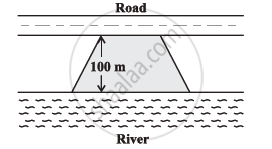
Mohan wants to buy a trapezium shaped field. Its side along the river is parallel to and twice the side along the road. It the area of this field is 10500 m2 and the perpendicular distance between the two parallel sides is 100 m, find the length of the side along the river.
A flooring tile has the shape of a parallelogram whose base is 24 cm and the corresponding height is 10 cm. How many such tiles are required to cover a floor of area 1080 m2?
The area of a rhombus is 240 cm2 and one of the diagonal is 16 cm. Find another diagonal.
The diagonals of a rhombus are 7.5 cm and 12 cm. Find its area.
Find the area of a rhombus whose side is 6 cm and whose altitude is 4 cm. If one of its diagonals is 8 cm long, find the length of the other diagonal.
In exchange of a square plot one of whose sides is 84 m, a man wants to buy a rectangular plot 144 m long and of the same area as of the square plot. Find the width of the rectangular plot.
The area of a rhombus is 84 m2. If its perimeter is 40 m, then find its altitude.
The area of a rhombus is equal to the area of a triangle whose base and the corresponding altitude are 24.8 cm and 16.5 cm respectively. If one of the diagonals of the rhombus is 22 cm, find the length of the other diagonal.
