Advertisements
Advertisements
प्रश्न
A regular hexagon is inscribed in a circle of radius r. The perimeter of the regular hexagon is ______.
पर्याय
3r
6r
9r
12r
Advertisements
उत्तर
A regular hexagon is inscribed in a circle of radius r. The perimeter of the regular hexagon is 6r.
Explanation:
A regular hexagon comprises 6 equilateral triangles, each of them having one of their vertices at the centre of the hexagon.
The sides of the equilateral triangle are equal to the radius of the smallest circle inscribing the hexagon.
Hence, each side of the hexagon is equal to the radius of the hexagon and the perimeter of the hexagon is 6r.
APPEARS IN
संबंधित प्रश्न
Find the area of a rhombus whose side is 5 cm and whose altitude is 4.8 cm. If one of its diagonals is 8 cm long, find the length of the other diagonal.
A flooring tile has the shape of a parallelogram whose base is 24 cm and the corresponding height is 10 cm. How many such tiles are required to cover a floor of area 1080 m2?
The length of a side of a square field is 4 m. what will be the altitude of the rhombus, if the area of the rhombus is equal to the square field and one of its diagonal is 2 m?
Find the area of the field in the form of a rhombus, if the length of each side be 14 cm and the altitude be 16 cm.
The cost of fencing a square field at 60 paise per metre is Rs 1200. Find the cost of reaping the field at the rate of 50 paise per 100 sq. metres.
In exchange of a square plot one of whose sides is 84 m, a man wants to buy a rectangular plot 144 m long and of the same area as of the square plot. Find the width of the rectangular plot.
The area of a rhombus is equal to the area of a triangle whose base and the corresponding altitude are 24.8 cm and 16.5 cm respectively. If one of the diagonals of the rhombus is 22 cm, find the length of the other diagonal.
Find the area of the following regular hexagon.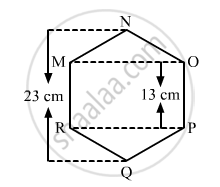
Polygon ABCDE is divided in different parts as shown in figure. If AD = 8 cm, AH = 6 cm, AG = 4 cm, AF = 3 cm and BF = 2 cm, CH = 3cm, EG = 2.5 cm. Then find the area of the polygon.

