हिंदी

A Neutron, an Electron and an Alpha Particle, Moving with Equal Velocities, Enter a Uniform Magnetic Field Going into the Plane of the Paper, as Shown. Trace Their Paths in the Field and Justify Your Answer. - Physics

Advertisements
Advertisements

प्रश्न

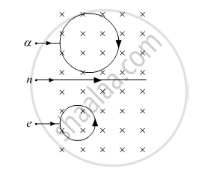
A neutron, an electron and an alpha particle, moving with equal velocities, enter a uniform magnetic field going into the plane of the paper, as shown. Trace their paths in the field and justify your answer.

Advertisements

उत्तर

We know that a charged particle will experience a force when it enters a magnetic field. The magnetic field will move the charged particle in a circular path, as the force is perpendicular to the velocity of particle. The radius of the circular path will be given by

`(mv^2)/r=Bqv`

`r=(mv)/(Bq)`

As B and v are constant, we can write

`rpropm/q`

The neutron will move along the straight line as it has no charge.

The electron will inscribe a circle of radius smaller than that of the alpha particle as the mass to charge ratio of the alpha particle is more than that of the electron.

So, the alpha particle will move in the clockwise direction and the electron will move in anticlockwise direction according to the right-hand rule.
shaalaa.com
Force on a Moving Charge in Uniform Magnetic and Electric Fields
  क्या इस प्रश्न या उत्तर में कोई त्रुटि है?
2015-2016 (March) Delhi Set 1

संबंधित प्रश्न

Write the expression for the force `vecF` acting on a particle of mass m and charge q moving with velocity `vecV` in a magnetic field `vecB` , Under what conditions will it move in (i) a circular path and (ii) a helical path?


An electron moving horizontally with a velocity of 4 ✕ 104 m/s enters a region of uniform magnetic field of 10−5 T acting vertically upward as shown in the figure. Draw its trajectory and find out the time it takes to come out of the region of magnetic 

field.


If a charged particle at rest experiences no electromagnetic force,
(a) the electric field must be zero
(b) the magnetic field must be zero
(c) the electric field may or may not be zero
(d) the magnetic field may or may not be zero


A charged particle moves along a circle under the action of possible constant electric and magnetic fields. Which of the following is possible?
(a) E = 0, B = 0
(b) E = 0, B ≠ 0
(c) E ≠ 0, B = 0
(d) E ≠ 0, B ≠ 0


Consider three quantities  \[x = E/B,   y = \sqrt{1/ \mu_0 \epsilon_0}\] and \[z = \frac{l}{CR}\] . Here, l is the length of a wire, C is a capacitance and R is a resistance. All other symbols have standard meanings.

(a) xy have the same dimensions.
(b) yz have the same dimensions.
(c) zx have the same dimensions.
(d) None of the three pairs have the same dimensions.


A magnetic field of strength 1.0 T is produced by a strong electromagnet in a cylindrical region of radius 4.0 cm, as shown in the figure. A wire, carrying a  current of 2.0 A, is placed perpendicular to and intersecting the axis of the cylindrical region. Find the magnitude of the force acting on the wire.


Protons with kinetic energy K emerge from an accelerator as a narrow beam. The beam is bent by a perpendicular magnetic field, so that it just misses a plane target kept at a distance l in front of the accelerator. Find the magnetic field.


The figure shows a convex lens of focal length 12 cm lying in a uniform magnetic field Bof magnitude 1.2 T parallel to its principal axis. A particle with charge 2.0 × 10⁻³ C  and mass 2.0 × 10⁻⁵ kg is projected perpendicular to the plane of the diagram with a speed of 4.8 m s−1. The particle moves along a circle with its centre on the principal axis at a distance of 18 cm from the lens. Show that the image of the particle moves along a circle and find the radius of that circle.


A long, straight wire carrying a current of 30 A is placed in an external, uniform magnetic field of 4.0 × 10⁻⁴ T parallel to the current. Find the magnitude of the resultant magnetic field at a point 2.0 cm away from the wire.


A particle of mass 10 mg and having a charge of 50 mC is projected with a speed of 15 m/s into a uniform magnetic field of 125 mT. Assuming that the particle is projected with its velocity perpendicular to the magnetic field, the time after which the particle reaches its original position for the first time is ______.


Share
Notifications

Englishहिंदीमराठी


      Forgot password?
Use app×