Advertisements
Advertisements
प्रश्न
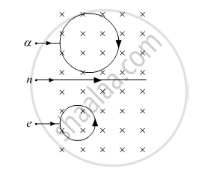
A neutron, an electron and an alpha particle, moving with equal velocities, enter a uniform magnetic field going into the plane of the paper, as shown. Trace their paths in the field and justify your answer.

Advertisements
उत्तर
We know that a charged particle will experience a force when it enters a magnetic field. The magnetic field will move the charged particle in a circular path, as the force is perpendicular to the velocity of particle. The radius of the circular path will be given by
`(mv^2)/r=Bqv`
`r=(mv)/(Bq)`
As B and v are constant, we can write
`rpropm/q`
The neutron will move along the straight line as it has no charge.
The electron will inscribe a circle of radius smaller than that of the alpha particle as the mass to charge ratio of the alpha particle is more than that of the electron.
So, the alpha particle will move in the clockwise direction and the electron will move in anticlockwise direction according to the right-hand rule.
संबंधित प्रश्न
Show that the kinetic energy of the particle moving in a magnetic field remains constant.
Write the expression for the force,`vecF` acting on a charged particle of charge ‘q’, moving with a velocity `vecV` in the presence of both electric field `vecF`and magnetic field `vecB` . Obtain the condition under which the particle moves undeflected through the fields.
When a proton is released from rest in a room, it starts with an initial acceleration a0towards west. When it is projected towards north with a speed v0, it moves with an initial acceleration 3a0 towards west. Find the electric field and the maximum possible magnetic field in the room.
A current of 2 A enters at the corner d of a square frame abcd of side 20 cm and leaves at the opposite corner b. A magnetic field B = 0.1 T exists in the space in a direction perpendicular to the plane of the frame, as shown in the figure. Find the magnitude and direction of the magnetic forces on the four sides of the frame.
A charged particle is accelerated through a potential difference of 12 kV and acquires a speed of 1.0 × 10⁶ m s−1. It is then injected perpendicularly into a magnetic field of strength 0.2 T. Find the radius of the circle described by it.
Two particles, each with mass m are placed at a separation d in a uniform magnetic field B, as shown in the figure. They have opposite charges of equal magnitude q. At time t = 0, the particles are projected towards each other, each with a speed v. Suppose the Coulomb force between the charges is switched off. (a) Find the maximum value vmof the projection speed, so that the two particles do not collide. (b) What would be the minimum and maximum separation between the particles if v = vm/2? (c) At what instant will a collision occur between the particles if v = 2vm? (d) Suppose v = 2vm and the collision between the particles is completely inelastic. Describe the motion after the collision.

A particle with a charge of 5.0 µC and a mass of 5.0 × 10⁻¹² kg is projected with a speed of 1.0 km s−1 in a magnetic field of magnitude 5.0 mT. The angle between the magnetic field and the velocity is sin−1 (0.90). Show that the path of the particle will be a helix. Find the diameter of the helix and its pitch.
When does a moving charged particle nor experience any force while moving through a uniform magnetic field?
A uniform magnetic field of 1.5 T exists in a cylindrical region of radius 10.0 cm, its direction parallel to the axis along east to west. A wire carrying current of 7.0 A in the north to south direction passes through this region. What is the magnitude and direction of the force on the wire if,
(a) the wire intersects the axis,
(b) the wire is turned from N-S to northeast-northwest direction,
(c) the wire in the N-S direction is lowered from the axis by a distance of 6.0 cm?
Current flows through uniform, square frames as shown in the figure. In which case is the magnetic field at the centre of the frame not zero?
