Advertisements
Advertisements
प्रश्न
A device Y is connected across an AC source of emf e = e0 sin ωt. The current through Y is given as i = i0 sin (ωt + π/2).
- Identify the device Y and write the expression for its reactance.
- Draw graphs showing a variation of emf and current with time over one cycle of AC for Y.
- How does the reactance of the device Y vary with the frequency of the AC? Show graphically.
- Draw the phasor diagram for device Y.
Advertisements
उत्तर
1. The device Y is a capacitor. Its reactance is `"X"_"C" = 1/(omega"C")`, where ω is the angular frequency of the applied emf and C is the capacitance of the capacitor.
2.
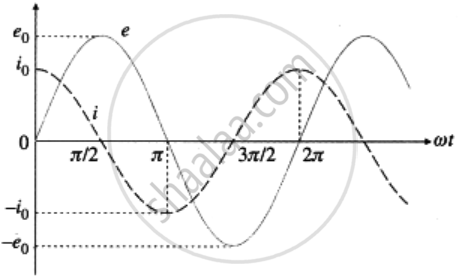
3. `"X"_"C" = 1/(omega"C") = 1/(2pi"fC")`. Thus `"X"_"C" prop 1/"f"`, where f is the frequency of AC.
Suppose C = `(1000/(2pi))`pF
For f = 100 Hz, XC = 1 × 10⁷ Ω = 10 M Ω;
for f = 200 Hz, XC = 5 M Ω;
for f = 300 Hz, XC = `10/3` M Ω;
for f = 400 Hz, XC = 2.5 M Ω
for f = 500 Hz, XC = 2 M Ω and so on.
(1 M Ω = 106 Ω)
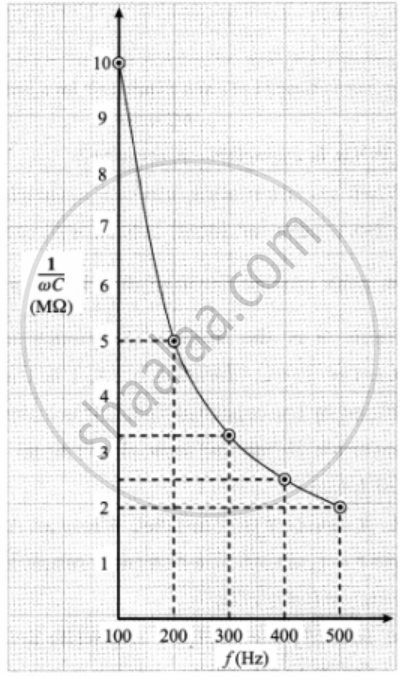
Variation of `1/(omega"C")` with f
4. Phasor diagram for a purely capacitive circuit
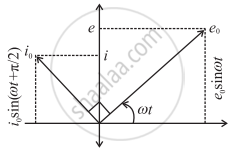
The phasor representing the peak emf (e0) makes an angle wt in an anticlockwise direction with respect to the horizontal axis. As the current leads the voltage by 90°, the phasor representing the peak current (i0) is turned 90° anticlockwise with respect to the phasor representing emf e0. The projections of these phasors on the vertical axis give instantaneous values of e and i.
APPEARS IN
संबंधित प्रश्न
A 2 µF capacitor, 100 Ω resistor and 8 H inductor are connected in series with an AC source.
(i) What should be the frequency of the source such that current drawn in the circuit is maximum? What is this frequency called?
(ii) If the peak value of e.m.f. of the source is 200 V, find the maximum current.
(iii) Draw a graph showing variation of amplitude of circuit current with changing frequency of applied voltage in a series LRC circuit for two different values of resistance R1 and R2 (R1 > R2).
(iv) Define the term 'Sharpness of Resonance'. Under what condition, does a circuit become more selective?
Show that the current leads the voltage in phase by π/2 in an AC circuit containing an ideal capacitor ?
An AC source producing emf ε = ε0 [cos (100 π s−1)t + cos (500 π s−1)t] is connected in series with a capacitor and a resistor. The steady-state current in the circuit is found to be i = i1 cos [(100 π s−1)t + φ1) + i2 cos [(500π s−1)t + ϕ2]. So,
The AC voltage across a resistance can be measured using
A bulb rated 60 W at 220 V is connected across a household supply of alternating voltage of 220 V. Calculate the maximum instantaneous current through the filament.
Suppose the initial charge on the capacitor is 6 mC. What is the total energy stored in the circuit initially? What is the total energy at later time?
Average power supplied to a capacitor over one complete cycle is ______.
If circuit containing capacitance only, the current ______.
A capacitor has capacitance C and reactance X, if capacitance and frequency become double, then reactance will be ______.
An alternating current of 1.5 mA and angular frequency 300 rad/sec flows through a 10 k Ω resistor and a 0.50 µF capacitor in series. Find the rms voltage across the capacitor and impedance of the circuit.
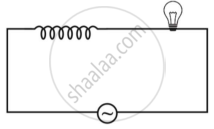
An iron cored coil is connected in series with an electric bulb with an AC source as shown in figure. When iron piece is taken out of the coil, the brightness of the bulb will ______.
An AC source is connected to a capacitor C. Due to decrease in its operating frequency ______.
In an alternating current circuit consisting of elements in series, the current increases on increasing the frequency of supply. Which of the following elements are likely to constitute the circuit?
What is the applied voltage at any instant when a capacitor is connected to an AC source?
What does \[v_m\] represent?
What does \[\omega\] represent?
Which relation expresses that the voltage across the capacitor equals the applied voltage?
What instantaneous current results from \[q=Cv_m\sin\omega t\]?
What is the peak current in a capacitor connected to an AC source?
What happens when a DC source is connected to a capacitor?
How does a lamp in series with a capacitor behave after the capacitor charges from a DC source?
What is the capacitive reactance of a \[15.0\,\mu\mathrm{F}\] capacitor connected to a \[50\,\mathrm{Hz}\] source?
What is the peak current when the rms current is \[1.04\,\mathrm{A}\]?
How does the current in a capacitor connected to an AC source compare in phase with the voltage?
