Advertisements
Advertisements
प्रश्न
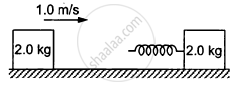
A block of mass 2.0 kg is moving on a frictionless horizontal surface with a velocity of 1.0 m/s (In the following figure) towards another block of equal mass kept at rest. The spring constant of the spring fixed at one end is 100 N/m. Find the maximum compression of the spring.
Advertisements
उत्तर
Given,
Mass of each block, MA = MB = 2 kg
Initial velocities of block A, Va = 1 m/s
Initial velocity of block B, Vb = 0
Spring constant of the spring = 100 N/m
Block A strikes the spring with a velocity of 1 m/s.
After the collision, it's velocity decreases continuously. At an instant the whole system (Block A + the compound spring + Block B) moves together with a common velocity V (say).
Using the law of conservation of energy, we get:
\[\left( \frac{1}{2} \right) M_A V_A^2 + \left( \frac{1}{2} \right) M_B V_B^2 = \left( \frac{1}{2} \right) M_A V^2 + \left( \frac{1}{2} \right) M_B V^2 + \left( \frac{1}{2} \right)k x^2 \]
\[\]
\[\left( \frac{1}{2} \right) \times 2(1 )^2 + 0 = \left( \frac{1}{2} \right) + \left( \frac{1}{2} \right) \times v^2 + \left( \frac{1}{2} \right) x^2 \times 100\]
(where x is the maximum compression of the spring)
⇒ 1 − 2v2 = 50x2 ...(1)
As there is no external force acting in the horizontal direction, the momentum is conserved.
\[\Rightarrow M_A V_A + M_B V_B = ( M_A + M_B )V\]
\[ \Rightarrow 2 \times 1 = 4 \times V\]
\[ \Rightarrow V = \left( \frac{1}{2} \right)\text{m/s} . . . (2)\]
\[\text{ Susbstituting this value of V in equation (1), we get: }\]
\[ 1 = 2 \times \left( \frac{1}{4} \right) + 50 x^2 \]
\[ \Rightarrow \frac{1}{4} = 50 x^2 \]
\[ \Rightarrow x^2 = \frac{1}{100} \]
\[ \Rightarrow x = \frac{1}{10}m\]
\[ \Rightarrow x = 10 \text{cm}\]

APPEARS IN
संबंधित प्रश्न
Consider the situation of the previous problem. Take "the table plus the ball" as the system. friction between the table and the ball is then an internal force. As the ball slows down, the momentum of the system decreases. Which external force is responsible for this change in the momentum?
A van is standing on a frictionless portion of a horizontal road. To start the engine, the vehicle must be set in motion in the forward direction. How can be persons sitting inside the van do it without coming out and pushing from behind?
The quantities remaining constant in a collisions are
In an elastic collision
(a) the kinetic energy remains constant
(b) the linear momentum remains constant
(c) the final kinetic energy is equal to the initial kinetic energy
(d) the final linear momentum is equal to the initial linear momentum.
A ball of mass 50 g moving at a speed of 2.0 m/s strikes a plane surface at an angle of incidence 45°. The ball is reflected by the plane at equal angle of reflection with the same speed. Calculate (a) the magnitude of the change in momentum of the ball (b) the change in the magnitude of the momentum of the ball.
A 60 kg man skating with a speed of 10 m/s collides with a 40 kg skater at rest and they cling to each other. Find the loss of kinetic energy during the collision.
A bullet of mass 25 g is fired horizontally into a ballistic pendulum of mass 5.0 kg and gets embedded in it. If the centre of the pendulum rises by a distance of 10 cm, find the speed of the bullet.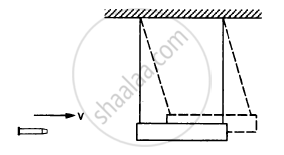
A bullet of mass 20 g moving horizontally at a speed of 300 m/s is fired into a wooden block of mass 500 g suspended by a long string. The bullet crosses the block and emerges on the other side. If the centre of mass of the block rises through a height of 20.0 cm, find the speed of the bullet as it emerges from the block.
Two mass m1 and m2 are connected by a spring of spring constant k and are placed on a frictionless horizontal surface. Initially the spring is stretched through a distance x0 when the system is released from rest. Find the distance moved by the two masses before they again come to rest.
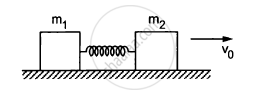
Two blocks of masses m1 and m2 are connected by a spring of spring constant k (See figure). The block of mass m2 is given a sharp impulse so that it acquires a velocity v0 towards right. Find (a) the velocity of the centre of mass, (b) the maximum elongation that the spring will suffer.
A small block of superdense material has a mass of 3 × 1024kg. It is situated at a height h (much smaller than the earth's radius) from where it falls on the earth's surface. Find its speed when its height from the earth's surface has reduce to to h/2. The mass of the earth is 6 × 1024kg.
A metre stick is held vertically with one end on a rough horizontal floor. It is gently allowed to fall on the floor. Assuming that the end at the floor does not slip, find the angular speed of the rod when it hits the floor.
A uniform rod pivoted at its upper end hangs vertically. It is displaced through an angle of 60° and then released. Find the magnitude of the force acting on a particle of mass dm at the tip of the rod when the rod makes an angle of 37° with the vertical.
A solid sphere of mass m is released from rest from the rim of a hemispherical cup so that it rolls along the surface. If the rim of the hemisphere is kept horizontal, find the normal force exerted by the cup on the ball when the ball reaches the bottom of the cup.
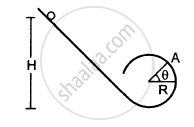
The following figure shows a small spherical ball of mass m rolling down the loop track. The ball is released on the linear portion at a vertical height H from the lowest point. The circular part shown has a radius R.
(a) Find the kinetic energy of the ball when it is at a point A where the radius makes an angle θ with the horizontal.
(b) Find the radial and the tangential accelerations of the centre when the ball is at A.
(c) Find the normal force and the frictional force acting on the if ball if H = 60 cm, R = 10 cm, θ = 0 and m = 70 g.