Advertisements
Advertisements
प्रश्न
A ball is thrown vertically upwards with a velocity of 49 m/s. Calculate
- the maximum height to which it rises.
- the total time it takes to return to the surface of the earth.
Advertisements
उत्तर
i. Initial velocity = 49m/s
Final velocity at maximum height = 0
g = −9.8m/s2 since the ball is moving in the opposite direction
Let the maximum height = h
Third equation of motion
v2 = u2 + 2gh
02 = (49)2 + 2x (−9.8) × h
2401 = 2 × 9.8h
122.5m = h
ii. Let the time taken to reach the maximum height = t
The first equation of motion
v = u + gt
0 = 49 + (−9.8) × t
49 = 9.8 × t
t = `49/9.8`
t = 5s
Time taken to reach maximum height = 5s
Total time taken by the ball to reach back to the earth 5 + 5 = 10s
संबंधित प्रश्न
What do you mean by acceleration due to gravity?
Figure shows the velocity-time graph of a particle of mass 100 g moving in a straight line. Calculate the force acting on the particle.
(Hint : Acceleration = Slope of the v-t graph)
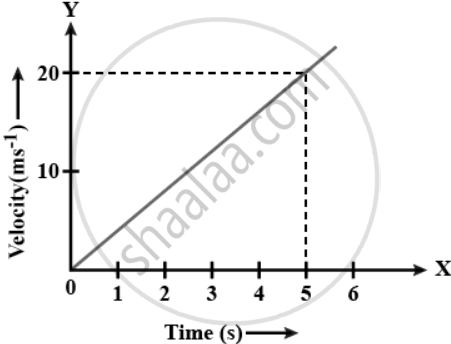
A car is moving with a uniform velocity 30 ms-1. It is stopped in 2 s by applying a force of 1500 N through its brakes. Calculate the following values : The retardation produced in car.
In vacuum, all freely falling objects have the same force. Is it true?
Explain why:
Objects fall to the earth.
The value of gravitational acceleration (g) is ______.
The mass of planet ‘X’ is four times that of the earth, and its radius is double the radius of the earth. The escape velocity of a body from the earth is 11.2 × 10³ m/s. Find the escape velocity of a body from the planet ‘X’.
Write a short note.
Escape Velocity
Calculate the escape velocity on the surface of the moon given the mass and radius of the moon to be 7.34 × 10²² kg and 1.74 × 10⁶ m respectively.
(Given: G = 6.67 × 10⁻¹¹ Nm2/kg2)
When is free fall possible?
