Topics
Introduction to Indian Society
- Study of Indian Society: Sociological Connections with History and Anthropology
- Study of Indian Society
- Religious Beliefs and Practices in Ancient India
- Religion in Ancient Indian Civilizations
- Jainism and Buddhism in Ancient India
- Religious Beliefs and Practices in Medieval India
- Status of Women in Indian Society
- Nature of Education in Ancient and Medieval India
- Social Life in Ancient and Medieval India
- Urbanisation in Ancient India
- Concept of Sociological Imagination
- Colonial Period in India
- Effects of Colonialisation in India
- Factors Affecting Post-Independence India
- Overview of Introduction to Indian Society
Segments of Indian Society
- Introduction to Segments of Indian Society
- The Tribal Community in India
- Tribal Development in India
- Exploitation and Problems of the Indian Tribal Community
- The Rural Community in India
- Rural Development in India (Sociological Perspective)
- The Urban Community in India
- Urban Development in India
- Overview of Segments of Indian Society
Diversity and Unity in Indian Society
- Introduction of Diversity and Unity in Indian Society
- Diversity in Indian Society
- Unity in Diversity
- Challenges to National Unity
- Factors that Are Responsible for Economic Inequality in Society
- Overview of Diversity and Unity in Indian Society
Processes of Social Change in India
- Industrialisation
- Urbanisation in India
- Modernisation
- Digitalisation
- Factors Responsible for Social Change
- Overview of Processes of Social Change in India
Social Movements in India
- Meaning and Nature of Social Movement
- Types of Social Movements
- Causes of Social Movements
- Social Movements and Social Change
- Womens’ Movement in India
- Workers’ Movements
- Farmer's Movements
- Environmental Movement in India
- Overview of Social Movements in India
Social Problems in India
- Social Problem
- Ageing
- The Problems of Ageing
- Measures to Tackle the Problems of Ageing
- Concept of Unemployment
- Causes of Unemployment
- General Measures to Reduce Unemployment
- Farmers’ Suicide
- Causes of Farmers’ Suicide
- Consequences of Farmers’ Suicides
- Measures to Tackle the Problem of Farmer Suicides
- Domestic Violence
- Causes of Domestic Violence
- Consequences of Domestic Violence
- Measures to Deal with Domestic Violence
- Addiction (Substance, Internet, Mobile)
- Types of Addiction
- Causes of Addiction
- Consequences of Addiction
- Measures to Tackle Addiction Problems
- Overview of Social Problems in India
Passages
- Passages
- Sociology: A Recap
- Definition: Social Practices
- Examples of Social Practices
- Using the Past to Understand Indian Society
- Connection between Sociology and History
- Examples Showing the Connection between Sociology and History
- Stages in the Development of Early Indian Society
- Definition: Anthropology
- Connection between Anthropology and Sociology
- Using Anthropology to Understand Indian Social Life
- Key Takeaways
Sociology: A Recap
-
Sociology studies how humans behave in groups—how society shapes our actions, ideas, and habits.
-
Sociologists ask, "What do people do?" How do they do it? Why do they do it?
-
Our social relationships (family, school, friends) influence what we think and how we act.
Definition : Social Practices
Social practices are the common ways people in a society do things together, like celebrating festivals, greeting each other, or eating meals. These are repeated actions and habits that everyone recognizes and often follows as part of their daily life.
Examples of Social Practices
| Country/Region | Social Practice | Description |
|---|---|---|
| India | Diwali celebration | Festival of Lights is celebrated with prayers, sweets, and fireworks |
| USA | Thanksgiving dinner | Families share a meal and give thanks every November |
| Japan | Bowing | People bow to greet or show respect |
| China | Lunar New Year | Setting off fireworks, giving red envelopes during family gatherings |
| Brazil | Carnival parade | Dancing in music-filled street parades before Lent |
| Worldwide | Shaking hands | A common way of greeting or starting agreements everywhere |
Using the Past to Understand Indian Society
Sociology as a science started in Europe in the mid-19th century CE, but India's civilization is much older.
To learn about the past, experts use:
- Artifacts: Tools, pots, jewelry, art, coins, old buildings
- Writings: Travel stories, memoirs, court records, edicts (orders by king/government)
- Remains: Bones, fossils, ancient city ruins
Modern technology helps to understand the age and story behind these finds.
Connection between Sociology and History
- History and sociology are closely connected because both study how societies develop and change, but from different angles.
- Sociology uses historical events to understand present-day social patterns, while history can use sociological ideas—like family, class, or power—to explain why past events happened the way they did.
- Together, these subjects help us see how past events shape today’s social life and how social structures have changed over time.
- So, history gives sociology a timeline and context, and sociology gives history deeper meanings and patterns behind how people live together
Examples Showing the Connection between Sociology and History
| Topic/Theme | How History Informs Sociology | How Sociology Helps Explain History |
|---|---|---|
| Caste System | Ancient texts and colonial records show how castes started and changed over time | Sociologists study present-day caste discrimination and social mobility |
| Family Structure | Historical census data shows the rise/fall of joint and nuclear families | Sociology explains why families changed (urbanization, jobs, culture) |
| Social Reform Movements | History describes events like the abolition of Sati or independence struggles | Sociology explores why reforms succeeded or failed (group beliefs, resistance) |
| British Rule in India | Chronicles and reports give details of policies, laws, and major events | Sociologists analyze how these changed social habits, education, and status |
| Village Community Studies | Historical accounts document rural life and structure | Sociologists use these to compare today's villages with the past |
| Religion and Social Change | History tracks the rise of religions (Buddhism, Sikhism) and their effects | Sociology studies how these still shape Indian society, conflict, and values |
| Social Surveys | British colonial census records launched systematic data-keeping | Sociologists use these numbers for research on class, occupation, etc. |
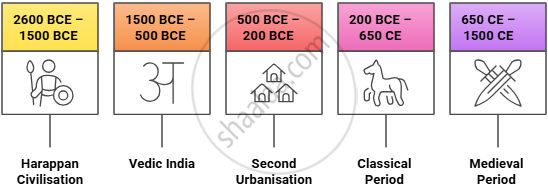
Stages in the Development of Early Indian Society
Definition : Anthropology
Anthropology is the scientific study of human beings, their societies, cultures, and physical traits, which began as a formal discipline in the 19th century.
Connection between Anthropology and Sociology
| Aspect | Anthropology | Sociology | Connection |
|---|---|---|---|
| What it studies | Human beings, cultures, evolution, traditions | Human societies, groups, interactions, institutions | Both study people and their behaviour and cultures |
| Focus level | Individual, family, and community (micro-level) | Society and groups (macro-level) | Both examine how people connect and organise. |
| Main methods | Qualitative (fieldwork, observation, ethnography) | Qualitative and quantitative (surveys, stats, interviews) | Share some research methods, but sociology uses more data/stats |
| Goal | Understand cultural differences, evolution, origins | Solve social issues, understand institutions | Both can help improve understanding of societies |
| Subject overlap | Society, kinship, religion, customs, language, art | Social classes, movements, politics, economics | Often study same topics from different angles |
Using Anthropology to Understand Indian Social Life
| Anthropological Approach | Sociological Perspective in India | How It Helps |
|---|---|---|
| Ethnography (fieldwork in communities) | Studies caste, tribes, kinship, villages | Reveals real-life social patterns and diversity |
| Participant observation | Examines local customs, rituals, and social roles | Understands how traditions shape social groups |
| Comparative study of cultures | Compares practices across regions and religions | Explains unity and variation in Indian society |
| Analysis of family and marriage | Studies changes in joint, nuclear families and arranged marriage | Tracks social change over time through family life |
| Focus on language and art | Looks at local dialects, literature, and folk art | Shows cultural identity and social connections |
Key Takeaways
-
Sociology focuses on understanding present-day social groups, behaviours, and institutions, while history studies past events and their impact on societies.
-
Anthropology studies human beings, cultures, and physical traits scientifically and adds depth to sociological understanding by exploring cultural diversity and human evolution.
-
Sociology, history, and anthropology together provide a fuller understanding of Indian society, explaining how customs, social structures, and practices developed and evolved.
-
Social practices are shared habits and customs, such as greetings and festivals, that vary across cultures and time.
- Indian society has evolved through several major historical phases—ancient civilisations, Vedic culture, urbanisation, classical empires, and medieval diversity.
-
Anthropology aids sociological study of Indian society through methods like ethnography, participant observation, and cultural comparisons, revealing real-life social patterns.
-
Understanding Indian society requires an interdisciplinary approach using sociology, history, and anthropology to capture social change, diversity, and cultural identity.
