Topics
Introduction to Indian Society
- Study of Indian Society: Sociological Connections with History and Anthropology
- Study of Indian Society
- Religious Beliefs and Practices in Ancient India
- Religion in Ancient Indian Civilizations
- Jainism and Buddhism in Ancient India
- Religious Beliefs and Practices in Medieval India
- Status of Women in Indian Society
- Nature of Education in Ancient and Medieval India
- Social Life in Ancient and Medieval India
- Urbanisation in Ancient India
- Concept of Sociological Imagination
- Colonial Period in India
- Effects of Colonialisation in India
- Factors Affecting Post-Independence India
- Overview of Introduction to Indian Society
Segments of Indian Society
- Introduction to Segments of Indian Society
- The Tribal Community in India
- Tribal Development in India
- Exploitation and Problems of the Indian Tribal Community
- The Rural Community in India
- Rural Development in India (Sociological Perspective)
- The Urban Community in India
- Urban Development in India
- Overview of Segments of Indian Society
Diversity and Unity in Indian Society
- Introduction of Diversity and Unity in Indian Society
- Diversity in Indian Society
- Unity in Diversity
- Challenges to National Unity
- Factors that Are Responsible for Economic Inequality in Society
- Overview of Diversity and Unity in Indian Society
Processes of Social Change in India
- Industrialisation
- Urbanisation in India
- Modernisation
- Digitalisation
- Factors Responsible for Social Change
- Overview of Processes of Social Change in India
Social Movements in India
- Meaning and Nature of Social Movement
- Types of Social Movements
- Causes of Social Movements
- Social Movements and Social Change
- Womens’ Movement in India
- Workers’ Movements
- Farmer's Movements
- Environmental Movement in India
- Overview of Social Movements in India
Social Problems in India
- Social Problem
- Ageing
- The Problems of Ageing
- Measures to Tackle the Problems of Ageing
- Concept of Unemployment
- Causes of Unemployment
- General Measures to Reduce Unemployment
- Farmers’ Suicide
- Causes of Farmers’ Suicide
- Consequences of Farmers’ Suicides
- Measures to Tackle the Problem of Farmer Suicides
- Domestic Violence
- Causes of Domestic Violence
- Consequences of Domestic Violence
- Measures to Deal with Domestic Violence
- Addiction (Substance, Internet, Mobile)
- Types of Addiction
- Causes of Addiction
- Consequences of Addiction
- Measures to Tackle Addiction Problems
- Overview of Social Problems in India
Passages
- Passages
- Introduction
- Overview: Effects of Colonial Rule in India
- Effects on Education
- Effects on Culture
- Types of Impacts of Western Culture
- Examples: Types of Impacts of Western Culture
- Effects on Administration
- Effects on Economy
- Effects on Transport & Communication
- Nationalist Movement
- Definition: Social Reform Movements
- Examples: Social Reform Movements in India
- Definition: Social Legislation
- Examples: Social Legislation in India
- Social Reform Movements vs. Social Legislation
- Key Takeaways
Introduction
- Colonial rule in India (1757–1947) transformed almost every part of society—education, economy, politics, culture, and social norms.
- While it brought infrastructure and new ideas, it also caused deep exploitation and inequality.
Overview : Effects of Colonial Rule in India
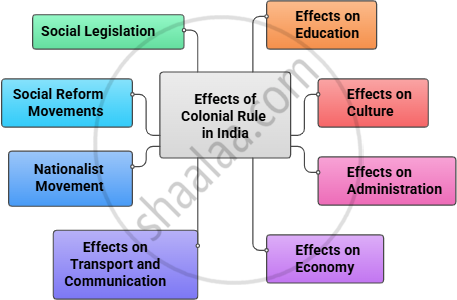
Effects on Education
| Key Ideas | Explanation / Details |
|---|---|
| Introduction of English |
|
| New Universities (1857) |
|
| Impact | Rise of Indian intelligentsia - thinkers who led social and political reform |
Effects on Culture
- Colonial rule had a profound effect on Indian culture. The British introduced the English language and Western education, which led to a shift in traditional attitudes and practices, especially among the educated elite.
- Western customs, foods, clothing, sports, beliefs, and entertainment gradually influenced everyday Indian life, causing a division between those who adopted these new ways and those who retained traditional ones.
- This period also saw important social reforms (like banning sati and allowing widow remarriage), but some reforms were viewed as culturally intrusive.
Types of Impacts of Western Culture
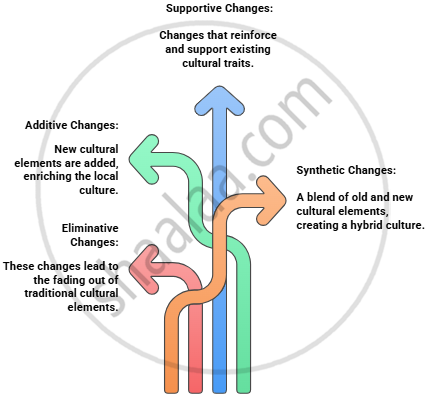
Examples : Types of Impacts of Western Culture
| Type of Impact | Example |
|---|---|
| Eliminative changes | Traditional Indian attire like dhoti and saree worn less in cities |
| Additive changes | Celebrating Christmas and Valentine’s Day along with Indian festivals |
| Supportive changes | Using English phrases during Indian festivals to connect with youth |
| Synthetic changes | Wearing jeans with a traditional kurta, or fusion food like paneer pizza |
Effects on Administration
| Key Ideas | Explanation |
|---|---|
| New Services | Economic, Revenue, Education, and Administrative Services established. |
| Judiciary |
|
| Democratic Values |
|
Effects on Economy
| Key Ideas | Explanation |
|---|---|
| Commercialization of Agriculture | Peasants forced to grow cash crops (cotton, indigo) instead of food, leading to famines |
| Decline of Crafts | British imports destroyed local industries. Artisans lost traditional livelihoods. |
| Urbanization |
|
Effects on Transport & Communication
| Key Ideas | Explanation |
|---|---|
| Infrastructure | Railways, telegraphs, post, and roads were built mainly for British trade interests. |
| Suez Canal (1869) | Shortened route between India and Britain, increasing export-import efficiency. |
Nationalist Movement
| Key Ideas | Explanation |
|---|---|
| Common Language (English) | Enabled educated Indians to communicate ideas and unite. |
| National Consciousness | The rise of political awareness led to the formation of the Indian National Congress (1885). |
| Gandhian Era | Mahatma Gandhi mobilized masses for independence through non-violence and truth. |
Definition : Social Reform Movements
Social reform movements are organized efforts by groups of people who work together to remove social evils, promote equality, and improve society by changing unfair customs, beliefs, and practices into modern and just ones.
Examples : Social Reform Movements in India
Reformers fought social evils and promoted equality through education and awareness.
| Movements of Social Reforms | Founder | Explanation |
|---|---|---|
| Brahmo Samaj | Raja Rammohan Roy |
Sought to
|
| Arya Samaj | Swami Dayanand Saraswati |
|
| Prarthana Samaj | Aatmaram Pandurang Tarkhadkar |
|
| Satya Shodhak Samaj | Mahatma Jotiba Phule |
|
| Harijan Sevak Sangh | Mahatma Gandhi |
|
| Seva Sadan (Mumbai) | Behramji Malbari | Focused on women's education and social upliftment, especially for widows |
| Dharma Sabha | Radhakant Deb |
|
| Wahhabi Movement | Syed Waliullah |
Islamic revivalist movement aiming to
|
| Self-Respect Movement | Erode V. Ramasamy (Periyar) |
|
Definition : Social Legislation
Social legislation is a set of laws made by the government to remove social evils and improve the living conditions of people—especially the weak and disadvantaged—in order to create a fair and just society.
Examples : Social Legislation in India
| Year | Name of the Act | Explanation |
|---|---|---|
| 1829 | The Prevention of Sati Act | Banned the practice of sati (burning of widows with their husband’s body) |
| 1843 | The Indian Slavery Act | Abolished slavery and all forms of bonded labor in British India |
| 1850 | The Caste Disabilities Removal Act | Allowed people to inherit property even after changing religion or caste |
| 1856 | The Hindu Widow Remarriage Act | Legalized the remarriage of Hindu widows, promoting women’s rights |
| 1870 | The Female Infanticide Prevention Act | Aimed to prevent the killing of girl infants |
| 1872 | The Civil (or Special) Marriage Act | Allowed inter-caste and inter-religion civil marriages outside religious rites |
| 1929 | The Child Marriage Restraint Act | Set minimum age for marriage to prevent child marriages (Sarda Act) |
Social Reform Movements vs. Social Legislation
| Aspect | Social Reform Movements | Social Legislation |
|---|---|---|
| Purpose |
|
Enforce legal change for social justice |
| Driving Force |
|
British colonial government (often influenced by reformers) |
| Method |
|
Passing laws and acts |
| Focus Areas |
|
|
| Outcome |
|
Created safeguards and obligations under law |
| Relation | Often preceded or inspired legislative changes | Provided official backing and protection for reforms |
Key Takeaways
-
Colonial rule transformed Indian education, economy, administration, transport, society, and culture.
-
Education reforms and the English language united Indians, sparking national consciousness and reform movements.
-
Colonial administration introduced centralized bureaucracy, modern judiciary, and democratic values in civil services and legislation.
-
Western influence brought eliminative, additive, supportive, and synthetic changes to Indian culture, blending old and new practices.
-
Transport and communication systems—railways, roads, telegraph, and post—connected regions, supported British trade, and unified India.
-
The nationalist movement gained momentum as the English language and modern education united diverse Indians, leading to organizations like the Indian National Congress and the freedom movement.
-
Social reform movements ended social evils and promoted equality
-
Social legislation legally abolished harmful practices and protected vulnerable groups.
