Advertisements
Advertisements
There are four convex lenses L1, L2, L3 and L4 of focal length 2, 4, 6 and 8 cm, respectively. Two of these lenses from a telescope of length 10 cm and magnifying power 4. The objective and eye lenses are respectively
Concept: undefined >> undefined
At absolute zero temperature, pure silicon behaves as ______.
Concept: undefined >> undefined
Advertisements
When the observer moves towards the stationary source with velocity, 'V1', the apparent frequency of the emitted note is 'F1'. When the observer moves away from the source with velocity 'V1', the apparent frequency is 'F2'. If 'V' is the velocity of sound in air and `"F"_1/"F"_2 = 4` then `"V"/"V"_1 = ?`
Concept: undefined >> undefined
If two tuning forks A and B are sounded together, they produce 4 beats per second. When A is slightly loaded with wax, they produce 2 beats when sounded again. The frequency of A is 256 Hz. The frequency of B will be ______
Concept: undefined >> undefined
A stone of mass 1 kg is rotated in a horizontal circle of radius 0.5 m. If it makes `100/pi` rps, then its angular momentum is ______
Concept: undefined >> undefined
A charged particle (charge = q: mass = m) is rotating in a circle of radius 'R' with uniform speed 'v'. The ratio of its magnetic moment (M) to the angular momentum (L) is ______
Concept: undefined >> undefined
A tuning fork 'A' produces 5 beats per second with a tuning fork of frequency 480 Hz. When a little wax is stuck to a prong of fork A, the number of beats heard per second becomes 2. What is the frequency of tuning fork A before the wax is stuck to it?
Concept: undefined >> undefined
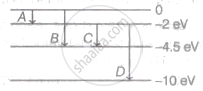
The energy levels with transitions for the atom are shown. The transitions corresponding to emission of radiation of maximum and minimum wavelength are respectively.
Concept: undefined >> undefined
An object is clearly seen through an astronomical telescope of length 50 cm. The focal lengths of its objective and eye-piece respectively can be ______.
Concept: undefined >> undefined
By increasing the aperture of the objective lens, wavelength of light, focal length of the objective lens and the resolving power of an astronomical telescope respectively.
Concept: undefined >> undefined
Angular momentum of the earth revolving around the sun is proportional to rn , where r is the distance between the earth and the sun. Value of n is ____________.
Concept: undefined >> undefined
If the angular momentum of a body increases by 50%, then its kinetic energy of rotation increases by ______ (M.I. remains constant)
Concept: undefined >> undefined
A telescope has large diameter of the objective. Then its resolving power is ______.
Concept: undefined >> undefined
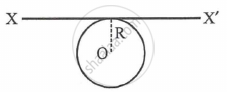
A thin metal wire of length 'L' and uniform linear mass density 'ρ' is bent into a circular coil with 'O' as centre. The moment of inertia of a coil about the axis XX' is ______.
Concept: undefined >> undefined
When a convex lens of 12.5 cm focal length is used as a magnifying glass, normal eye can see an object clearly at a distance of 25 cm. The magnifying power of the instrument is ____________.
Concept: undefined >> undefined
The angular momentum of electron in hydrogen atom is proportional to ____________.
Concept: undefined >> undefined
If the kinetic energy of rotation of a body is doubled, then its angular momentum ____________.
Concept: undefined >> undefined
Two bodies with moments of inertia I1 and I2 (I1 > I2) have equal angular momenta. lf E1 and E2 are their rotational kinetic energies respectively, then ____________.
Concept: undefined >> undefined
A hot and a cold body are kept in vacuum separated from each other. Which of the following causes decrease in temperature of the hot body?
Concept: undefined >> undefined
The ratio of the dimensions of Planck's constant to that of moment of inertia is the dimensions of ______.
Concept: undefined >> undefined
