Advertisements
Advertisements
A particle goes round a circular path with uniform speed v. After describing half the circle, what is the change in its centripetal acceleration?
Concept: undefined >> undefined
The ratio of angular speed of a hour-hand to the second-hand of a watch is ____________.
Concept: undefined >> undefined
Advertisements
Refractive index of a flint glass varies from 1.60 to 1.66 for visible range. Radii of curvature of a thin convex lens are 10 cm and 12 cm. The chromatic aberration between extreme colours is ____________.
Concept: undefined >> undefined
The ratio of the angular speed of minute hand and hour hand of a watch is ____________.
Concept: undefined >> undefined
A segment of wire vibrates with a fundamental frequency of 450 Hz under a tension of 9 kg weight. The tension at which the fundamental frequency of the same wire becomes 900 Hz is ____________.
Concept: undefined >> undefined
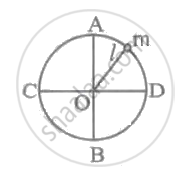
A small sphere is attached to a cord and rotates in a vertical circle about a point O. If the average speed of the sphere is increased, the cord is most likely to break at the orientation when the mass is at ____________.
Concept: undefined >> undefined
A convex lens of focal length 'f' is placed in contact with a concave lens of the same focal length. The equivalent focal length of the combination is ______.
Concept: undefined >> undefined
A sonometer wire is in unison with a tuning fork, when it is stretched by weight w and the corresponding resonating length is L1· If the weight is reduced to `("w"/4)`, the corresponding resonating length becomes L2. The ratio `("L"_1/"L"_2)` is ______.
Concept: undefined >> undefined
A particle performs uniform circular motion in a horizontal plane. The radius of the circle is 8 cm. The centripetal force acting on the particle is 15 N. Its kinetic energy is ____________.
Concept: undefined >> undefined
A particle is moving in uniform circular motion with speed 'V' and radius 'R'. The angular acceleration of the particle is ______.
Concept: undefined >> undefined
A particle of mass m is executing uniform circular motion on a path of radius r. If p is the magnitude of its linear momentum, the radial force acting on the particle is ______.
Concept: undefined >> undefined
Focal length of a convex lens will be minimum for ______.
Concept: undefined >> undefined
A circular disc 'X' of radius 'R' made from iron plate of thickness 't' has moment of inertia 'Ix' about an axis passing through the centre of disc and perpendicular to its plane. Another disc 'Y' of radius '3R' made from an iron plate of thickness `("t"/3)` has moment of inertia 'Iy' about the s same as that of disc X. The relation between Ix and ly is ______.
Concept: undefined >> undefined
Certain neutron stars are believed to be rotating at about 1 rev/s. If such a star has a radius of 1.6 km, the acceleration of an object on the equator of the star will be nearly ____________.
Concept: undefined >> undefined
A disc has mass 'M' and radius 'R'. How much tangential force should be applied to the rim of the disc, so as to rotate with angular velocity 'ω' in time t?
Concept: undefined >> undefined
Two bodies have their moments of inertia I and 2I respectively about their axes of rotation. If their kinetic energies of rotation are equal, their angular momenta will be in the ratio ______.
Concept: undefined >> undefined
A pipe closed at one end has length 0.8 cm. At its open end a 0.5 m long uniform string is vibrating in its second harmonic and it resonates with the fundamental frequency of the pipe. If the tension in the wire is 50 N and the speed of sound is 320 m/s, the mass of the string is ______.
Concept: undefined >> undefined
Two identical strings of length 'l' and '2l' vibrate with fundamental frequencies 'N' hertz and '1.5 N' hertz, respectively. The ratio of tensions for smaller length to larger ______.
Concept: undefined >> undefined
The fundamental frequency of a string stretched with a weight 'M' kg is 'n' hertz. Keeping the vibrating length constant, the weight required to produce its octave is ______.
Concept: undefined >> undefined
The equiconvex lens has a focal length 'f'. If the lens is cut along the line perpendicular to principal axis and passing through the pole, what will be the focal length of any half part?
Concept: undefined >> undefined
