Advertisements
Advertisements
In a photocell, frequency of incident radiation is increased by keeping other factors constant (v > v0), the stopping potential ______.
Concept: undefined >> undefined
If the electron in hydrogen atom jumps from second Bohr orbit to ground state and difference between energies of the two states is radiated in the form of photons. If the work function of the material is 4.2 eV, then stopping potential is ______.
[Energy of electron in nth orbit = `-13.6/"n"^2` eV ]
Concept: undefined >> undefined
Advertisements
The equation of the progressive wave is y = 3sin `[ pi("t"/3-x/5) + pi/4]`, where x and y are in metre and time in second. Which of the following is correct?
Concept: undefined >> undefined
On a photosensitive material when frequency of incident radiation is increased by 30%, kinetic energy of emitted photoelectrons increases from 0.4 eV. The work function of the surface is ______.
Concept: undefined >> undefined
Light of wavelength λ, which is less than threshold wavelength is incident on a photosensitive material. If incident wavelength is decreased so that emitted photoelectrons are moving with same velocity, then stopping potential will ______.
Concept: undefined >> undefined
A progressive wave is represented by y = 12 sin (5t - 4x) cm. On this wave, how far away are the two points having phase difference of 90°?
Concept: undefined >> undefined
The following graphs show the variation of stopping potential corresponding to the frequency of incident radiation (ν) for a given metal. The correct variation is shown in graph [ν0 = threshold frequency].
|
(A) |
(B) |
|
(C) |
(D) |


Concept: undefined >> undefined
In a compound microscope, let u0 and v0 be the object distance and image distance respectively. The objective of focal length f0 magnifies a tiny object into a real, inverted image. The linear magnification of the objective is ______.
Concept: undefined >> undefined
Light of two different frequencies whose photons have energies 1.3 eV and 2.8 eV respectively, successfully illuminate a metallic surface whose work function is 0.8 eV. The ratio of maximum speeds of emitted electrons will be ______.
Concept: undefined >> undefined
A beam of light passes from medium 1 to medium 2 to medium 3 as shown in the diagram. What may be concluded about the three refractive indices n1, n2 and n3?
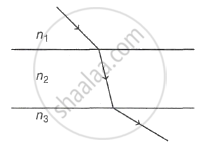
Concept: undefined >> undefined
Photoelectric emission is observed from a metallic surface for frequencies ν1 and ν2 of the incident light rays (ν1 > ν2). If the ratio of the maximum value of the kinetic energy of the photoelectrons emitted in the first case to that in the second case is 2 : K, then the threshold frequency of the metallic surface is ______.
Concept: undefined >> undefined
The photoelectric threshold for a certain metal surface is 3600 Å. If the metal surface is irradiated by a wavelength of 1100 Å, then kinetic energy of the emitted photoelectrons is ______.
Concept: undefined >> undefined
The stress-strain graph of a material is shown in the figure. The region in which the material is elastic is ______.

Concept: undefined >> undefined
Which of the following expression represents the relation between orbital magnetic moment and orbital angular momentum of an electron?
Concept: undefined >> undefined
A bar magnet of magnetic moment M1 is cut into two pieces along its axis. The pieces are kept perpendicular to each other with their unlike poles in contact. The magnetic moment of the arrangement is M2. The ratio of M1/M2 is ______.
Concept: undefined >> undefined
If a body is executing simple harmonic motion, then ______.
Concept: undefined >> undefined
Two simple harmonic motion are represented by the equations, y1 = 10 sin `(3pi"t"+pi/4)` and y2 = 5`(3sin3pi"t"+sqrt3cos3pi"t")`. Their amplitudes are in the ratio of ______.
Concept: undefined >> undefined
Halley's Comet revolves around the sun for a time period of 76 years. The aphelion distance if perihelion is given by 8.9 × 10¹⁰ m, will be ______.
(Take, the mass of sun = 2 × 1030 kg and G = 6.67 × 10⁻¹¹ Nm3/kg2)
Concept: undefined >> undefined
The temperature of a liquid drops from 365 K to 361 K in 2 min. Find the time during which the temperature of the liquid drops from 344 K to 342 K.
(Take, room temperature = 293 K)
Concept: undefined >> undefined
An alternating voltage varies with time (t) as V = 100 sin (50 πt). The rms voltage and the frequency respectively, are ______.
Concept: undefined >> undefined
