Advertisements
Advertisements
Match the physical quantities given in column A to their S I units given in column B:
| (A) | (B) | ||
| (a) | Pressure | (i) | cubic metre |
| (b) | Temperature | (ii) | kilogram |
| (c) | Density | (iii) | pascal |
| (d) | Mass | (iv) | kelvin |
| (e) | Volume | (v) | kilogram per cubic metre |
Concept: undefined >> undefined
The non S I and S I units of some physical quantities are given in column A and column B respectively. Match the units belonging to the same physical quantity:
| (A) | (B) | ||
| (a) | degree celsius | (i) | kilogram |
| (b) | centimetre | (ii) | pascal |
| (c) | gram per centimetre cube | (iii) | metre |
| (d) | bar | (iv) | kelvin |
| (e) | milligram | (v) | kilogram per metre cube |
Concept: undefined >> undefined
Advertisements
The non S I and S I units of some physical quantities are given in column A and column B respectively. Match the units belonging to the same physical quantity:
| (A) | (B) | ||
| (a) | degree celsius | (i) | kilogram |
| (b) | centimetre | (ii) | pascal |
| (c) | gram per centimetre cube | (iii) | metre |
| (d) | bar | (iv) | kelvin |
| (e) | milligram | (v) | kilogram per metre cube |
Concept: undefined >> undefined
You want to wear your favourite shirt to a party, but the problem is that it is still wet after a wash. What steps would you take to dry it faster?
Concept: undefined >> undefined
You want to wear your favourite shirt to a party, but the problem is that it is still wet after a wash. What steps would you take to dry it faster?
Concept: undefined >> undefined
Rusting of an article made up of iron is called
Concept: undefined >> undefined
Rusting of an article made up of iron is called
Concept: undefined >> undefined
Which of the following statements is not true about an atom?
Concept: undefined >> undefined
3.42 g of sucrose are dissolved in 18g of water in a beaker. The number of oxygen atoms in the solution are
Concept: undefined >> undefined
In this crossword puzzle, the names of 11 elements are hidden. Symbols of these are given below. Complete the puzzle.
| 1 | Cl |
| 2 | H |
| 3 | Ar |
| 4 | O |
| 5 | Xe |
| 6 | N |
| 7 | He |
| 8 | F |
| 9 | Kr |
| 10 | Rn |
| 11 | Ne |
Identify the total number of inert gases, their names, and symbols from this crossword puzzle.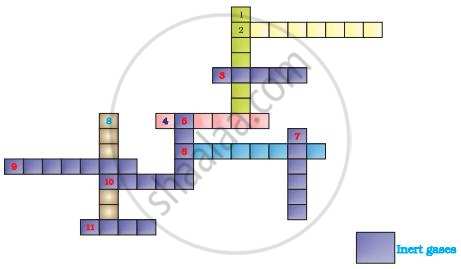
Concept: undefined >> undefined
In photosynthesis, 6 molecules of carbon dioxide combine with an equal number of water molecules through a complex series of reactions to give a molecule of glucose having a molecular formula C6 H12 O6 . How many grams of water would be required to produce 18 g of glucose? Compute the volume of water so consumed assuming the density of water to be 1 g cm–3.
Concept: undefined >> undefined
Which of the following tissues has dead cells?
Concept: undefined >> undefined
Which of the following statements are true for pure substances?
(i) Pure substances contain only one kind of particles
(ii) Pure substances may be compounds or mixtures
(iii) Pure substances have the same composition throughout
(iv) Pure substances can be exemplified by all elements other than nickel
Concept: undefined >> undefined
Which of the following statements are true for pure substances?
(i) Pure substances contain only one kind of particles
(ii) Pure substances may be compounds or mixtures
(iii) Pure substances have the same composition throughout
(iv) Pure substances can be exemplified by all elements other than nickel
Concept: undefined >> undefined
Which of the following are homogeneous in nature?
(i) ice
(ii) wood
(iii) soil
(iv) air
Concept: undefined >> undefined
Which of the following are homogeneous in nature?
(i) ice
(ii) wood
(iii) soil
(iv) air
Concept: undefined >> undefined
Give some examples of the Tyndall effect observed in your surroundings?
Concept: undefined >> undefined
Give some examples of the Tyndall effect observed in your surroundings?
Concept: undefined >> undefined
Non-metals are usually poor conductors of heat and electricity. They are non-lustrous, non-sonorous, non-malleable and are coloured.
Name a non-metal which exists as a liquid at room temperature.
Concept: undefined >> undefined
Non-metals are usually poor conductors of heat and electricity. They are non-lustrous, non-sonorous, non-malleable and are coloured.
Name a non-metal which exists as a liquid at room temperature.
Concept: undefined >> undefined
