Advertisements
Advertisements
Verify a − (−b) = a + b for the given values of a and b.
a = 118, b = 125
Concept: undefined >> undefined
Verify a − (−b) = a + b for the following values of a and b.
a = 75, b = 84
Concept: undefined >> undefined
Advertisements
Verify a − (−b) = a + b for the following values of a and b.
a = 28, b = 11
Concept: undefined >> undefined
Use the sign of >, < or = in the box to make the statements true.
(– 8) + (– 4)  (–8) – (– 4)
Concept: undefined >> undefined
Use the sign of >, < or = in the box to make the statements true.
(– 3) + 7 – (19) 15 – 8 + (– 9)
Concept: undefined >> undefined
Use the sign of >, < or = in the box to make the statements true.
23 – 41 + 11 23 – 41 – 11
Concept: undefined >> undefined
Use the sign of >, < or = in the box to make the statements true.
39 + (– 24) – (15) 36 + (– 52) – (– 36)
Concept: undefined >> undefined
Use the sign of >, < or = in the box to make the statements true.
– 231 + 79 + 51 –399 + 159 + 81
Concept: undefined >> undefined
A water tank has steps inside it. A monkey is sitting on the topmost step (i.e., the first step). The water level is at the ninth step.
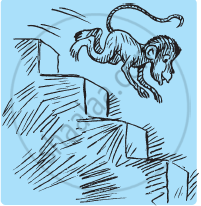
1) He jumps 3 steps down and then jumps back 2 steps up. In how many jumps will he reach the water level?
2) After drinking water, he wants to go back. For this, he jumps 4 steps up and then jumps back 2 steps down in every move. In how many jumps will he reach back the top step?
3) If the number of steps moved down is represented by negative integers and the number of steps moved up by positive integers, represent his moves in part (i) and (ii) by completing the following; (a) − 3 + 2 − … = − 8 (b) 4 − 2 + … = 8. In (a) the sum (− 8) represents going down by eight steps. So, what will the sum 8 in (b) represent?
Concept: undefined >> undefined
Using laws of exponents, simplify and write the answer in exponential form:
(34)3
Concept: undefined >> undefined
Say true or false and justify your answer:
23 > 52
Concept: undefined >> undefined
Construct ΔDEF such that DE = 5 cm, DF = 3 cm and m∠EDF = 90°.
Concept: undefined >> undefined
Construct an isosceles triangle in which the lengths of each of its equal sides is 6.5 cm and the angle between them is 110°.
Concept: undefined >> undefined
Construct ΔABC with BC = 7.5 cm, AC = 5 cm and m∠C = 60°.
Concept: undefined >> undefined
If ΔABC ≅ ΔFED under the correspondence ABC ↔ FED, write all the Corresponding congruent parts of the triangles.
Concept: undefined >> undefined
If ΔDEF ≅ ΔBCA, write the part(s) of ΔBCA that correspond to ∠E
Concept: undefined >> undefined
If ΔDEF ≅ ΔBCA, write the part(s) of ΔBCA that correspond to `bar(EF)`
Concept: undefined >> undefined
If ΔDEF ≅ ΔBCA, write the part(s) of ΔBCA that correspond to ∠F
Concept: undefined >> undefined
If ΔDEF ≅ ΔBCA, write the part(s) of ΔBCA that correspond to `bar(DF)`
Concept: undefined >> undefined
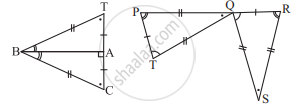
Complete the congruence statement:
ΔBCA ≅?
ΔQRS ≅?
Concept: undefined >> undefined
