Advertisements
Advertisements
The chief architect of the Indian Constitution is ______.
Concept: undefined >> undefined
A state is "a body that successfully claims a monopoly of legitimate force in a particular territory", according to ____________.
Concept: undefined >> undefined
Advertisements
Ageing population implies:
Concept: undefined >> undefined
The newly married couple stays with the groom’s parents. Which form of family is this?
Concept: undefined >> undefined
____________ is often grounded in stereotypes.
Concept: undefined >> undefined
What criterion is used to define minority in the sociological sense?
Concept: undefined >> undefined
Assertion: Sanskritisation usually accompanies or follows a rise in the economic status of the caste attempting it.
Reason: Adopting the ritual, domestic and social practices of a caste (or castes) of higher status raises the social status of the members of middle or lower castes.
Concept: undefined >> undefined
Among the Khasis, the family is:
Concept: undefined >> undefined
Parsis or Sikhs are examples of anomalous minority groups because of which of the following reasons?
Concept: undefined >> undefined
Choose the incorrect statement about communalism.
Concept: undefined >> undefined
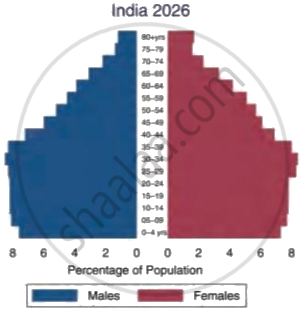
When does the bottom of a population pyramid become narrow?
Concept: undefined >> undefined
Which kind of society is depicted in this pyramid?
Concept: undefined >> undefined
This pyramid does not indicate which of the following?
Concept: undefined >> undefined
| The present study…deals with a Muslim biradri (community) called the Multani Lohars. ... Karkhanedar is a vernacular term used for a person engaged in the business of manufacturing of which he is generally the owner…The karkhanas under study operate in domestic conditions and, therefore, have certain pervasive effects on the life of the karkhanedars who work in them. …The following case illustrates this. Mahmood, aged forty years, was living with his two younger brothers, one of whom was married. He had three children and was the head of the complex household. …All the three brothers were employed in various karkhanas and factories as skilled workers. Mahmood successfully fabricated replica of a motor part the import of which had been banned. This greatly encouraged him to start his own karkhana…Later it was decided that two karkhanas should be set up to manufacture the motor part. One was to be owned by the two elder brothers, and the other by the youngest, provided he set up a separate household. Rasheed set up an independent household, consisting of his wife and unmarried children. Therefore, one complex household, comprising three married brothers, gave birth to a simple household as a result of new entrepreneurial opportunities. Excerpted from S.M. Akram Rizvi, ‘Kinship and Industry among the Muslim Karkhanedars in Delhi’, in Imtiaz Ahmad, ed. Family, Kinship and Marriage among Muslims in India, New Delhi, Manohar, 1976, pp. 27- 48. |
The given case states that the family type is:
Concept: undefined >> undefined
| The present study…deals with a Muslim biradri (community) called the Multani Lohars. ... Karkhanedar is a vernacular term used for a person engaged in the business of manufacturing of which he is generally the owner…The karkhanas under study operate in domestic conditions and, therefore, have certain pervasive effects on the life of the karkhanedars who work in them. …The following case illustrates this. Mahmood, aged forty years, was living with his two younger brothers, one of whom was married. He had three children and was the head of the complex household. …All the three brothers were employed in various karkhanas and factories as skilled workers. Mahmood successfully fabricated replica of a motor part the import of which had been banned. This greatly encouraged him to start his own karkhana…Later it was decided that two karkhanas should be set up to manufacture the motor part. One was to be owned by the two elder brothers, and the other by the youngest, provided he set up a separate household. Rasheed set up an independent household, consisting of his wife and unmarried children. Therefore, one complex household, comprising three married brothers, gave birth to a simple household as a result of new entrepreneurial opportunities. Excerpted from S.M. Akram Rizvi, ‘Kinship and Industry among the Muslim Karkhanedars in Delhi’, in Imtiaz Ahmad, ed. Family, Kinship and Marriage among Muslims in India, New Delhi, Manohar, 1976, pp. 27- 48. |
Along with family structures, which of the following has not undergone a change?
Concept: undefined >> undefined
| The present study…deals with a Muslim biradri (community) called the Multani Lohars. ... Karkhanedar is a vernacular term used for a person engaged in the business of manufacturing of which he is generally the owner…The karkhanas under study operate in domestic conditions and, therefore, have certain pervasive effects on the life of the karkhanedars who work in them. …The following case illustrates this. Mahmood, aged forty years, was living with his two younger brothers, one of whom was married. He had three children and was the head of the complex household. …All the three brothers were employed in various karkhanas and factories as skilled workers. Mahmood successfully fabricated replica of a motor part the import of which had been banned. This greatly encouraged him to start his own karkhana…Later it was decided that two karkhanas should be set up to manufacture the motor part. One was to be owned by the two elder brothers, and the other by the youngest, provided he set up a separate household. Rasheed set up an independent household, consisting of his wife and unmarried children. Therefore, one complex household, comprising three married brothers, gave birth to a simple household as a result of new entrepreneurial opportunities. Excerpted from S.M. Akram Rizvi, ‘Kinship and Industry among the Muslim Karkhanedars in Delhi’, in Imtiaz Ahmad, ed. Family, Kinship and Marriage among Muslims in India, New Delhi, Manohar, 1976, pp. 27- 48. |
As per the given passage, a complex household implies which of the following?
Concept: undefined >> undefined
| Another set of complications is created by the tension between the Indian state’s simultaneous commitment to secularism as well as the protection of minorities. The protection of minorities requires that they be given special consideration in a context where the normal working of the political system places them at a disadvantage vis-à-vis the majority community. But providing such protection immediately invites the accusation of favouritism or ‘appeasement’ of minorities. Opponents argue that secularism of this sort is only an excuse to favour the minorities in return for their votes or other kinds of support. Supporters argue that without such special protection, secularism can turn into an excuse for imposing the majority community’s values and norms on the minorities. |
As per the given passage, which of the following is true for India?
Concept: undefined >> undefined
| Another set of complications is created by the tension between the Indian state’s simultaneous commitment to secularism as well as the protection of minorities. The protection of minorities requires that they be given special consideration in a context where the normal working of the political system places them at a disadvantage vis-à-vis the majority community. But providing such protection immediately invites the accusation of favouritism or ‘appeasement’ of minorities. Opponents argue that secularism of this sort is only an excuse to favour the minorities in return for their votes or other kinds of support. Supporters argue that without such special protection, secularism can turn into an excuse for imposing the majority community’s values and norms on the minorities. |
The complication mentioned in the passage is not due to:
Concept: undefined >> undefined
| Another set of complications is created by the tension between the Indian state’s simultaneous commitment to secularism as well as the protection of minorities. The protection of minorities requires that they be given special consideration in a context where the normal working of the political system places them at a disadvantage vis-à-vis the majority community. But providing such protection immediately invites the accusation of favouritism or ‘appeasement’ of minorities. Opponents argue that secularism of this sort is only an excuse to favour the minorities in return for their votes or other kinds of support. Supporters argue that without such special protection, secularism can turn into an excuse for imposing the majority community’s values and norms on the minorities. |
Which of the following does not convey the meaning of secularisation?
Concept: undefined >> undefined
A small IT firm in India is developing a computer programme for a big company in England. Identify the most suitable term to refer this phenomenon.
Concept: undefined >> undefined
