Advertisements
Advertisements
Standing waves of frequency 5.0 kHz are produced in a tube filled with oxygen at 300 K. The separation between the consecutive nodes is 3.3 cm. Calculate the specific heat capacities Cp and Cv of the gas.
Concept: undefined >> undefined
On a winter day when the atmospheric temperature drops to −10°C, ice forms on the surface of a lake. (a) Calculate the rate of increase of thickness of the ice when 10 cm of the ice is already formed. (b) Calculate the total time taken in forming 10 cm of ice. Assume that the temperature of the entire water reaches 0°C before the ice starts forming. Density of water = 1000 kg m−3, latent heat of fusion of ice = 3.36 × 10⁵ J kg−1and thermal conductivity of ice = 1.7 W m−1°C−1. Neglect the expansion of water of freezing.
Concept: undefined >> undefined
Advertisements
A semicircular rod is joined at its end to a straight rod of the same material and the same cross-sectional area. The straight rod forms a diameter of the other rod. The junctions are maintained at different temperatures. Find the ratio of the heat transferred through a cross section of the semicircular rod to the heat transferred through a cross section of the straight rod in a given time.
Concept: undefined >> undefined
Steam at 120°C is continuously passed through a 50 cm long rubber tube of inner and outer radii 1.0 cm and 1.2 cm. The room temperature is 30°C. Calculate the rate of heat flow through the walls of the tube. Thermal conductivity of rubber = 0.15 J s−1 m−1°C−1.
Concept: undefined >> undefined
Consider the situation shown in the figure . The frame is made of the same material and has a uniform cross-sectional area everywhere. Calculate the amount of heat flowing per second through a cross section of the bent part if the total heat taken out per second from the end at 100°C is 130 J.

Concept: undefined >> undefined
A room has a window fitted with a single 1.0 m × 2.0 m glass of thickness 2 mm. (a) Calculate the rate of heat flow through the closed window when the temperature inside the room is 32°C and the outside is 40°C. (b) The glass is now replaced by two glasspanes, each having a thickness of 1 mm and separated by a distance of 1 mm. Calculate the rate of heat flow under the same conditions of temperature. Thermal conductivity of window glass = 1.0 J s−1 m−1°C−1 and that of air = 0.025 m-1°C-1 .
Concept: undefined >> undefined
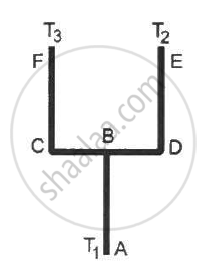
Four identical rods AB, CD, CF and DE are joined as shown in following figure . The length, cross-sectional area and thermal conductivity of each rod are l, A and K respectively. The ends A, E and F are maintained at temperature T1, T2 and T3 respectively. Assuming no loss of heat to the atmosphere, find the temperature at B.
Concept: undefined >> undefined
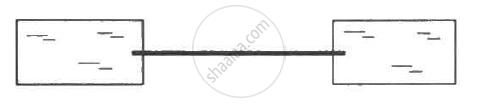
Following figure shows two adiabatic vessels, each containing a mass m of water at different temperatures. The ends of a metal rod of length L, area of cross section A and thermal conductivity K, are inserted in the water as shown in the figure. Find the time taken for the difference between the temperatures in the vessels to become half of the original value. The specific heat capacity of water is s. Neglect the heat capacity of the rod and the container and any loss of heat to the atmosphere.
Concept: undefined >> undefined
A calorimeter of negligible heat capacity contains 100 cc of water at 40°C. The water cools to 35°C in 5 minutes. The water is now replaced by K-oil of equal volume at 40°C. Find the time taken for the temperature to become 35°C under similar conditions. Specific heat capacities of water and K-oil are 4200 J kg−1 K−1 and 2100 J kg−1 K−1respectively. Density of K-oil = 800 kg m−3.
Concept: undefined >> undefined
Which of the following pairs of physical quantities does not have same dimensional formula?
Concept: undefined >> undefined
If momentum (P), area (A) and time (T) are taken to be fundamental quantities, then energy has the dimensional formula ______.
Concept: undefined >> undefined
The displacement of a progressive wave is represented by y = A sin(ωt – kx), where x is distance and t is time. Write the dimensional formula of (i) ω and (ii) k.
Concept: undefined >> undefined
In Figure, the co-efficient of friction between the floor and the body B is 0.1. The co-efficient of friction between the bodies B and A is 0.2. A force F is applied as shown on B. The mass of A is m /2 and of B is m. Which of the following statements are true?
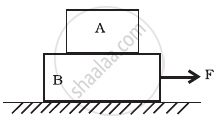
- The bodies will move together if F = 0.25 mg.
- The body A will slip with respect to B if F = 0.5 mg.
- The bodies will move together if F = 0.5 mg.
- The bodies will be at rest if F = 0.1 mg.
- The maximum value of F for which the two bodies will move together is 0.45 mg.
Concept: undefined >> undefined
Mass m1 moves on a slope making an angle θ with the horizontal and is attached to mass m2 by a string passing over a frictionless pulley as shown in figure. The coefficient of friction between m1 and the sloping surface is µ.
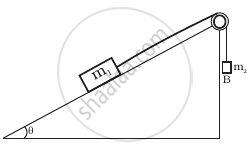
- If m2 > m1 sin θ, the body will move up the plane.
- If m2 > m1 (sin θ + µ cos θ), the body will move up the plane.
- If m2 < m1 (sin θ + µ cos θ), the body will move up the plane.
- If m2 < m1 (sin θ − µ cos θ), the body will move down the plane.
Concept: undefined >> undefined
Why are mountain roads generally made winding upwards rather than going straight up?
Concept: undefined >> undefined
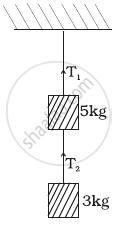
Two masses of 5 kg and 3 kg are suspended with help of massless inextensible strings as shown in figure. Calculate T1 and T2 when whole system is going upwards with acceleration = 2 ms2 (use g = 9.8 ms–2).
Concept: undefined >> undefined
A block of mass M is held against a rough vertical wall by pressing it with a finger. If the coefficient of friction between the block and the wall is µ and the acceleration due to gravity is g, calculate the minimum force required to be applied by the finger to hold the block against the wall?
Concept: undefined >> undefined
A person in an elevator accelerating upwards with an acceleration of 2 ms–2, tosses a coin vertically upwards with a speed of 20 ms1. After how much time will the coin fall back into his hand? ( g = 10 ms–2)
Concept: undefined >> undefined
A rectangular box lies on a rough inclined surface. The co-efficient of friction between the surface and the box is µ. Let the mass of the box be m.
- At what angle of inclination θ of the plane to the horizontal will the box just start to slide down the plane?
- What is the force acting on the box down the plane, if the angle of inclination of the plane is increased to α > θ ?
- What is the force needed to be applied upwards along the plane to make the box either remain stationary or just move up with uniform speed?
- What is the force needed to be applied upwards along the plane to make the box move up the plane with acceleration a?
Concept: undefined >> undefined
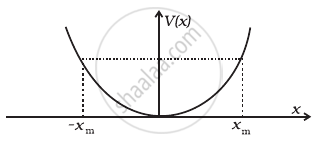
The potential energy function for a particle executing linear SHM is given by `V(x) = 1/2 kx^2` where k is the force constant of the oscillator (Figure). For k = 0.5 N/m, the graph of V(x) versus x is shown in the figure. A particle of total energy E turns back when it reaches `x = ±x_m`. If V and K indicate the P.E. and K.E., respectively of the particle at `x = +x_m`, then which of the following is correct?
Concept: undefined >> undefined
