Advertisements
Advertisements
A sphere cannot roll on
Concept: undefined >> undefined
In rear-wheel drive cars, the engine rotates the rear wheels and the front wheels rotate only because the car moves. If such a car accelerates on a horizontal road the friction
(a) on the rear wheels is in the forward direction
(b) on the front wheels is in the backward direction
(c) on the rear wheels has larger magnitude than the friction on the front wheels
(d) on the car is in the backward direction.
Concept: undefined >> undefined
Advertisements
A sphere can roll on a surface inclined at an angle θ if the friction coefficient is more than \[\frac{2}{7}g \tan\theta.\] Suppose the friction coefficient is \[\frac{1}{7}g\ tan\theta.\] If a sphere is released from rest on the incline, _____________ .
Concept: undefined >> undefined
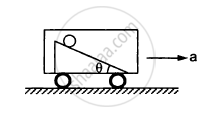
The following figure shows a smooth inclined plane fixed in a car accelerating on a horizontal road. The angle of incline θ is related to the acceleration a of the car as a = g tanθ. If the sphere is set in pure rolling on the incline, _____________.
Concept: undefined >> undefined
To construct a barometer, a tube of length 1 m is filled completely with mercury and is inverted in a mercury cup. The barometer reading on a particular day is 76 cm. Suppose a 1 m tube is filled with mercury up to 76 cm and then closed by a cork. It is inverted in a mercury cup and the cork is removed. The height of mercury column in the tube over the surface in the cup will be
Concept: undefined >> undefined
A cylinder rolls on a horizontal place surface. If the speed of the centre is 25 m/s, what is the speed of the highest point?
Concept: undefined >> undefined
A string is wrapped over the edge of a uniform disc and the free end is fixed with the ceiling. The disc moves down, unwinding the string. Find the downward acceleration of the disc.
Concept: undefined >> undefined
A hollow sphere is released from the top of an inclined plane of inclination θ. (a) What should be the minimum coefficient of friction between the sphere and the plane to prevent sliding? (b) Find the kinetic energy of the ball as it moves down a length l on the incline if the friction coefficient is half the value calculated in part (a).
Concept: undefined >> undefined
A solid sphere of mass 0⋅50 kg is kept on a horizontal surface. The coefficient of static friction between the surfaces in contact is 2/7. What maximum force can be applied at the highest point in the horizontal direction so that the sphere does not slip on the surface?
Concept: undefined >> undefined
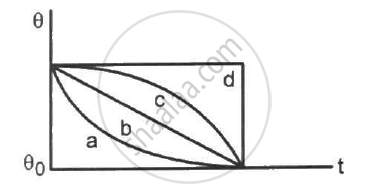
A hot liquid is kept in a big room. Its temperature is plotted as a function of time. Which of the following curves may represent the plot?
Concept: undefined >> undefined
50 cc of oxygen is collected in an inverted gas jar over water. The atmospheric pressure is 99.4 kPa and the room temperature is 27°C. The water level in the jar is same as the level outside. The saturation vapour pressure at 27°C is 3.4 kPa. Calculate the number of moles of oxygen collected in the jar.
Concept: undefined >> undefined
A 100 W bulb has tungsten filament of total length 1.0 m and radius 4 × 10⁻⁵ m. The emissivity of the filament is 0.8 and σ = 6.0 × 10⁻⁸ W m−2K4. Calculate the temperature of the filament when the bulb is operating at correct wattage.
Concept: undefined >> undefined
A spherical tungsten piece of radius 1.0 cm is suspended in an evacuated chamber maintained at 300 K. The piece is maintained at 1000 K by heating it electrically. Find the rate at which the electrical energy must be supplied. The emissivity of tungsten is 0.30 and the Stefan constant σ is 6.0 × 10⁻⁸ W m−2 K−4.
Concept: undefined >> undefined
A sphere, a cube and a thin circular plate, all of the same material and same mass are initially heated to same high temperature.
Concept: undefined >> undefined
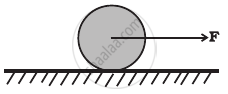
A uniform disc of radius R, is resting on a table on its rim.The coefficient of friction between disc and table is µ (Figure). Now the disc is pulled with a force F as shown in the figure. What is the maximum value of F for which the disc rolls without slipping?
Concept: undefined >> undefined
‘Gulab Jamuns’ (assumed to be spherical) are to be heated in an oven. They are available in two sizes, one twice bigger (in radius) than the other. Pizzas (assumed to be discs) are also to be heated in oven. They are also in two sizes, one twice big (in radius) than the other. All four are put together to be heated to oven temperature. Choose the correct option from the following:
- Both size gulab jamuns will get heated in the same time.
- Smaller gulab jamuns are heated before bigger ones.
- Smaller pizzas are heated before bigger ones.
- Bigger pizzas are heated before smaller ones.
Concept: undefined >> undefined
In the following example of motion, can the body be considered approximately a point object:
A monkey sitting on top of a man cycling smoothly on a circular track.
Concept: undefined >> undefined
In the following example of motion, can the body be considered approximately a point object:
A spinning cricket ball that turns sharply on hitting the ground.
Concept: undefined >> undefined
In the following example of motion, can the body be considered approximately a point object:
A tumbling beaker that has slipped off the edge of a table.
Concept: undefined >> undefined
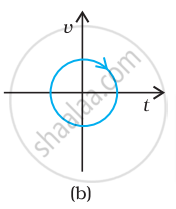
Look at the graph carefully and state, with reason, that this cannot possibly represent the one-dimensional motion of a particle.
Concept: undefined >> undefined
