Advertisements
Advertisements
Read the first activity, read the extract and then do all the activities:
A1. Correct the following statements with the help of the facts from the extract :
(1) Everybody in every part of the globe would have access to administration and social care services because he or she would not be able to afford them.
(2) We would avoid boom and bust cycles and be able to surmount natural disaster with great ease.
|
To me, a world without poverty means that every person would have the ability to take care of his or her own basic life needs. In such a world, nobody would die of hunger or suffer from malnutrition. This is a goal world leaders have been calling for decades, but have never set out any way of achieving it. Today 40,000 children die each day around the world from hunger-related diseases. In a poverty-free world, no children would die of such causes. Everybody in every part of the globe would have access to education and health-care services because he or she would be able to afford them. Unlike today, the state would not be required to provide free or subsidized health-care or schooling. All state organizations created to provide free or subsidized services for the poor would no longer be required and welfare agencies, or the national welfare department. No free schools, no free hospital care, no begging in the streets. State-run safety-net programmers would have no rationale for existence because no one would live on charity anymore. State-run social security programmers, income-support programmes would be unnecessary. Social structures in a poverty-free world would, of course, be quite different from those that exist in a poverty-ridden world. But nobody would be at the mercy of anyone else, and that is what would make all the difference between a world without poverty and one riddled with it. Finally, a poverty-free world would be economically much Stronger and far more stable than the world today. one-fifth of the world's inhabitants who today live a life of extreme poverty would become income earners and income spenders. They would generate extra demand in the market to make the world economy grow. They would bring their creativity and innovations into the market-place to increase the world's productive capacity. Since nobody would ever become poor, except on a temporary and limited basis, the economy would probably not go through extreme swings. We would avoid boom-and-bust cycles and be able to surmount man-made disasters with greater ease. |
A2.
Complete the following statement :
The situation in the world without poverty would be different, because -
(1) the state need not ___________
(2) nobody __________
A3. Find out :
Find and write in the blank boxes :
One-fifth of the world's inhabitants today live a life of extreme poverty. How would they economically Stand in a poverty-free world?
| They would be income earners and income spenders |
A4. Vocabulary :
Find out the words from the extract that mean the following :
(1) calamity (2) overcome
(3) bringing new ideas (4) financially
A5. Personal Response :
Suggest at least four solutions to overcome the problems of increasing poverty.
A6. Grammar :
Rewrite the following sentences in the ways instructed :
(1) Nobody would die of hunger or suffer from malnutrition.
(Remove the negative and rewrite.)
(2) Everybody in every part of the globe would have accessed education and health-care services.
(Rewrite the above sentences beginning with 'Education'.)
Concept: Unseen Passage Comprehension
A Read the first activity, read the extract and then do all the activities :
A1. Complete :
Complete the following sentences :
(1) The two organizations that conducted the research to develop a smartphone-based optical bio-sensor are _______ and __________ .
(2) The _________ and _________ methods were used in the research instead of the differential method.
|
Urea is a major product of nitrogen metabolism in humans. It is eliminated from the body mainly by the kidneys through urine. Urea levels in body fluids, such as blood and saliva, rise drastically under certain kidney dysfunctions. Heart failure, hypovolemic shock, gastrointestinal bleeding, and severe infections can also lead to a rise. Thus urea in blood and saliva provides key information on renal function and helps diagnose various disorders. Most methods for estimating urea in body fluids are based on colorimetry. These methods are time-consuming and involve painful blood extraction. Collecting saliva is non-evasive and research has correlated salivary and blood urea levels. Recently scientists from the IIT-D and the AIIMS, New Delhi successfully developed a smartphone-based optical biosensor to detect urea in saliva. To fabricate the sensor, they directly immobilised the urease enzyme with a pH indicator on a filter paper-based strip. As a response to the urea on saliva, the paper strip changes colour. The red, green and blue levels help measure urea concentration. The scientists used the slope method, sensor response change per unit time, instead of the differential method, the difference in sensor response between two-time intervals, to increase sensitivity and eliminate interference by variations in ambient light. The team clinically validated spiked saliva samples and samples from healthy volunteers. The smartphone application with paper strip can even be operated by non-professional with limited training. This saves time and cost spent on bulky spectroscopic procedures. The report can revolutionise the medical screening of large populations. And such mass screening of diseases would boost national health. |
A2. Complete the following sentence using the correct alternatives from those given below :
Two objectives to conduct the research are ___________ .
(i) The colorimetry method used to estimate urea in body fluids consumes more time.
(ii) Information obtained from the presence of urea in blood and saliva is not helpful to diagnose various diseases.
(iii) Collecting samples of saliva is a non-invasive procedure.
(iv) Blood extraction is the easiest and less painful exercise.
A3. Write two benefits of the smartphone-based optical biosensor.
A4. Find out similar-meaning words from the extract for the following words :
(1) specimen (2) extremely (3) focus (4) remove
A5. Personal Response :
'Research revolutionises the lifestyle of people in all spheres of life'-
Do you agree? Explain with an example in about 25 words.
A6. Grammar :
Rewrite the following sentences in the ways instructed :
(1) These methods are time consuming and painful.
(Rewrite the sentence using 'as well as'.)
(2) The smartphone application with paper-strip can be operated.
(Begin the sentence with 'They ___ .)
(B) Summerise the above extract with the help of the points given and suggest a suitable title::
Research by the organisations - methods adopted - reasons for the research - advantages.
Concept: Unseen Passage Comprehension
Read the extract and do all the activities that follow:
We used to think seven generations ahead
Now we have become selfish
Only thinking about me, myself and I
Only thinking in the present, not learning from the past.
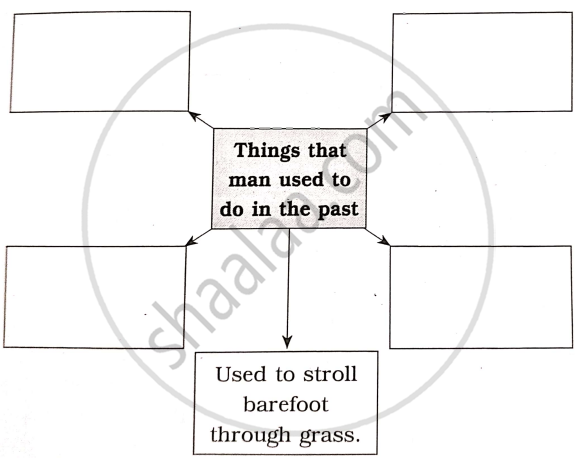
We used to stroll barefoot through the overgrown grass,
Its morning dew tickling our feet
Now we step outside onto the rugged concrete
No more natural than the over-processed food we eat
We used to walk down the snow sprinkled trail,
Maybe catch a glimpse of a bobcat, playing eye tricks with its tail
Now there is only one type of bobcat we see
The one that is fur-free, clearing the pavement of all debris
We used to walk through a footpath in a forest of pine
The smell intoxicating our lungs and mind
Now the only smell to be found comes from plastic trees.
Swaying on my rearview mirror, labelled pine breeze
we used to watch the valley play hide and seek
A1. Web :
Complete the web with the things man used to do in the past:
A2. Poetic Devices :
'We used to walk down the snow sprinkled trail'
Name the figure of speech in the above line and find out another example of the same from the extract.
A3. Personal Response :
Write in brief your views about past and present lifestyle.
A4. Poetic Creativity :
'Now we step outside onto the rugged concrete No more natural than the over-processed food.'
Read the above lines and compose at least two lines of your own. based on the same theme.
Concept: Unseen Poem Comprehension
Read the extract and do the activities that follow :
When Rosalind heard about Orlando's wound and saw the handkerchief stained with his blood, she also fainted; and later she told Oliver that she was really Rosalind, and loved Orlando dearly. Oliver had already fallen in love with gentle Celia, and he persuaded the two girls to accompany him to Duke Senior's court. Rosalind, however, wanted to play one more trick as Ganymede, so she made Oliver promise not to tell anyone that the young shepherd boy and his sister Aliena were really Rosalind and Celia.
And so Aliena and Ganymede were introduced to the old Duke, and he did not recognize his daughter, although he remarked on Ganymede's likeness to Rosalind.
Then the "shepherd boy" told Orlando and the Duke that he could find Rosalind and would bring her to them, making the Duke promise that he would allow his daughter to marry Orlando. she and Celia ran quickly to the shepherd's cottage, changed into their own clothes and removed the brown stains from their faces. Then they returned to the Duke, where they were welcomed with great rejoicing.
'To you, I give myself, for I am yours,' Rosalind said to the Duke, her father. Then she turned to Orlando and said: 'To you, I give myself, for I am yours.'
Rosalind and Orlando were married at once in the forest and on the same day Oliver who was no longer selfish and wicked, married Celia. Just as they were going to be married, a messenger came to ask Duke Senior to go back to his dukedom. Celia's father, Duke Frederick, had mended his wicked ways and asked his brother to return.
A1. True/False :
Choose the true statements from those given below and write them down :
(i) Rosalind played the role of a shepherd boy Ganymede.
(ii) Senior Duke recognised his daughter, Celia.
(iii) Oliver married Rosalind.
(iv) Duke Frederick had mended his wicked ways.
A2. Convert into a dialogue :
Convert the above extract into a dialogue form.
Concept: Unseen Passage Comprehension
Read the extract and do the activities that follow :
Two weeks later, I wrote: "Dear Mum, thanks for the socks. But I wish you had sent me a food parcel instead. How about some guava cheese? And some mango pickle. They don't give us pickle in school. Headmaster's wife says it heats the blood."
"About that skeleton. If a dead body was hidden in that cupboard after 1930- must have been, if the newspapers of that year were under the skeleton - it must have been someone who disappeared around that time or a little later. Must have been before Tirloki joined the hotel, or he'd remember. What about the registers- would they give us a clue?"
Received a parcel containing guava cheese, strawberry jam, and mango pickle. HEadmaster confiscated the pickle. Maybe he needed it to heat his blood.
A note enclosed with parcel read: "Old hotel registers missing. Must have been thrown out. Or perhaps Mr. Green took them away when he left. Tirloki says a German spy stayed in the hotel just before the War broke out. The spy used to visit the Gurkha Lines and the armaments factory. He was passing information on to a dentist who visited Germany every year. When war broke out, the dentist was kept in a prisoner-of-war camp. The spy disappeared-some say to Tibet. Could the spy have been silenced and put away in the cupboard? But I keep forgetting it was a woman's skeleton. Tirloki says the spy was a man. But a clever spy may have been a woman dressed as a man. But a clever spy may have been a woman dressed as a man. what do you think? "
It was the football season, and I wasn't doing much thinking. Chasing a football in the monsoon mist and slush called for single-minded endurance, especially when we were being beaten 5-0 by Simla Youngs, a team of junior clerks from the government offices. Not the ideal training for a boy-detective. The winter holidays were still four months distant, and the case of the unidentified skeleton appeared to be resolving itself with a little help from my mother and her friends.
B1. Complete :
Complete the following sentences :
(1) The narrator's football team was beaten 5-0 by ___________ .
(2) Headmaster's wife says that ___________ .
(3) Things that the narrator received in the parcel are __________ .
(4) The German spy was passing information ___________ .
B2. Write a gist :
Write a gist of the extract in about 50 words.
Concept: Unseen Passage Comprehension
(A) Read the following extract and answer the questions given below:
One afternoon in 1977, as his parents and two brothers fished in the Gulf of Mexico, 12-year old Michael Dell sat on the beach. painstakingly putting together a trotline - a maze of ropes to ''which several fish hooks could be attached."You're wasting your time," the rest of the family called to Michael, as they pulled in fish. "Grab a pole and join in the fun."
Michael kept working. It was dinner time when he finished, and everyone else was ready to call it a day. Still, the youngster
cast the trotline far into the water. anchoring it to a stick that he plunged deep in the sand.
Over dinner, his family teased young Michael about coming away empty-handed. But afterward, Michael reeled in his trotline, and on the hooks were more fish than the others had caught all together!
Michael Dell has always been fond of saying, "If you think you have a good idea, try it!" And today, at 29 he has discovered the power of another good idea that has helped him rise in just a few years from teen to a tycoon. He has become the fourth-largest manufacturer of personal computers in America and the youngest man ever to head a Fortune 500 corporation.
(1) What were Michael Dell’s achievements at his age of 29?
(2) What is the secret of Michael Dell’s Success?
(3) How did Michael surprise his family members?
(4) Do you think trying new ideas can make your life successful? How?
(5) Rewrite the following sentences in the ways instructed:
(i) He has discovered the power of another good idea.
(Rewrite the sentence beginning with 'The power of ...' )
(ii) Michael Dell sat on the beach.
(Rewrite it using past perfect continuous tense.)
(iii) The youngster cast the trotline.
(Frame a Wh-question to get the underlined part as
its answer.)
(6) 'Grab a pole and join in the fun'.
Pick out the contextual meaning of the underlined word from
the options are given below:
(i) smash
(ii) hold firmly
(iii) throw away
Concept: Unseen Passage Comprehension
Read the following extract and answer the questions given below :
I was 33 at the time, a doctor in the West End of London. I had been lucky)' in advancing through severed arduous Welsh mining assistantships to my own practice- acquired on the installment plan from a dear old family physician who, at our first interview, gazed at my cracked boots and frayed cuffs and trusted me.
I think I wasn't a bad doctor. My patients seemed to like me not only 1he nice old ladies with nothing wrong with them, who lived near the Park and paid handsomely for my cheerful bedside manner but the cabbies, porters, and deadbeats in the mews and back streets of Bayswater, who paid nothing and often had a great deal wrong with them. Yet there was something- though I treated everything that came my way, read all Ille medical journals, attended scientific meetings, and even found time to take complex postgraduate diplomas - I wasn't quite sure of myself. I didn't stick at anything for long. I had successive ideas of specializing in dermatology, in aural surgery, in pediatrics, but discarded them all. While I worked all day and half of most nights, I really lacked perseverance, stability. One day I developed indigestion. After resisting my wife's entreaties for several weeks, I went casually to consult a friendly colleague. I expected a bottle of bismuth and an invitation to a bridge. I received instead of the shock of my life: a sentence to six months' complete rest in the country on a milk diet. I had a gastric ulcer.
(I) What does the doctor tell us about his profession?
(2) What sort of patients did the doctor handle?
(3) What shock of life did the doctor receive when he visited his doctor colleague?
(4) What qualities of the doctor appeal you the most?
(5) Rewrite the following sentences in the ways instructed:
(i) I read all the medical journals.
(Rewrite it using the past perfect continuous tense.)
(ii) I treated everything that came n1y way.
(Rewrite the sentence beginning with "Everything ... ")
(iii) I received the shock of my life.
(Make it a Rhetorical question.)
(6) Find out the words from the extract which mean :
(i) involving a lot of effort and energy.
(ii) serious requests
Concept: Unseen Passage Comprehension
Read the following extract and answer the questions given
below:
So what is a city? It's a dense amalgamation of buildings and people. A city must provide equity and also be sustainable. As an architect who has been closely connected with Delhi and its planning, my wish list is more about the direction we need to take
so that future generations don't end up living in chaotic dysfunctional cities.
The first requirement for a city is a pragmatic plan. Many of our cities such as Delhi and Bhubaneshwar and even Port Blair in the Andamans have reasonably good master plans. Many also have City Development Plans which have been made an essential
requirement to draw funds from the government's Urban Renewal Programme (JNNURM). But they should be updated frequently based on the changing needs of its people.
And let's not forget its citizens-they need to be more proactively involved when evolving master plans. But often, there's a lack of planning and inadequate implementation systems. This applies to all essential components of city-streets, public transport system, traffic management, affordable housing, cars and parking, drainage, water supply, sewerage, and garbage. Any deficiency in these will lead to poor quality cities which won't be able to handle the pressure of increased population and changing needs.
The second requirement of a good city is good social infrastructure such as parks and places for leisure such as river and sea fronts. It needs to preserve and protect its heritage.
(1) What does a city require to emerge as a good city?
(2) What is the second requirement of a good city?
(3) What are the basic requirements to draw funds from the government's-Urban Renewal programme (JNNURM)?
(4) What suggestions will you give to make your city ideal?
(5) Rewrite the following sentences in the ways instructed:
(i) It's a dense amalgamation of buildings and people.
(Rewrite it using 'as well as'.)
(ii) A city must provide equity and also be sustainable.
(Rewrite it using another modal auxiliary showing "advice".)
(iii) The first requirement for a city is a pragmatic plan.
(Frame a 'Wh' ·question to get the underlined part as an answer.)
(6) Match the words in column 'A' with their meaning in 'B':
| Column A | Column B |
| 1 pragmatic | 1 blend |
| 2 amalgamation | 2 fantastic |
| 3 realistic | |
| 4 ancient |
Concept: Unseen Passage Comprehension
Read the following extract and answer the questions given below:
While I lay awake in bed,
God's still small voice came to me and said,
"While dealing with a stranger, common courtesy you use,
But the children you love, you seem to abuse.
Look on the kitchen floor,
You'll find some flowers there by the door.
Those are the flowers she brought for you.
She picked them herself, pink, yellow and blue.
She stood quietly not to spoil the surprise,
And you never saw the tears in her eyes."
(1) How did the mother deal with a stranger?
(2) What do you learn from this extract?
(3) Give the rhyming pairs of words from the extract. (Any two)
(4) Pick out the line from the extract suggesting the mother's
insensitive behavior towards her daughter.
Concept: Unseen Poem Comprehension
Read the following extract and answer the questions given below :
If you do not get lowered in your own eyes
While you raise yourself in those of others
If you do not give in to gossips and lies
Rather heed them not, saying, 'Who bothers'?
You may be the person I am looking for.
If you crave not for praise when you win
And look not for sympathy while you lose
If cheers let not your head toss or spin
And after a set -back you offer no excuse.
You may be the person I am looking for.
(1) What care should you take while raising yourself in the eyes of others?
(2) What good qualities of your parents impress you the most?
(3) Pick out the example of antithesis from the first stanza of the above extract.
(4) Pick out the lines from the extract which advise you how to react at your success and defeat.
Concept: Unseen Poem Comprehension
Read the following extract and answer the questions given below:
The banyan tree was three times as tall as our house
Its trunk had a circumference of fifty feet
Its scraggly aerial roots fell to the ground
From thirty feet or more so first they cut the branches
Sawing them off for seven days and the heap was huge
Insects and birds began to leave the tree
And then they came to its massive trunk
Fifty men with axes chopped and chopped
The great tree revealed its rings of two hundred years
We watched in terror and fascination this slaughter
As a raw mythology revealed to us its age
(1) What were the feelings of the family members at the felling of the banyan tree?
(2) Why, according to you, did insects and birds begin to leave the banyan tree?
(3) Find out an example of 'Repetition' from the extract.
(4) Pick out the line from the extract expressing the feelings of the people who watched the merciless cutting of the banyan
tree.
Concept: Unseen Poem Comprehension
Read the following extract and answer the questions given below:
I asked her why
She was so sad?
She told me her baby
was killed in Auschwitz.
her daughter in Hiroshima
and her sons in Vietnam,
Ireland, Israel, Palestine, Lebanon,
Bosnia. Rwanda, Kosovo, and Chechnya.
(1) Why was the woman in the extract sad?
(2) What do you think. are the dire consequences ofa war?
(3) Name and explain the figure of speech in the following lines :
'I asked her why
she was so sad ?'
(4) What purpose docs the dialogue form serve in the extract?
Concept: Unseen Poem Comprehension
Read the following extract and answer the questions given below:
Old women once
were continents.
They had deep woods in them,
lakes, mountains, volcanoes even,
even raging gulfs.
When the earth was in heat
they melted, shrank,
leaving only their maps.
You can fold them
and keep them handy:
who knows, they might help you find
your way home.
Question
(1) For what purpose did the old women leave their 'maps' behind them?
(2) How can old people be helpful to us?
(3) Name and explain the figure of speech in the following lines:
Old women once
were continents.
(4) Make a list of geographical expressions from the extract.
Concept: Unseen Poem Comprehension
Read the following extract and answer the questions given below:
Not gold but only men can make
A people great and strong;
Men who for truth and honor's sake
Stand fast and suffer long.
Brave men who work while others sleep,
Who dare while others fly ...
They build a nation's pillars deep
And lift them to the sky.
(1) What qualities of people according to poet, are essential to build a nation?
(2) “Not gold but only men make A people great and strong” Do you agree? Explain.
(3) Name and explain the figure of speech in the line “ Stand fast and suffer long”.
(4) What is the underlying message of the extract
Concept: Unseen Poem Comprehension
Read the following extract and complete the activities given below:
|
The government of India is encouraging medical tourism in the country by offering tax benefits and export incentives to the participating hospitals. Medical visas are being cleared quickly without any hassles. With a view to facilitating the growth of medical tourism industry, the Ministry of Health and Family Welfare along with the Ministry of Tourism has set up a task force to evaluate the opportunities in the industry. Efforts are being made to standardise procedures and to guide foreign patients to select the hospitals most suited to their needs. Meanwhile, several private hospitals are seeking to take advantage of the booming medical tourism industry and are investing hugely in acquiring equipments and skills. However, medical tourism carries some risks that locally provided medical care does not. Some countries like India, Malaysia and Thailand have very different infectious diseases rarely found in Europe and North America. Exposure to disease without having built-up natural immunity can be a hazard for weak individuals specially with respect to gastrointestinal diseases like Hepatitis A, amoebic dysentery etc., which could slow down the recovery process. Also, medical tourists may be at risk from mosquito-transmitted diseases, influenza and tuberculosis. The quality of post-operative care can also vary dramatically depending on the hospital and the country. Finally, after returning home, a patient has limited contact with their surgeon. This may make it difficult to deal with any complications that may arise later, such as a delayed infection. The concept of medical tourism raises some important questions regarding accessibility, affordability and ethics in medical care. It is unfortunate that a large section of the Indian population has little or no access to private health care. Public health care system is inadequate and lacks proper infrastructure and facilities. One wonders if it is sensible to make provisions for medical tourism in a democratic country like India, which has failed to provide nourishment, sanitation and health care to its masses. |
A1. Complete the web: (2)

A2. Complete the following statements with the help of information provided in the extract: (2)
- Building up natural immunity is must for all because ______.
- The concept of medical tourism can not be much successful in India because _______.
A3. Complete the following table with reference to the statement ‘Medical Tourism is a mixed blessing’: (2)
| Positive aspects of Medical Tourism | Hazard/Nagative aspects of Medical Tourism |
||
| 1. | 1. | ||
| 2. | 2. | ||
A4. ‘We need to promote the concept of Wildlife Tourism in India’. State whether you agree or disagree with the statement. Mention any two arguments. (2)
A5. Language study: (2)
(i) ‘Govt. of India is encouraging medical tourism in the country’. ...(Choose the correct present perfect form of the given statement.)
- Govt. of India is encouraged medical tourism in the country.
- Govt. of India had encouraged medical tourism in the country.
- Govt. of India has been encouraged medical tourism in the country.
- Govt. of India has encouraged medical tourism in the country.
(ii) ‘This may make it difficult to deal with any complication’. ...(Identify the replaced version of the statement using the auxiliary of certainty or definiteness.)
- This can make it difficult to deal with any complication.
- This might make it difficult to deal with any complication.
- This will make it difficult to deal with any complication.
- This have made it difficult to deal with any complication.
A6. Identify the words from the passage with the following meaning: (2)
- growing immensely
- threat
- obtaining
- able to approach/possible to approach
Concept: Unseen Passage Comprehension
Read the extract and complete the activities given below:
|
This is what Camus meant when he said that "what gives value to travel is fear"-disruption, in other words, (or emancipation) from circumstance, and all the habits behind which we hide. And that is why many of us travel not in search of answers, but of better questions. I, like many people, tend to ask questions of the places I visit, and relish most the ones that ask the most searching questions back of me: "The ideal travel book," Christopher Isherwood once said, "should be perhaps a little like a crime story in which you're in search of something." And it's the best kind of something, I would add, if it's one that you can never quite find. I remember, in fact, after my first trips to Southeast Asia, more than a decade ago, how I would come back to my apartment in New York, and lie in my bed, kept up by something more than jet lag, playing back, in my memory, over and over, all that I had experienced, and paging wistfully through my photographs and reading and re-reading my. diaries, as if to extract some mystery from them. Anyone witnessing this strange scene would have drawn the right conclusion: I was in love. When we go abroad is that we are objects of scrutiny as much as the people we scrutinize, and we are being consumed by the cultures we consume, as much on the road as when we are at home. At the very least, we are objects of speculation (and even desire) who can seem as exotic to the people around us as they do to us. All, in that sense, believed in "being moved" as one of the points of taking trips, and "being transported" by private as well as public means; all saw that "ecstasy" ("ex-stasis") tells us that our highest moments come when we're not stationary, and that epiphany can follow movement as much as it precipitates it. |
A1. Read and rewrite the following sentences and state whether they are True or False: (2)
-
- A traveller may sink in love with his travel-memoirs.
- One gets inspected as he inspects the world around him.
- Quest for something may end in more mystery.
- Staying in comfort at home gives one more happiness than travelling.
A2. Match the persons given in column 'A' with opinions/ characteristics given in column 'B': (2)
| Column 'A' | Column 'B' |
|
(1) Narrator
|
a) ideal travel should be like a crime story. |
|
(2) Camus
|
b) in love with his memoirs. |
|
(3) Isherwood
|
c) more happy when on move. |
| (4) Traveller | d) fear gives value to travel. |
A3. Give reasons: (2)
"We are objects of scrutiny," because
- ______
- ______
A4. "Travelling is an interesting teacher." Write your views in 3-4 sentences. (2)
A5. Do as directed: (2)
- I like to ask questions of the places I visit. (Choose the correct tense form of the above sentence from the following options and rewrite.)
- Simple past tense
- Simple present tense
- Past perfect tense
- Present perfect tense
- I would come back to my apartment in New York. (Choose the correct option using 'used to' for the given sentence and rewrite.
- I use to come back to my apartment in New York.
- I have used to come back to my apartment in New York.
- I used to come back to my apartment in New York.
- I had used to come back to my apartment in New York.
A6. Find out the words from passage which mean: (2)
- reminiscence
- exhilaration
Concept: Unseen Passage Comprehension
Read the following extract and Complete the activities given below:
|
Love is a great force in Private life; it is indeed the greatest of all things, but love in public affairs does not work. It has been tried again and again; by the people of the Middle Ages, and also by the French Revolution, a secular movement which reasserted the Brotherhood of Man, And it has always failed. The idea that nations should love one another, or that business concerns or marketing boards should love one another or that a man in Portugal should love a man in Peru of whom he has never heard — it is absurd, unreal, dangerous. ‘Love is what is needed,” we chant, and then sit back and the world goes on as before. The fact is we can only love what we know personally. And we cannot know much. In public affairs, in the rebuilding of civilization, something much less dramatic and emotional is needed, namely tolerance. Tolerance is a very dull virtue. It is boring. It is negative. It merely means putting up with people, being able to stand things. No one has ever written an ode to tolerance or raised a statute to her. Yet this is the quality which will be most needed after the war. This is the sound state of mind which we are looking for. This is the only force which will enable different races and classes and interests to settle down together to the work of reconstruction. The world is very full of people— appallingly full; it has never been so full before and they are all tumbling over each other. Most of these people one doesn’t know, and some of them doesn't like. Well, what is one to do? If you don't like people, put up with them as well as you can. Don't try to love them; you can't. But try to tolerate them. On the basis of that tolerance, a civilized future may be built. Certainly, I can see no other foundation for the post-war world. |
A1. Choose two correct alternatives which define the theme of the extract: (2)
- Love is a greater force in private as well as in public affairs.
- To rebuild civilization we need tolerance more than love.
- Patience is the solution in any sort of confrontation.
- When you do not like people, nations or civilizations, you need to love them to change them.
A2. Complete the following table with the help of the extract: (2)
Give one merit and one demerit of ‘Love’ and ‘Patience.’
| Love | (i) ______ |
| (ii) ______ | |
| Patience | (i) ______ |
| (ii) ______ |
A3. Write how we can build up a civilized society; with the help of the extract: (2)
A4. ‘Love and tolerance are the true indicators of a civilized person.’ Justify. (2)
A5. Do as directed: (2)
- It has been tried again and again.
(Identify the Active Voice of the above sentence from the given options and rewrite.)
- They had tried it again and again.
- They has tried it again and again.
- They tried it again and again.
- They have tried it again and again.
- It is the sound state of mind which we are looking for.
(Identify the correct simple sentence from the given options and rewrite.)- It is the sound state of mind and we are looking for it.
- We are looking for the sound state of mind.
- We are looking for it but it is the sound state of mind.
- The sound state of mind is looked for.
A6. Match the words in column ‘A’ with their meanings in column ‘B’. (2)
| Column ‘A’ | Column ‘B’ |
| (i) Secular | (a) feeling of great friendship and understanding between people. |
| (ii) Absurd | (b) a society which has its own highly developed culture and ways of life. |
| (iii) Civilization | (c) not connected with any religion. |
| (iv) Brotherhood | (d) not at all logical or sensible. |
Concept: Unseen Passage Comprehension
