Advertisements
Advertisements
Question
Minimize z = 6x + 21y, subject to x + 2y ≥ 3, x + 4y ≥ 4, 3x + y ≥ 3, x ≥ 0, y ≥ 0.
Advertisements
Solution
First we draw the lines AB, CD and EF whose equations are x + 2y = 3, x + 4y = 4 and 3x + y = 3 respectively.
| Line | Equation | Points on the X-axis | Points on the Y-axis | Sign | Region |
| AB | x + 2y = 3 | A(3, 0) | B`(0, 3/2)` | ≥ | non-origin side of line AB |
| CD | x + 4y = 4 | C(4, 0) | D(0, 1) | ≥ | non-origin side of line CD |
| EF | 3x + y = 3 | E(1, 0) | F(0, 3) | ≥ | non-origin side of line EF |
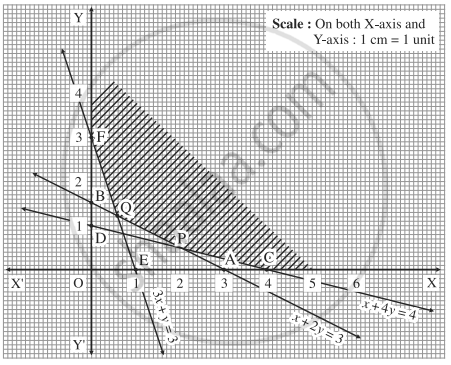
The feasible region is XCPQFY which is shaded in the graph.
The vertices of the feasible region are C(4, 0), P, Q and F (0, 3).
P is the point of intersection of the lines x + 4y = 4 and x + 2y = 3
On subtracting, we get
2y = 1
∴ y = `1/2`
Substituting y = `1/2` in x + 2y = 3, we get
x + 2`(1/2)` = 3
∴ x = 2
∴ P ≡ `(2, 1/2)`
Q is the point of intersection of the lines
x + 2y = 3 ....(1)
and 3x + y = 3 ...(2)
Multiplying equation (1) by 3, we get
3x + 6y = 9
Subtracting equation (2) from this equation, we get
5y = 6
∴ y =`6/5`
∴ from (1), x + 2`(6/5) = 3`
∴ x = `3 - 12/5 = 3/5`
∴ Q ≡ `(3/5,6/5)`
The values of the objective function z = 6x + 21y at these vertices are
z(C) = 6(4) + 21(0) = 24
z(P) = 6(2) + 21`(1/2)`
= 12 + 10.5 = 22.5
z (Q) = `6(3/5) + 21(6/5)`
`= 18/5 + 126/5 = 144/5 = 28.8`
z(F) = 6(0) + 21(3) = 63
∴ z has minimum value 22.5, when x = 2 and y = `1/2`.
