Advertisements
Advertisements
Question
Give two reasons to explain why a reflecting telescope is preferred over a refracting telescope.
Advertisements
Solution
The reflecting telescopes are preferred over the refracting type because of the following reasons:
- There is no chromatic aberration in the case of reflecting telescopes, as the objective is a mirror.
- Spherical aberration is reduced in the case of reflecting telescopes by using a mirror objective in the form of a paraboloid.
APPEARS IN
RELATED QUESTIONS
Use the mirror equation to show that an object placed between f and 2f of a concave mirror produces a real image beyond 2f.
Use the mirror equation to deduce that an object placed between the pole and focus of a concave mirror produces a virtual and enlarged image.
Using mirror formula, explain why does a convex mirror always produce a virtual image.
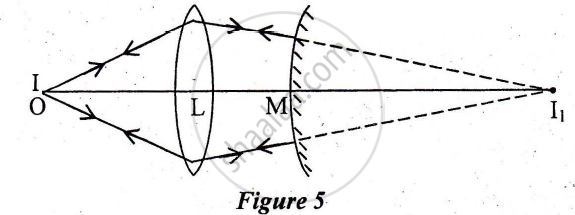
A point object O is placed at a distance of 15cm from a convex lens L of focal length 1 Ocm as shown in Figure 5 below. On the other side of the lens, a convex mirror M is placed such that its distance from the lens is equal to the focal length of the lens. The final image formed by this combination is observed to coincide with the object O. Find the focal length of the convex mirror
The rays of different colours fail to converge at a point after going through a converging lens. This defect is called
Mark the correct options.
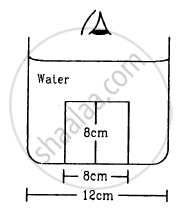
A cylindrical vessel of diameter 12 cm contains 800π cm3 of water. A cylindrical glass piece of diameter 8.0 cm and height 8.0 cm is placed in the vessel. If the bottom of the vessel under the glass piece is seen by the paraxial rays (see figure), locate its image. The index of refraction of glass is 1.50 and that of water is 1.33.
A light ray is incident at an angle of 45° with the normal to a √2 cm thick plate (μ = 2.0). Find the shift in the path of the light as it emerges out from the plate.
An upright object is placed at a distance of 40 cm in front of a convergent lens of a focal length of 20 cm. A convergent mirror of focal length 10 cm is placed at a distance of 60 cm on the other side of the lens. The position and size of the final image will be ______.
Two plane mirrors are inclined at an angle of 40°. The possible number of images of an object placed at point P would be?

