Advertisements
Chapters
*: Bharat Our Land
2: The Pot Maker
*: Gifts of Grace: Honouring Our Vocations
3: Winds of Change
▶ *: Canvas of Soil
4: Vitamin-M
*: I Cannot Remember My Mother
5: The World of Limitless Possibilities
*: Nine Gold Medals
6: Twin Melodies
*: A Friend Found in Music
7: Carrier of Words
*: Words
8: Follow That Dream
*: Believe in Yourself

Advertisements
Solutions for Chapter *: Canvas of Soil
Below listed, you can find solutions for Chapter * of CBSE NCERT for इंग्लिश कावेरी कक्षा ९.
NCERT solutions for इंग्लिश कावेरी कक्षा ९ * Canvas of Soil Reflect and Respond [Pages 86 - 87]
Work in pairs. Discuss what all you see in a garden. Think of the colours you see and where you see them. Share your responses with your teacher.
Look at the picture of a garden and a painting given below. Speak about any similarities between the garden and the painting.
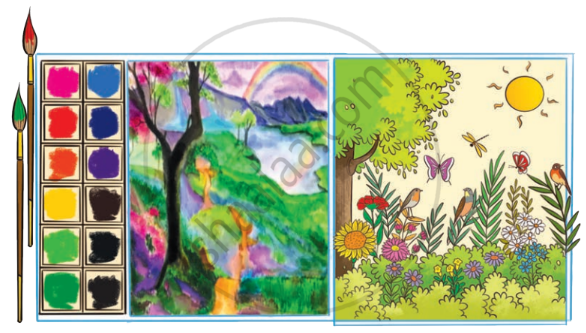
Speak using the following:
- Just as a garden ______, similarly, a painting ______.
- A garden and a painting, both ______.
- ______ is common to both a garden and a painting.
- Like a garden, a painting too ______.
Let us acquaint ourselves with the meanings of palette, hue, and canvas.
- Palette: a thin oval or rectangular board or tablet that a painter holds and mixes colours on.
- Hue: shade of a colour
- Canvas: (here) painting
Now, look at the painting given above and identify palette, canvas, and select a hue.
NCERT solutions for इंग्लिश कावेरी कक्षा ९ * Canvas of Soil Exercise [Pages 87 - 96]
Check Your Understanding:
Read the poem again and complete the summary of each stanza by filling in the blanks.
The ______ is portrayed as a rich palette where gardeners’ __ __ __ a __ s flourish in the form of ______, awaiting spring.
Read the poem again and complete the summary of each stanza by filling in the blanks.
The garden flowers ______ into a beautiful display of different b __ __ __ __ __ m s, resembling a ______ by Mother Nature, in the light of morning.
Read the poem again and complete the summary of each stanza by filling in the blanks.
Each garden is likened to a wide __ __ n __ __ s, integrating art and ______. Through the efforts of gardeners, gardens transform into still-life ______.
Select the appropriate title for each stanza from those given below. There are two extra titles.
- Nature’s Work of Art
- Sweet-smelling Blossoms
- Gardens as Living Canvases
- Earth and Possibilities
- The Painter’s Canvas
Match the poetic devices in Column 1 to the examples in Column 2. Discuss your responses in pairs. Then share the responses with your classmates and teacher.
| Column 1 | Column 2 |
| 1. Imagery [mind pictures] | (i) appreciative |
| 2. Metaphor [comparison without use of ‘like’ or ‘as’] | (ii) AABB |
| 3. Rhyme Scheme | (iii) ‘Blossoms bloom’ |
| 4. Tone [what the poet feels] | (iv) colours, brushstrokes, blossoms, shades of green |
| 5. Mood [what the reader feels] | (v) a gardener |
| 6. Speaker | (vi) garden as a painting, plot as canvas, seeds as brushstrokes |
| 7. Alliteration [same consonant sound] | (vii) joyful |
Critical Reflection:
Read the given extract from the poem and answer the questions that follow.
| Brushstrokes of seeds, planted true, Awaiting spring’s vibrant hue. |
(i) The poet has used a metaphor in ‘Brushstrokes of seeds’. Which option from those given below uses a metaphor?
- Her mother’s heart heard her heartfelt request with kindness.
- She has a heart of gold.
- Her heart did a dance of joy on seeing the new doll.
- She has a very kind heart.
(ii) Complete the sentence appropriately.
The phrase ‘planted true’ is significant because it implies ______.
(iii) Why has the poet used the word ‘hue’ instead of ‘colours’ in the extract?
(iv) Complete the following analogy correctly with a word from the extract.
Summer : hot : : Spring : ______
(v) Read the Assertion (A) and the Reason (R) and select the option that is correctly suited.
(A): Gardeners wait for Spring.
(R): Gardens are worth painting in Spring.
- Both (A) and (R) are true and (R) is the correct explanation of (A).
-
Both (A) and (R) are true but (R) is not the correct explanation of (A).
- (A) is true but (R) is false.
- (A) is false but (R) is true.
Read the given extract from the poem and answer the questions that follow.
| Each plot, a canvas wide, Where art and life coincide. |
(i) What does ‘Each plot’ refer to in this extract?
(ii) Select which option imitates the rhyme scheme of the extract.
- beautiful and clear
laughter and cheer - beautiful and clear
laughter and tears
(iii) Select the line from the extract that conveys that gardening blends aesthetic beauty with natural growth.
(iv) Complete the following sentence appropriately.
The plot is likened to a canvas suggesting that ______.
(v) Why has the poet most likely used the word ‘wide’ instead of ‘long’ in ‘canvas wide’?
Give reason for the comparisons made by the poet in the poem.
A painter is compared to a gardener because.....
Give reason for the comparisons made by the poet in the poem.
A palette is like earth as.....
Give reason for the comparisons made by the poet in the poem.
The brushstrokes are like seeds because.....
Give reason for the comparisons made by the poet in the poem.
A canvas is similar to a garden plot as.....
Answer the following questions.
How does the metaphor ‘Brushstrokes of seeds’, enhance the understanding of gardening as an art form?
What can you infer about the poet’s perspective on the relationship between nature and creativity from the following lines?
‘Each plot, a canvas wide,/Where art and life coincide.’
Do you think the imagery in the poem successfully paints a vivid picture in the reader’s mind? If yes, why? If no, why not?
Support the view that the poet’s mention of the colour yellow, besides red, blue and green, would have lent effectively to the imagery.
Considering the line ‘Gardens become paintings still’, what can you interpret about the poet’s view on the timelessness of nature’s beauty?
Justify the title of the poem, ‘Canvas of Soil’.
Vocabulary in Context:
The poet refers to the shades of green, red, and blue in the poem. Let us read some of the names of different shades of these colours.
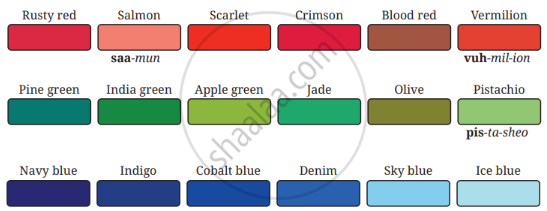
Now, Discuss in pairs, any two things that you can associate with these colours.
You have studied painting-related words like palette, brushstrokes, shades, hue, colours, and canvas. Now, read the following paragraph and discuss in pairs what the underlined painting-related words might mean. Discuss this way:
I think ______ means ______ because the passage talks about ______.
Example: I think portrait means a picture of someone’s face because the passage talks about capturing a friend’s features.
In the art studio, young painters eagerly approached their easels, each framing a canvas that they had to work on. The teacher encouraged them to experiment with a diverse tonal range, playing with shades and hues to bring their paintings to life. One student focused on a detailed portrait, capturing his friend’s features, first with careful underpainting and then filling the final colours. Another student worked on a mural, depicting a Spring Day on the right wall of the classroom. The room continued to buzz with artistic energy.
Listen and Respond:
You will listen to a young girl describe her school garden. As you listen identify which of the following 1-3, she does not talk about.
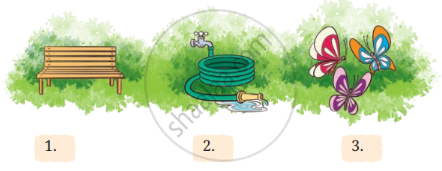
You will once again listen to the young girl. As you listen, select the correct answer from the options given below.
The colour of flowers in the first row.
white
red
pink
You will once again listen to the young girl. As you listen, select the correct answer from the options given below.
The type of flowers in the second row.
marigold
jasmine
rose
You will once again listen to the young girl. As you listen, select the correct answer from the options given below.
Position of the type of the useful plants.
left corners
right corners
left and right corners
You will once again listen to the young girl. As you listen, select the correct answer from the options given below.
The number of potted evergreen plants
15
20
25
You will once again listen to the young girl. As you listen, select the correct answer from the options given below.
The paint colour on the bricks bordering the garden.
black and white
red and black
white and red
You will once again listen to the young girl. As you listen, select the correct answer from the options given below.
Type of tree in the centre of the garden
neem
peepal
banyan
You will once again listen to the young girl. As you listen, select the correct answer from the options given below.
Things created with waste material.
dustbins
plant name boards
bird houses
Speaking Activity:
People wish to have a garden at home. Some like a flower garden and some a vegetable garden. Think and note some advantages of both these types, as gardens for homes.
Would you like to have a flower garden or a vegetable garden at home? Why?
Take turns with your partner and speak your points aloud, one by one, by using the given sentence prompts to express your preference, with reasons.
- I prefer ______ to ______ because...
- For me, it is a ______ instead of a ______ due to...
- If I had a choice I’d rather have a ______ than a ______ as...
- I would prefer ______ rather than ______ since...
Writing Task:
Write a descriptive piece of two to three paragraphs describing the details and colours in the garden you have visited.
- Focus on how different shades of blue, red, and green interact, create contrast, and bring the garden to life.
- Pay attention to details like the texture of petals, the varying greens of leaves, and the way light affects the colours.
Learning Beyond the Text: Mini-Project:
- Do research and collect information on any FIVE famous gardens of India, such as Amrit Udyan, Brindavan Gardens, and many others.
- Focus on history, design elements, and cultural significance.
- Prepare a short report and make a presentation.
- Explore various art forms (painting, sculpture) inspired by gardens. Select an art piece and analyse how the garden is represented.
- Create a visual or written response inspired by the garden.
Design your own garden
- Design a garden on paper or using digital tools.
- Incorporate elements and artistic inspirations learned from parts (1)/(2).
- Present your choices in design and artistic influences to the class.
Interview with a Gardener or Landscaping Expert
- Approach a local gardener or a landscaping expert for an interview.
- Prepare questions focussed on understanding the practical aspects of gardening/landscaping.
- Write a summary of your experience.
You must have read poems and songs about beauty of nature and different seasons in English and in your own language. Now, read and enjoy the poem given below.
Solutions for *: Canvas of Soil
NCERT solutions for इंग्लिश कावेरी कक्षा ९ chapter * - Canvas of Soil
Shaalaa.com has the CBSE Mathematics इंग्लिश कावेरी कक्षा ९ CBSE solutions in a manner that help students grasp basic concepts better and faster. The detailed, step-by-step solutions will help you understand the concepts better and clarify any confusion. NCERT solutions for Mathematics इंग्लिश कावेरी कक्षा ९ CBSE * (Canvas of Soil) include all questions with answers and detailed explanations. This will clear students' doubts about questions and improve their application skills while preparing for board exams.
Further, we at Shaalaa.com provide such solutions so students can prepare for written exams. NCERT textbook solutions can be a core help for self-study and provide excellent self-help guidance for students.
Concepts covered in इंग्लिश कावेरी कक्षा ९ chapter * Canvas of Soil are .
Using NCERT इंग्लिश कावेरी कक्षा ९ solutions Canvas of Soil exercise by students is an easy way to prepare for the exams, as they involve solutions arranged chapter-wise and also page-wise. The questions involved in NCERT Solutions are essential questions that can be asked in the final exam. Maximum CBSE इंग्लिश कावेरी कक्षा ९ students prefer NCERT Textbook Solutions to score more in exams.
Get the free view of Chapter *, Canvas of Soil इंग्लिश कावेरी कक्षा ९ additional questions for Mathematics इंग्लिश कावेरी कक्षा ९ CBSE, and you can use Shaalaa.com to keep it handy for your exam preparation.
