Go around your area and survey the rocks. Write down your observations.
Advertisements
Chapters
UNIT 1 - Our World
1: Earth as a Planet
2: Geographic Grid: Latitudes and Longitudes
3: Rotation and Revolution
UNIT 2 - Structure of the Earth
4: Earth’s Structure
5: Landforms of the Earth
▶ 6: Rocks
7: Volcanoes
8: Earthquakes
9: Weathering
10: Denudation
UNIT 3 - Hydrosphere
11: Hydrosphere
UNIT 4 - Atmosphere
12: Composition and Structure of the Atmosphere
13: Insolation
14: Atmospheric Pressure and Winds
15: Humidity
UNIT 5 - Pollution
16: Pollution
17: Sources of Pollution
18: Effects of Pollution
19: Preventive Measures
UNIT 6 - Natural Regions of the World
20: Natural Regions of the World
1: Earth as a Planet
2: Geographic Grid: Latitudes and Longitudes
3: Rotation and Revolution
UNIT 2 - Structure of the Earth
4: Earth’s Structure
5: Landforms of the Earth
▶ 6: Rocks
7: Volcanoes
8: Earthquakes
9: Weathering
10: Denudation
UNIT 3 - Hydrosphere
11: Hydrosphere
UNIT 4 - Atmosphere
12: Composition and Structure of the Atmosphere
13: Insolation
14: Atmospheric Pressure and Winds
15: Humidity
UNIT 5 - Pollution
16: Pollution
17: Sources of Pollution
18: Effects of Pollution
19: Preventive Measures
UNIT 6 - Natural Regions of the World
20: Natural Regions of the World
![Morning Star solutions for टोटल जियोग्राफी [इंग्रजी] इयत्ता ९ आयसीएसई chapter 6 - Rocks - Shaalaa.com](/images/total-geography-english-class-9-icse_6:383837e303f247e39353ecf0a3404fb4.jpg "Morning Star solutions for टोटल जियोग्राफी [इंग्रजी] इयत्ता ९ आयसीएसई chapter 6 - Rocks")
Advertisements
Solutions for Chapter 6: Rocks
Below listed, you can find solutions for Chapter 6 of CISCE Morning Star for टोटल जियोग्राफी [इंग्रजी] इयत्ता ९ आयसीएसई.
EXERCISES
EXERCISES [Pages 62 - 65]
Morning Star solutions for टोटल जियोग्राफी [इंग्रजी] इयत्ता ९ आयसीएसई 6 Rocks EXERCISES [Pages 62 - 65]
Choose the correct option:
An aggregate of minerals, with no definite chemical composition, that forms more or less a definite unit of the earth’s crust:
Rock
Mineral
Crust
Metamorphosis
The magma, when forced upwards, fills vertical cracks or fissures in existing rocks, and it then hardens there to form ______.
Necks
Sills
Dykes
Laccoliths
With reference to Intrusive Igneous Rocks which of the following is incorrect?
Batholiths – deep-seated large deposits of igneous rocks like graphite.
Hypobyssal Rocks – small rock deposits.
Neck – a plug at the top of a volcano.
Dykes – large deposits of cooled magma on the earth’s surface.
The process that turns loose sediments into rocks:
Compaction
Lithification
Cementation
None of the above
The bonding together of compacted sediments by natural bonding materials such as calcium compounds, silica, and iron:
Compaction
Lithification
Cementation
None of the above
Transported sediments get deposited in layers, leading to increased pressure and temperature on the lower layers. Select the correct sequence of processes involved in the lithification of these sediments.
Compaction – Evaporation – Cementation.
Evaporation – Compaction – Cementation.
Evaporation – Cementation – Compaction.
Evaporation – Dehydration – Cementation.
Sam was working under a geologist. He lost his balance and dropped the bags containing igneous rocks and sedimentary rocks, and the rocks got mixed. How would he separate them?
Igneous rocks are hard.
Igneous rocks are crystalline.
Sedimentary rocks have strata showing layers.
Sedimentary rocks are soft.
Assertion (A): Igneous rocks are called primary rocks.
Reason (R): They were the first to be formed.
Both A and R are true, and R is the correct explanation of A.
Both A and R are true, but R does not explain A.
A is true, but R is false.
A is false, but R is true.
The rocks, like peat, lignite, bituminous, and anthracite, are examples of ______.
Igneous rocks
Mechanical rocks
Metallic rocks
Carbonaceous rocks
The following pairs are the types of rocks on the basis of the agents of their formation. Which of the following is incorrect?
Lacustrine : lake beds
Aeolian : sand particles
Glacial : ocean floor
Riverine : flowing waters of rivers
The alteration of the composition or structure of a rock by heat, pressure, or other natural agency:
Hypobyssal
Metamorphism
Compaction
Compaction
Assertion (A): Igneous rocks are of interest to builders and sculptors.
Reason (R): Igneous rocks are usually compact.
Both A and R are true, and R is the correct explanation of A.
Both A and Rare true, but R does not explain A.
A is true, but R is false.
A is false, but R is true.
The transformation of rocks into metamorphic rocks takes place as a result of intense heat and pressure. Given below are the types of metamorphism and the processes involved. Which one is incorrect?
Thermal Metamorphism : high temperature.
Dynamic Metamorphism : pressure at great depths in the crust.
Regional Metamorphism : large scale earth movement.
Contact Metamorphism : high pressure below the ocean bed.
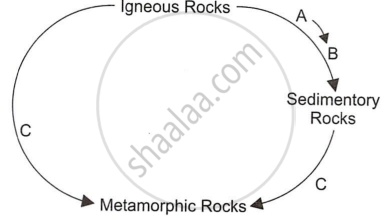
Study the diagram and identify A, B, and C.
A: action of agents of weathering B: deposition-sedimentation C: action of heat and pressure
A: deposition-sedimentation B: action of agents of weathering C: action of heat and pressure
A: deposition-sedimentation B: action of heat and pressure C: action of agents of weathering
A: action of heat and pressure B: action of agents of weathering C: deposition-sedimentation
The continuous process of transformation of old rocks into new ones:
Metamorphism
Rock flow
Rock cycle
Compaction
______ are deep-seated intrusion of igneous rocks.
Sills
Dykes
Laccoliths
Batholiths
Your sister had gone camping in Uttarakhand. She was fascinated with the smooth striated rocks she had collected. What type of rocks had she brought home with her?
Igneous rocks
Sedimentary rocks
Metamorphic rocks
Both Igneous rocks and Metamorphic rocks
Which of the following is NOT an organically formed rock?
Gypsum
Peat
Chalk
Limestone
Limestone is a mono-mineralic rock (i.e. a rock mainly made of a single mineral) of calcite. Glacier ice is actually a mono-mineralic rock. It is composed of which mineral?
Water
Carbon
Silica
Iron
Short Answer Questions
State two points of distinction between rocks and minerals.
Name three types of rocks.
Give one difference between Extrusive igneous and Intrusive igneous rocks.
Name any two characteristics of Igneous Rocks.
State two characteristics of Basic Igneous Rocks.
Name two important rock forms made by Igneous Rocks.
What is sills?
Give an example of Sills.
Which rocks are associated with ores of metals?
Which rocks are associated with fossil fuels?
Mention any two characteristics of Sedimentary Rocks.
Name the rocks which are most widespread on the earth.
Give two examples of rocks which are most widespread on the Earth.
Name the three stages of lithification of Sedimentary rocks.
Name the types Sedimentary rocks based on agents of formation.
Which agents are responsible for deposition of sediments?
What are known as metamorphic rocks?
Give two examples of metamorphic rocks.
Briefly define Mechanical Metamorphism.
Distinguish between the following:
Plutonic and Volcanic rocks.
Distinguish between the following:
Thermal and Dynamic Metamorphism.
Distinguish between the following:
Sills and Dykes.
Distinguish between the following:
Calcarious and Carbonacious rocks.
Distinguish between the following:
Acid Igneous Rocks and Basic Igneous Rocks.
Structured Questions
Distinguish between rocks and minerals.
Describe how igneous rocks are formed.
Name any two characteristics of Igneous Rocks.
Give reasons for the following:
Igneous rocks are also called Primary Rocks or Mother Rocks.
Give a reason for the following:
Igneous rocks are used by builders and sculptors.
Give a reason for the following:
Sedimentary rocks are called secondary rocks.
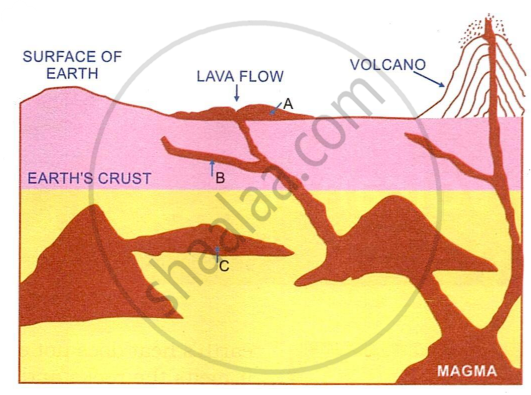
Study the picture. Identify the rocks formed in the case of A, B, and C. Give reasons to support your answer.
How are sedimentary rocks formed?
Explain the formation of sedimentary rocks on the basis of agents of formation.
Give a reason for the following:
Mechanically formed sedimentary rocks are also termed asstratified rocks.
Give a reason for the following:
Rocks like peat, lignite and anthracite are called carbonaceous rocks.
Give a reason for the following:
Fossils are present in sedimentary rocks.
What is metamorphism?
What are the causes of metamorphism?
Give an example of rocks formed by heat and pressure.
State the chief characteristics of metamorphic rocks.
State the economic significance of rocks.
What is meant by rock cycle?
How does the Rock Cycle keep the Earth young?
Draw a well labelled diagram of rock cycle.
Thinking Skills
The stone tools were quite significant in the growth and development of human civilisation. Are the rocks still important to humans today? Give reasons to support your answer.
Do you think the minerals in a rock provide an important clue about how the rock was formed? Give reasons to support your answer.
‘The rock cycle has no beginning and no end.’ Justify this statement with examples.
Project/Activity
Rock collection is a great hobby. Collect rock samples from different places and name them.
Solutions for 6: Rocks
EXERCISES
Morning Star solutions for टोटल जियोग्राफी [इंग्रजी] इयत्ता ९ आयसीएसई chapter 6 - Rocks
Shaalaa.com has the CISCE Mathematics टोटल जियोग्राफी [इंग्रजी] इयत्ता ९ आयसीएसई CISCE solutions in a manner that help students grasp basic concepts better and faster. The detailed, step-by-step solutions will help you understand the concepts better and clarify any confusion. Morning Star solutions for Mathematics टोटल जियोग्राफी [इंग्रजी] इयत्ता ९ आयसीएसई CISCE 6 (Rocks) include all questions with answers and detailed explanations. This will clear students' doubts about questions and improve their application skills while preparing for board exams.
Further, we at Shaalaa.com provide such solutions so students can prepare for written exams. Morning Star textbook solutions can be a core help for self-study and provide excellent self-help guidance for students.
Concepts covered in टोटल जियोग्राफी [इंग्रजी] इयत्ता ९ आयसीएसई chapter 6 Rocks are .
Using Morning Star टोटल जियोग्राफी [इंग्रजी] इयत्ता ९ आयसीएसई solutions Rocks exercise by students is an easy way to prepare for the exams, as they involve solutions arranged chapter-wise and also page-wise. The questions involved in Morning Star Solutions are essential questions that can be asked in the final exam. Maximum CISCE टोटल जियोग्राफी [इंग्रजी] इयत्ता ९ आयसीएसई students prefer Morning Star Textbook Solutions to score more in exams.
Get the free view of Chapter 6, Rocks टोटल जियोग्राफी [इंग्रजी] इयत्ता ९ आयसीएसई additional questions for Mathematics टोटल जियोग्राफी [इंग्रजी] इयत्ता ९ आयसीएसई CISCE, and you can use Shaalaa.com to keep it handy for your exam preparation.
