Advertisements
Chapters
1: Microeconomics and Macroeconomics: Introduction
2: Demand and Law of Demand
3: Theory of Consumer Behaviour: Marginal Utility and Indifference Curve Analysis
4: Elasticity of Demand
5: Supply - Law of Supply and Price Elasticity of Supply
▶ 6: Market Mechanism: Equilibrium Price and Quantity in a Competitive Market
7: Laws of Returns - Returns to a Factor and Returns to Scale
8: Cost and Revenue Analysis
9: Forms of Market
10: Producer's Equilibrium
11: Determination of Equilibrium Price and Output Under Perfect Competition
SECTION 2: THEORY OF INCOME AND EMPLOYMENT
12: Theory of Income and Employment
SECTION 3: MONEY AND BANKING
13: Money: Meaning and Functions
14: Banks: Commercial Bank and Central Bank
SECTION 4: BALANCE OF PAYMENTS AND EXCHANGE RATE
15: Balance of Payments and Exchange Rate
SECTION 5: PUBLIC FINANCE
16: Fiscal Policy
17: Government Budget
SECTION 6: NATIONAL INCOME
18: National Income and Circular Flow of Income
19: National Income Aggregates
20: Methods of Measuring National Income
SECTION 7: PROJECT WORK
21: Project Work
22: Model Short Answer Questions
![Frank solutions for इकॉनॉमिक्स [इंग्रजी] इयत्ता १२ आईएससी chapter 6 - Market Mechanism: Equilibrium Price and Quantity in a Competitive Market - Shaalaa.com](/images/economics-english-class-12-isc_6:872f47036b5c4267ae061d4279703803.jpg "Frank solutions for इकॉनॉमिक्स [इंग्रजी] इयत्ता १२ आईएससी chapter 6 - Market Mechanism: Equilibrium Price and Quantity in a Competitive Market")
Advertisements
Solutions for Chapter 6: Market Mechanism: Equilibrium Price and Quantity in a Competitive Market
Below listed, you can find solutions for Chapter 6 of CISCE Frank for इकॉनॉमिक्स [इंग्रजी] इयत्ता १२ आईएससी.
Frank solutions for इकॉनॉमिक्स [इंग्रजी] इयत्ता १२ आईएससी 6 Market Mechanism: Equilibrium Price and Quantity in a Competitive Market TEST YOURSELF QUESTIONS [Pages 118 - 123]
Select the correct option for each of the following questions: (1 mark each)
In a competitive market, the equilibrium price is determined when ______.
market demand is equal to market supply
market demand is greater than market supply
market demand is less than market supply
none of these
What is determined at the point of intersection of the market demand and market supply curves?
Equilibrium price
Equilibrium quantity
both of these
none of these
If the quantity demanded of a commodity in the market exceeds the quantity supplied at a particular price, such a situation is known as ______.
excess demand
excess supply
equilibrium level of output
none of these
If the quantity supplied of a commodity in the market is more than the quantity demanded, such a situation is known as ______.
excess demand
excess supply
equilibrium level of output
none of these
An increase in the demand for a commodity (rightward shift of the demand curve) would result in ______.
an increase in equilibrium price only
an increase in equilibrium quantity only
increase in both equilibrium price and equilibrium quantity
decrease in equilibrium quantity
An increase in the supply of a commodity (rightward shift of supply curve) causes ______.
decrease in equilibrium price and increase in equilibrium quantity
increase in equilibrium price
decrease in equilibrium quantity
no change
What will be the effect on equilibrium price and quantity when increase in demand is equal to increase in supply?
Equilibrium price will increase
Equilibrium quantity will fall
Equilibrium price will fall
Price will remain unchanged, but equilibrium quantity will increase
What will be the effect upon equilibrium price when an increase in demand is greater than increase in supply?
Equilibrium price remains unchanged
Equilibrium price rises
Equilibrium price falls
None of these
When the government intervenes in the functioning of the market by fixing a ‘price ceiling’ of an essential commodity to protect the interest of the consumers, at what level the price ceiling must be fixed to be meaningful:
equal to the equilibrium price
higher than equilibrium price
lower than equilibrium price
it does not matter at what level
When the government intervenes in the functioning of the market to protect the interest of the farmers by fixing the floor price (minimum support price) at which the traders have to buy the food-grains from them, the price is fixed at the level of ______.
equal to equilibrium price
higher than the equilibrium price
lower than the equilibrium price
it does not matter at what level
Which of the following statements is correct in case of price ceiling of a commodity fixed by the government?
It is the maximum legal price
It is fixed below the equilibrium price
It will create the shortage of the commodity
All the three
Which of the following statements is true about the policy of the government of fixing the minimum support price of the agricultural commodities?
It is the floor price
It provides renumeration price to the farmers
It is fixed above the market price
All of these
From the following statements given in Column I and Column II, choose the correct pair of statements.
| Column I | Column II |
| A. Equilibrium price | 1. The price at which the quantity demanded of a commodity equals the quantity supplied |
| B. Floor price | 2. Maximum legal price of a commodity which the sellers can charge |
| C. Price ceiling | 3. Minimum price at which the sellers may sell a particular good or service |
A - 1, B - 3, C - 2
A - 1, B - 2, C - 3
A - 2, B - 3, C - 1
Given below are two statements marked as Assertion (A) and Reason(R). Read the statements carefully and choose the correct option.
Assertion (A): Excess demand for a commodity exists when price is less than the equilibrium price.
Reason (R): When market price is less than the equilibrium price, quantity demanded exceeds the quantity supplied.
Both Assertion (A) and Reason (R) are true, and Reason (R) is the correct explanation of Assertion (A).
Both Assertion (A) and Reason (R) are true, but Reason (R) is not the correct explanation of Assertion (A).
Assertion (A) is true, but Reason (R) is false.
Assertion (A) is false, but Reason (R) is true.
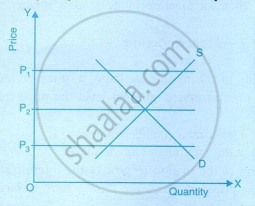
In figure given below, mark the equilibrium price, floor price and ceiling price.
Very Short Answer Questions (2 marks each)
Define equilibrium.
What is the equilibrium price?
When is market said to be in a state of equilibrium?
What is equilibrium quantity?
Define excess demand.
What is excess supply?
What is a stable equilibrium?
‘Demand and supply are two blades of a scissor.’ Explain.
Which is more important in determining equilibrium price, demand or supply?
Distinguish between the excess demand and excess supply.
What is ‘excess demand’?
What is excess demand’s impact on the equilibrium output and price?
What is the equilibrium price?
What changes may take place in the market when the prevailing price is greater than the equilibrium price?
What happens to the equilibrium price of a good when demand for that good increases?
What happens to the equilibrium price of a good when supply of that good increases?
Show with the help of diagrams the effect on equilibrium price and quantity when there is a fall in the price of substitute goods.
Show with the help of a diagram the effect on equilibrium price and quantity when there is a rise in the prices of inputs.
What would be the effect on equilibrium price when demand and supply increase by the same magnitude?
With the help of a diagram, illustrate the effect of a simultaneous and proportional decrease in demand and supply on equilibrium price and quantity.
When will an increase in demand lead to an increase in price but no change in the quantity supplied?
When will a change in demand have no impact on the equilibrium price of a commodity? Show with the help of a diagram.
When will an increase in demand lead to an increase in price but no change in the quantity supplied?
When will a change in supply will have no effect on the price of a commodity?
When does changes in supply have no effect on the equilibrium quantity?
With the help of a diagram, show how equilibrium price and quantity of a commodity are affected when demand is perfectly elastic and supply decreases.
With the help of a diagram, show how equilibrium price and quantity of a commodity are affected when supply is perfectly elastic and demand increases.
What is price ceiling?
Explain price ceiling with the help of a diagram.
Explain price ceiling with the help of a diagram.
What is floor price?
Illustrate the floor price diagrammatically.
Differentiate between price ceiling and floor price.
Why is price ceiling resorted by the government?
What is meant by black-marketing?
Why is a price floor followed by the government?
Give some examples of fixation of price floor in India.
What is meant by buffer stock?
Short Answer Questions (3 marks each)
Explain diagrammatically how equilibrium price and equilibrium quantity are affected by changes in the demand for a commodity, with the supply remaining constant.
Given the following information, identify the equilibrium price and quantity.
| Price (₹) |
Demand (Units) |
Supply (Units) |
| 10 | 1000 | 5000 |
| 9 | 2000 | 4000 |
| 8 | 3000 | 3000 |
| 7 | 4000 | 2000 |
What will happen if the market price is:
- ₹ 10
- ₹ 7
Explain what happens when the market price is less than the equilibrium price.
Explain what happens when the market price is more than the equilibrium price.
With the help of diagrams, show the effect of a change in demand (or shift in demand curves) on equilibrium price and quantity of a commodity when Supply curve is perfectly elastic.
With the help of diagrams, show the effect of a change in demand (or shift in demand curves) on equilibrium price and quantity of a commodity when the supply curve is perfectly inelastic.
Using diagrams, explain when equilibrium price does not change with a change in supply.
Explain the concept of Maximum Price Legislation with the help of a diagram.
What is floor price?
Explain the floor price impact on producers.
Long Answer Questions (6 marks each)
What is the equilibrium price?
How is equilibrium price determined? Show it diagrammatically.
What is meant by equilibrium?
What is the equilibrium price?
Illustrate, using appropriate diagrams, the effect of change in demand on equilibrium price.
Explain the determination of price of a commodity in a competitive market with the help of a diagram. What will happen if price is more than the equilibrium price?
Explain the determination of the price of a commodity in a competitive market with the help of a diagram. What will happen if the price is less than the equilibrium price?
Explain how equilibrium price can be determined with the help of demand and supply schedules.
Explain how the equilibrium price can be determined with the help of demand and supply curves.
Show, with the help of a diagram, the effect of the following change on the equilibrium price:
When the demand for a commodity alone increases.
Show, with the help of a diagram, the effect of the following change on the equilibrium price:
When the supply of a commodity alone increases.
How is equilibrium price determined? Show it diagrammatically.
How is equilibrium price affected by changes in demand for the commodity (shift in demand curves)?
How is the equilibrium price of a commodity affected by changes in its supply (shift in supply curves)?
Changes in both demand and supply of a commodity may or may not affect its equilibrium price. Explain.
Why will the equilibrium price of a commodity not change even if its demand and supply both increase? Explain with the help of a diagram.
Explain the effect of a simultaneous increase in both demand and supply on equilibrium price and quantity.
Why will the equilibrium price of a commodity not change even if its demand and supply both increase? Explain with the help of a diagram.
Explain with the help of diagrams how equilibrium price and quantity change when both demand and supply decrease (both demand and supply curves shift to the left).
With the help of a diagram, show the effect of a change in supply (or shift in supply curves) on the price and quantity sold in the following situation:
When the demand curve is perfectly inelastic.
With the help of a diagram, show the effect of a change in supply (or shift in supply curves) on the price and quantity sold in the following situation:
When the demand curve is perfectly elastic.
With the help of diagrams, show the effect of a change in demand (or shift in demand curves) on equilibrium price and quantity of a commodity when Supply curve is perfectly elastic.
With the help of diagrams, show the effect of a change in demand (or shift in demand curves) on equilibrium price and quantity of a commodity when the supply curve is perfectly inelastic.
How do the following affect the equilibrium price and quantity? Show graphically.
A change in consumers’ tastes in favour of the product
How do the following affect the equilibrium price and quantity? Show graphically.
A reduction in consumers’ income
How do the following affect the equilibrium price and quantity? Show graphically.
An increase in the price of complementary goods.
Show with the help of diagrams the effect on equilibrium price and quantity when there is a fall in the price of substitute goods.
Show with the help of a diagram the effect on equilibrium price and quantity when there is a rise in the prices of inputs.
What is the effect of price ceiling on equilibrium price and output?
How is the problem of allocating limited supply tackled?
Explain the rationale of the policy of fixation of floor price.
Explain the implication of the policy of fixation of floor price.
Thinking Beyond...
From a demand function Qd = 2000 − 30 P and a supply function Qs = 20 P, find out
- equilibrium price
- equilibrium quantity
Suppose the wages of labourers in an economy are low because of excess supply of labour. In order to help the labourers, the government enacts a legislation to fix minimum wages above the equilibrium level as determined by the free play of the market forces of demand and supply. Explain the implications of such a policy with the help of an appropriate diagram.
Solutions for 6: Market Mechanism: Equilibrium Price and Quantity in a Competitive Market
Frank solutions for इकॉनॉमिक्स [इंग्रजी] इयत्ता १२ आईएससी chapter 6 - Market Mechanism: Equilibrium Price and Quantity in a Competitive Market
Shaalaa.com has the CISCE Mathematics इकॉनॉमिक्स [इंग्रजी] इयत्ता १२ आईएससी CISCE solutions in a manner that help students grasp basic concepts better and faster. The detailed, step-by-step solutions will help you understand the concepts better and clarify any confusion. Frank solutions for Mathematics इकॉनॉमिक्स [इंग्रजी] इयत्ता १२ आईएससी CISCE 6 (Market Mechanism: Equilibrium Price and Quantity in a Competitive Market) include all questions with answers and detailed explanations. This will clear students' doubts about questions and improve their application skills while preparing for board exams.
Further, we at Shaalaa.com provide such solutions so students can prepare for written exams. Frank textbook solutions can be a core help for self-study and provide excellent self-help guidance for students.
Concepts covered in इकॉनॉमिक्स [इंग्रजी] इयत्ता १२ आईएससी chapter 6 Market Mechanism: Equilibrium Price and Quantity in a Competitive Market are Applications of Tools of Demand and Supply Price Control, Effects of Changes (Shifts) in Demand on Equilibrium Price and Equilibrium Quantity, Equilibrium Price and Quantity in a Competitive Market, Effects of Simultaneous Changes (Shifts) in Demand and Supply, Some Special Cases of Equilibrium, Basic Concepts of Equilibrium and Equilibrium Price, Effects of Changes (Shifts) in Supply on Equilibrium Price and Equilibrium Quantity, Mаximum Price Legislation or Price Ceiling and Rationing, Minimum Price Legislation or Floor Price, Introduction to Market Mechanism, Changes in Equilibrium, Importance of the Element in the Determination of Price, Important Areas of Applications of Tools of Demand and Supply Curves, Meaning of Perfect Competition, Assumptions and Conditions of Perfect Competition, Pure and Perfect Competition, Time Element in the Theory of Price Determination, Determination of Equilibrium Prices, Normal Price and Law of Returns, Comparison between Market Price and Normal Price, Practical Applications of Tools of Demand and Supply Analysis.
Using Frank इकॉनॉमिक्स [इंग्रजी] इयत्ता १२ आईएससी solutions Market Mechanism: Equilibrium Price and Quantity in a Competitive Market exercise by students is an easy way to prepare for the exams, as they involve solutions arranged chapter-wise and also page-wise. The questions involved in Frank Solutions are essential questions that can be asked in the final exam. Maximum CISCE इकॉनॉमिक्स [इंग्रजी] इयत्ता १२ आईएससी students prefer Frank Textbook Solutions to score more in exams.
Get the free view of Chapter 6, Market Mechanism: Equilibrium Price and Quantity in a Competitive Market इकॉनॉमिक्स [इंग्रजी] इयत्ता १२ आईएससी additional questions for Mathematics इकॉनॉमिक्स [इंग्रजी] इयत्ता १२ आईएससी CISCE, and you can use Shaalaa.com to keep it handy for your exam preparation.
