Advertisements
Advertisements
Write the symbolic form of the following switching circuit construct its switching table and interpret it.
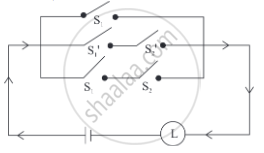
Concept: undefined >> undefined
Write the symbolic form of the following switching circuit construct its switching table and interpret it.
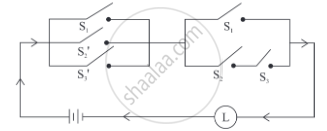
Concept: undefined >> undefined
Advertisements
Obtain the simple logical expression of the following. Draw the corresponding switching circuit.
p ∨ (q ∧ ∼ q)
Concept: undefined >> undefined
Obtain the simple logical expression of the following. Draw the corresponding switching circuit.
(∼ p ∧ q) ∨ (∼ p ∧ ∼ q) ∨ (p ∧ ∼ q)
Concept: undefined >> undefined
Obtain the simple logical expression of the following. Draw the corresponding switching circuit.
[p ∨ ( ∼ q) ∨ (∼ r)] ∧ [p ∨ (q ∧ r)]
Concept: undefined >> undefined
Obtain the simple logical expression of the following. Draw the corresponding switching circuit.
(p ∧ q ∧ ∼ p) ∨ (∼ p ∧ q ∧ r) ∨ (p ∧ ∼ q ∧ r) ∨ (p ∧ q ∧ r)
Concept: undefined >> undefined
Express the following circuit in the symbolic form. Prepare the switching table:
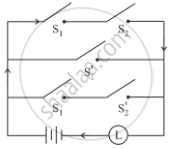
Concept: undefined >> undefined
Express the following circuit in the symbolic form. Prepare the switching table:
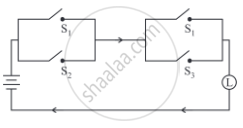
Concept: undefined >> undefined
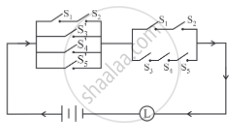
Simplify the following so that the new circuit has a minimum number of switches. Also, draw the simplified circuit.
Concept: undefined >> undefined
Check whether the following switching circuits are logically equivalent - Justify.
(i)
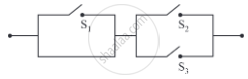
(ii)
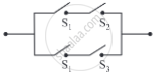
Concept: undefined >> undefined
Check whether the following switching circuits are logically equivalent - Justify.
(i)
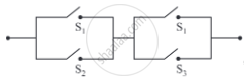
(ii)
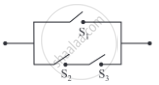
Concept: undefined >> undefined
Give alternative arrangement of the switching following circuit, has minimum switches.
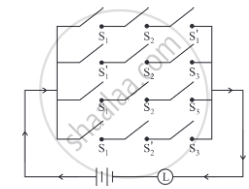
Concept: undefined >> undefined
Simplify the following so that the new circuit.
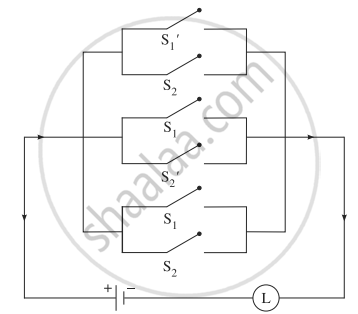
Concept: undefined >> undefined
Represent the following switching circuit in symbolic form and construct its switching table. Write your conclusion from the switching table.
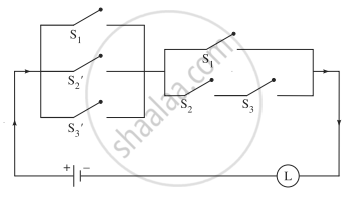
Concept: undefined >> undefined
Simplify the given circuit by writing its logical expression. Also, write your conclusion.

Concept: undefined >> undefined
Construct the switching circuit for the following logical statement:
(p ∨ ∼ q) ∨ (q ∧ r). Also construct the switching circuit for its simplified form.
Concept: undefined >> undefined
Find the alternative arrangement using minimum switches for the following switching circuit.

Concept: undefined >> undefined
