Please select a subject first
Advertisements
Advertisements
Answer in short.
State the laws of kinetic friction.
Concept: undefined >> undefined
Answer in short.
State advantages of friction.
Concept: undefined >> undefined
Advertisements
State disadvantages of friction.
Concept: undefined >> undefined
Long answer type question.
Define coefficient of static friction and coefficient of kinetic friction. Give the necessary formula for each.
Concept: undefined >> undefined
Calculate the coefficient of static friction for an object of mass 50 kg placed on horizontal table pulled by attaching a spring balance. The force is increased gradually it is observed that the object just moves when spring balance shows 50 N.
Concept: undefined >> undefined
Answer the following.
A block of mass 37 kg rests on a rough horizontal plane having coefficient of static friction 0.3. Find out the least force required to just move the block horizontally.
Concept: undefined >> undefined
A body of mass 37 kg rests on a rough horizontal surface. The minimum horizontal force required to just start the motion is 68.5 N. In order to keep the body moving with constant velocity, a force of 43 N is needed. What is the value of coefficient of static friction?
Concept: undefined >> undefined
The internal resistance of a cell of emf 2 V is 0.1 Ω it is connected to a resistance of 0.9 Ω. The voltage across the cell will be ______.
Concept: undefined >> undefined
Solve the following problem.
A battery after a long use has an emf 24 V and an internal resistance 380 Ω. Calculate the maximum current drawn from the battery? Can this battery drive starting motor of car?
Concept: undefined >> undefined
Solve the following problem.
A battery of emf 12 V and internal resistance 3 Ω is connected to a resistor. If the current in the circuit is 0.5 A,
- Calculate resistance of resistor.
- Calculate terminal voltage of the battery when the circuit is closed.
Concept: undefined >> undefined
Answer the following question.
Describe what is meant by order of magnitude.
Concept: undefined >> undefined
Justify the statement, “Work and energy are the two sides of a coin.”
Concept: undefined >> undefined
Answer the following question.
From the terrace of a building of height H, you dropped a ball of mass m. It reached the ground with speed v. Is the relation mgh = `1/2"mv"^2` applicable exactly? If not, how can you account for the difference? Will the ball bounce to the same height from where it was dropped?
Concept: undefined >> undefined
100 cells each of emf 5 V and internal resistance 1 Ω are to be arranged so as to produce maximum current in a 25 Ω resistance. Each row contains equal number of cells. The number of rows should be ______.
Concept: undefined >> undefined
Choose the correct alternative.
Five dry cells each of voltage 1.5 V are connected as shown in the diagram
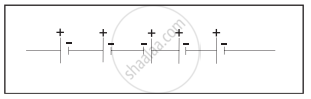
What is the overall voltage with this arrangement?
Concept: undefined >> undefined
Give reason/short answer.
In the given circuit diagram two resistors are connected to a 5V supply.

Calculate potential difference across the 8Ω resistor.
Concept: undefined >> undefined
Give reason/short answer.
In the given circuit diagram two resistors are connected to a 5V supply.
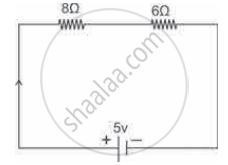
A third resistor is now connected in parallel with 6Ω resistor. Will the potential difference across the 8Ω resistor the larger, smaller, or the same as before? Explain the reason for your answer.
Concept: undefined >> undefined
Answer the following question.
State the law of conservation of linear momentum. It is a consequence of which law? Give an example from our daily life for the conservation of momentum. Does it hold good during the burst of a cracker?
Concept: undefined >> undefined
Solve the following problem.
A lighter object A and a heavier object B are initially at rest. Both are imparted with the same linear momentum. Which will start with greater kinetic energy: A or B or both will start with the same energy?
Concept: undefined >> undefined
Solve the following problem.
The figure below shows a block of mass 35 kg resting on a table. The table is so rough that it offers a self-adjusting resistive force 10% of the weight of the block for its sliding motion along with the table. A 20 kg wt load is attached to the block and is passed over a pulley to hang freely on the left side. On the right side, there is a 2 kg wt pan attached to the block and hung freely. Weights of 1 kg wt each, can be added to the pan. Minimum how many and maximum how many such weights can be added into the pan so that the block does not slide along the table?

Concept: undefined >> undefined
