Please select a subject first
Advertisements
Advertisements
How much energy is released in the following reaction : 7Li + p → α + α.
Atomic mass of 7Li = 7.0160 u and that of 4He = 4.0026 u.
(Use Mass of proton mp = 1.007276 u, Mass of `""_1^1"H"` atom = 1.007825 u, Mass of neutron mn = 1.008665 u, Mass of electron = 0.0005486 u ≈ 511 keV/c2,1 u = 931 MeV/c2.)
Concept: undefined >> undefined
Consider a neutron and an electron bound to each other due to gravitational force. Assuming Bohr's quantization rule for angular momentum to be valid in this case, derive an expression for the energy of the neutron-electron system.
Concept: undefined >> undefined
Advertisements
An aeroplane travels over a rectangular field 100 m × 50 m, parallel to its length. What should be the speed of the plane so that the field becomes square in the plane frame?
Concept: undefined >> undefined
Find the binding energy per nucleon of `""_79^197"Au"` if its atomic mass is 196.96 u.
(Use Mass of proton mp = 1.007276 u, Mass of `""_1^1"H"` atom = 1.007825 u, Mass of neutron mn = 1.008665 u, Mass of electron = 0.0005486 u ≈ 511 keV/c2,1 u = 931 MeV/c2.)
Concept: undefined >> undefined
The rest distance between Patna and Delhi is 1000 km. A nonstop train travels at 360 km h−1. (a) What is the distance between Patna and Delhi in the train frame?
(b) How much time elapses in the train frame between Patna and Delhi?
Concept: undefined >> undefined
Suppose in an imaginary world the angular momentum is quantized to be even integral multiples of h/2π. What is the longest possible wavelength emitted by hydrogen atoms in visible range in such a world according to Bohr's model?
Concept: undefined >> undefined
A person travels by a car at a speed of 180 km h−1. It takes exactly 10 hours by his wristwatch to go from the station A to the station B. (a) What is the rest distance between the two stations? (b) How much time is taken in the road frame by the car to go from the station A to the station B?
Concept: undefined >> undefined
According to the station clocks, two babies are born at the same instant, one in Howrah and other in Delhi. (a) Who is elder in the frame of 2301 Up Rajdhani Express going from Howrah to Delhi? (b) Who is elder in the frame of 2302 Dn Rajdhani Express going from Delhi to Howrah.
Concept: undefined >> undefined
Two babies are born in a moving train, one in the compartment adjacent to the engine and other in the compartment adjacent to the guard. According to the train frame, the babies are born at the same instant of time. Who is elder according to the ground frame?
Concept: undefined >> undefined
An electric bulb, connected to a make and break power supply, switches off and on every second in its rest frame. What is the frequency of its switching off and on as seen from a spaceship travelling at a speed 0.8c?
Concept: undefined >> undefined
At what speed the volume of an object shrinks to half its rest value?
Concept: undefined >> undefined
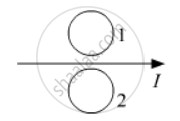
What is the direction of induced currents in metal rings 1 and 2 when current I in the wire is increasing steadily?
Concept: undefined >> undefined
Find the condition under which the charged particles moving with different speeds in the presence of electric and magnetic field vectors can be used to select charged particles of a particular speed.
Concept: undefined >> undefined
The following graph shows the variation of photocurrent for a photosensitive metal :
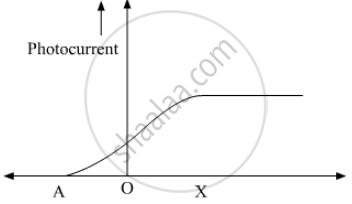
(a) Identify the variable X on the horizontal axis.
(b) What does the point A on the horizontal axis represent?
(c) Draw this graph for three different values of frequencies of incident radiation v1, v2 and v3 (v1 > v2 > v3) for same intensity.
(d) Draw this graph for three different values of intensities of incident radiation I1, I2 and I3 (I1 > I2 > I3) having same frequency.
Concept: undefined >> undefined
How does drift velocity of electrons in a metallic conductor vary with increase in temperature? Explain.
Concept: undefined >> undefined
(a) drift speed
(b) current density
(c) electric current
(d) electric field
Concept: undefined >> undefined
Derive an expression for drift velocity of free electrons in a conductor in terms of relaxation time.
Concept: undefined >> undefined
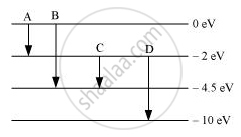
The energy levels of an atom are as shown below. Which of them will result in the transition of a photon of wavelength 275 nm?
Concept: undefined >> undefined
Which transition corresponds to emission of radiation of maximum wavelength?
Concept: undefined >> undefined
The charge on a proton is +1.6 × 10⁻¹⁹ C and that on an electron is −1.6 × 10⁻¹⁹ C. Does it mean that the electron has 3.2 × 10⁻¹⁹ C less charge than the proton?
Concept: undefined >> undefined
