Advertisements
Advertisements
The radii of two circles are in the ratio 3: 8. If the difference between their areas is 2695π cm2, find the area of the smaller circle.
Concept: undefined >> undefined
The diameters of three circles are in the ratio 3: 5: 6. If the sum of the circumferences of these circles is 308 cm; find the difference between the areas of the largest and the smallest of these circles.
Concept: undefined >> undefined
Advertisements
Find the area of a ring-shaped region enclosed between two concentric circles of radii 20 cm and 15 cm.
Concept: undefined >> undefined
If a square in inscribed in a circle, find the ratio of the areas of the circle and the square.
Concept: undefined >> undefined
Two circles touch each other externally. The sum of their areas is 74π cm2 and the distance between their centers is 12 cm. Find the diameters of the circle.
Concept: undefined >> undefined
A steel wire, when bent in the form of a square, encloses an area of 121 cm2. The same wire is bent in the form of a circle. Find area the circle.
Concept: undefined >> undefined
Two circles touch externally. The sum of their areas is 130π sq. cm and the distance between their centers is 14 cm. Find the radii of the circles.
Concept: undefined >> undefined
A hose-pipe of cross-section area 2 cm2 delivers 1500 liters of water in 5 minutes. What is the speed of water in m/s through the pipe?
Concept: undefined >> undefined
Water is discharged from a pipe of a cross-section area 3.2 cm2 at the speed of 5m/s. Calculate the volume of water discharged:
(i) In cm3 per sec.
(ii) In liters per minute.
Concept: undefined >> undefined
A rectangular tank 30 cm × 20 cm × 12 cm contains water to a depth of 6 cm. A metal cube of side 10 cm is placed in the tank with its one face resting on the bottom of the tank. Find the volume of water, in liters, that must be poured in the tank so that the metal cube is just submerged in the water.
Concept: undefined >> undefined
Plot the following points on the same graph paper:
(i) (8, 7)
(ii) (3, 6)
(iii) (0, 4)
(iv) (0, -4)
(v) (3, -2)
(vi) (-2, 5)
(vii) (-3, 0)
(viii) (5, 0)
(ix) (-4, -3)
Concept: undefined >> undefined
By plotting the following points on the same graph paper. Check whether they are collinear or not:
(i) (3, 5), (1, 1) and (0, -1)
(ii) (-2, -1), (-1, -4) and (-4, 1)
Concept: undefined >> undefined
In square ABCD; A = (3, 4), B = (-2, 4) and C = (-2, -1). By plotting these points on a graph paper, find the co-ordinates of vertex D. Also, find the area of the square.
Concept: undefined >> undefined
In the following figures, find the remaining angles of the parallelogram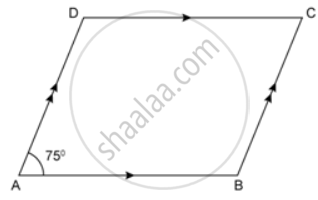
Concept: undefined >> undefined
In the following figures, find the remaining angles of the parallelogram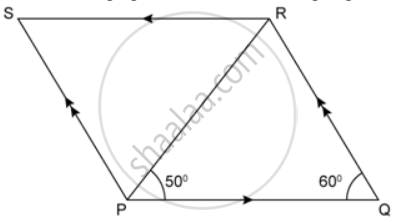
Concept: undefined >> undefined
In the following figures, find the remaining angles of the parallelogram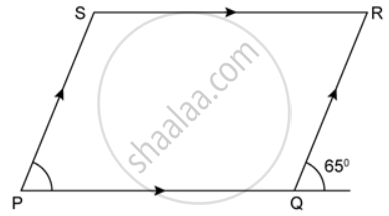
Concept: undefined >> undefined
In the following figures, find the remaining angles of the parallelogram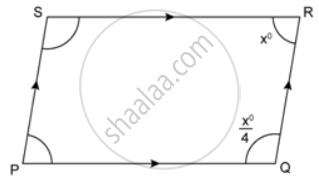
Concept: undefined >> undefined
In the following figures, find the remaining angles of the parallelogram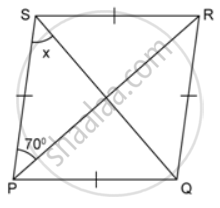
Concept: undefined >> undefined
In a parallelogram ABCD ∠C = 98°. Find ∠A and ∠B.
Concept: undefined >> undefined
The consecutive angles of a parallelogram are in the ratio 3:6. Calculate the measures of all the angles of the parallelogram.
Concept: undefined >> undefined
