Advertisements
Advertisements
प्रश्न
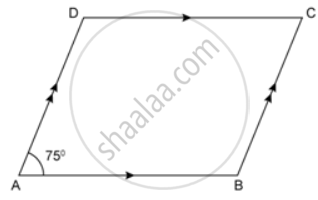
In the following figures, find the remaining angles of the parallelogram
Advertisements
उत्तर
ABCD is a parallelogram.
∠A = 75°
⇒ ∠C = 75° ....(Opposite angles of a parallelogram are eequal)
Now,∠A + ∠D = 180° ....(Interior angles)
⇒ ∠75° + ∠D = 180°
⇒ ∠D = 105°
⇒ ∠B = ∠D = 105° ....(Opposite angles of a parallelogram are equal)
Thus, we have
∠B = 105°, ∠C = 75° and ∠D = 105°.
APPEARS IN
संबंधित प्रश्न
In a parallelogram `square`ABCD, If ∠A = (3x + 12)°, ∠B = (2x - 32)° then find the value of x and then find the measures of ∠C and ∠D.
In the following figure, ABCD is a parallelogram. 
Prove that:
(i) AP bisects angle A.
(ii) BP bisects angle B
(iii) ∠DAP + ∠BCP = ∠APB
In the following figures, find the remaining angles of the parallelogram
The consecutive angles of a parallelogram are in the ratio 3:6. Calculate the measures of all the angles of the parallelogram.
Find the measures of all the angles of the parallelogram shown in the figure:
The angles of a triangle formed by 2 adjacent sides and a diagonal of a parallelogram are in the ratio 1 : 5 : 3. Calculate the measures of all the angles of the parallelogram.

Opposite angles of a quadrilateral ABCD are equal. If AB = 4 cm, determine CD.
The sum of adjacent angles of a parallelogram is ______.
