Advertisements
Advertisements
प्रश्न
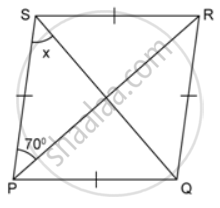
In the following figures, find the remaining angles of the parallelogram
Advertisements
उत्तर
PQRS is a parallelogram with all sides equal and opposite sides parallel.
Hence, PQRS is a Rhombus.
Diagonals of a Rhombus bisect each other.
In ΔPOS,
∠OSP + ∠SPO + ∠POS = 180°
⇒ x + 70° + 90° = 180°
⇒ x = 20°
In ΔQSP,
PS = PQ
⇒ ∠QSP = ∠PQS = x = 20°
And,
∠QSP + ∠PQS + ∠SPQ = 180°
⇒ 20° + 20° + ∠SPQ = 180°
⇒ ∠SPQ = 140°
⇒ ∠SPQ = 140° ....(Opposite angles are equal)
Now,
∠SPQ + ∠SR = 180°
⇒ 140° + PSR = 180°
⇒ ∠PSR = 40°
⇒ ∠PQR = 40° ....(Opposite angles are equal)
Hence,
∠P =∠R = 140° and ∠S = ∠Q = 40°.
APPEARS IN
संबंधित प्रश्न
In the following figure, ABCD and PQRS are two parallelograms such that ∠D = 120° and ∠Q = 70°.
Find the value of x.
In case of a parallelogram
prove that:
(i) The bisectors of any two adjacent angles intersect at 90o.
(ii) The bisectors of the opposite angles are parallel to each other.
In the given figure, AP is the bisector of ∠A and CQ is the bisector of ∠C of parallelogram ABCD. 
Prove that APCQ is a parallelogram.
In the following figures, find the remaining angles of the parallelogram
In a parallelogram ABCD ∠C = 98°. Find ∠A and ∠B.
Find the measures of all the angles of the parallelogram shown in the figure:
Opposite angles of a quadrilateral ABCD are equal. If AB = 4 cm, determine CD.
The sum of adjacent angles of a parallelogram is ______.
In parallelogram FIST, find ∠SFT, ∠OST and ∠STO.

