Advertisements
Advertisements
Give reasons/explain:
During the starch test, the leaf is boiled in methylated spirit.
Concept: undefined >> undefined
Given below is the diagram of an experimental set-up (final stage). Study the same and answer the following questions:

- What is the main aim of the experiment?
- Oxygen gas shown in the experiment is released from which of the raw materials?
- How would you confirm the presence of oxygen gas?
- Name the chemical substance which can be added in water to enhance the process/rate of release of oxygen gas.
- Draw a neat and labelled diagram of the same experiment for its initial stage.
Concept: undefined >> undefined
Advertisements
Name the following:
Two kinds of accomodations.
Concept: undefined >> undefined
Given alongside is a diagram depicting a defect of the human eye. Study the same and answer the questions that follow:
![]() |
- Name the defect shown in the diagram.
- Give two possible reasons for this defect.
- Name the parts labelled 1 to 4.
- Name the type of lens used to correct this eye defect.
- Draw a labelled diagram to show how the above mentioned defect is rectified using the lens named above.
Concept: undefined >> undefined
Have a look at the posture of this girl who is reading a book and answer the questions which follow:
![]() |
- Name the problem she is facing.
- What are the two conditions shown in sections A and B of the eye as applicable to her.
- What kind of reading glasses does she need?
![]() |
![]() |
| A | B |
Concept: undefined >> undefined
The diagram given below represents a plant cell after being placed in a strong sugar solution. Study the diagram and answer the questions that follow:

- What is the state of the cell shown in the diagram?
- Name the structure that acts as a selectively permeable membrane.
- Label the parts numbered 1 to 4 in the diagram.
- How can the above cell be brought back to its original condition? Mention the scientific term for the recovery of the cell.
- State any two features of the above plant cell which is not present in animal cells.
Concept: undefined >> undefined
A plant cell may burst when :
Concept: undefined >> undefined
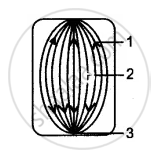
The diagram given below represents a certain stage of mitosis:

- Identify the stage of cell division.
- Name the parts labelled A and B.
- What is the unique feature observed in this stage?
- How many daughter cells are formed from this type of cell division?
Concept: undefined >> undefined
Explain Turgor pressure
Concept: undefined >> undefined
Give scientific reasons : Balsam plants wilt during mid-day even if the soil is well watered.
Concept: undefined >> undefined
The diagram given below represents a stage during cell division.
Study the same and answer the questions that follow:

- Identify whether it is a plant cell or an animal cell. Give a reason in support of your answer.
- Name the stage depicted in the diagram. What is the unique feature observed in this stage?
- Name the type of cell division that occurs during:
- Replacement of old leaves by new ones
- Formation of gametes
- What is the stage that comes before the stage shown in the diagram?
- Draw a neat, labelled diagram of the stage mentioned in (iv) above keeping the chromosome number constant.
Concept: undefined >> undefined
The diagram below represents a process in plants. The setup was placed in bright sunlight. Answer the following questions:

a) Name the physiological process depicted in the diagram.
Why was oil added to the water?
b) When placed in bright sunlight for four hours, what do you observe with regard to the initial and final weight of the plant? Give a suitable reason for your answer
c) What happens to the level of water when this setup is placed in:
- Humid conditions?
- Windy conditions?
d) Mention any three adaptations found in plants to overcome the process mentioned in (i).
e) Explain the term ‘Guttation’.
Concept: undefined >> undefined
The state of a cell in which the cell wall is rigid and stretched by the increase in volume due to the absorption of water is called.
Concept: undefined >> undefined
Give the equivalent term for the following:
The condition in which the cell contents are shrunken.
Concept: undefined >> undefined
Give the equivalent terms for the following:
Loss of water through a cut stem.
Concept: undefined >> undefined
Differentiate between the following:
Turgor pressure and wall pressure
Concept: undefined >> undefined
Differentiate between the following:
Turgidity and Flaccidity
Concept: undefined >> undefined
Mention whether the following statement is true or false Correct the false statement by altering the last word only.
Cells that have lost their water content are said to be deplasmolysed.
Concept: undefined >> undefined
What is the difference between ‘flaccid’ and ‘turgid’? Give one example of flaccid condition in plants.
Concept: undefined >> undefined
Give reasons for the following:
If you sprinkle some common salt on grass growing on a lawn, it is killed at that spot.
Concept: undefined >> undefined